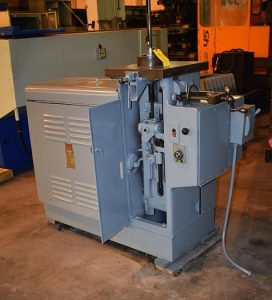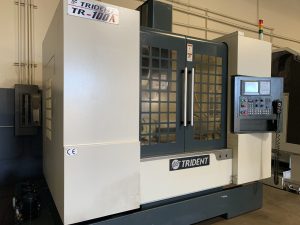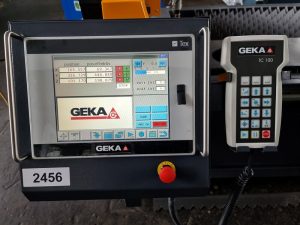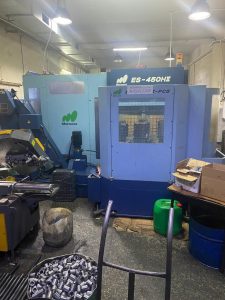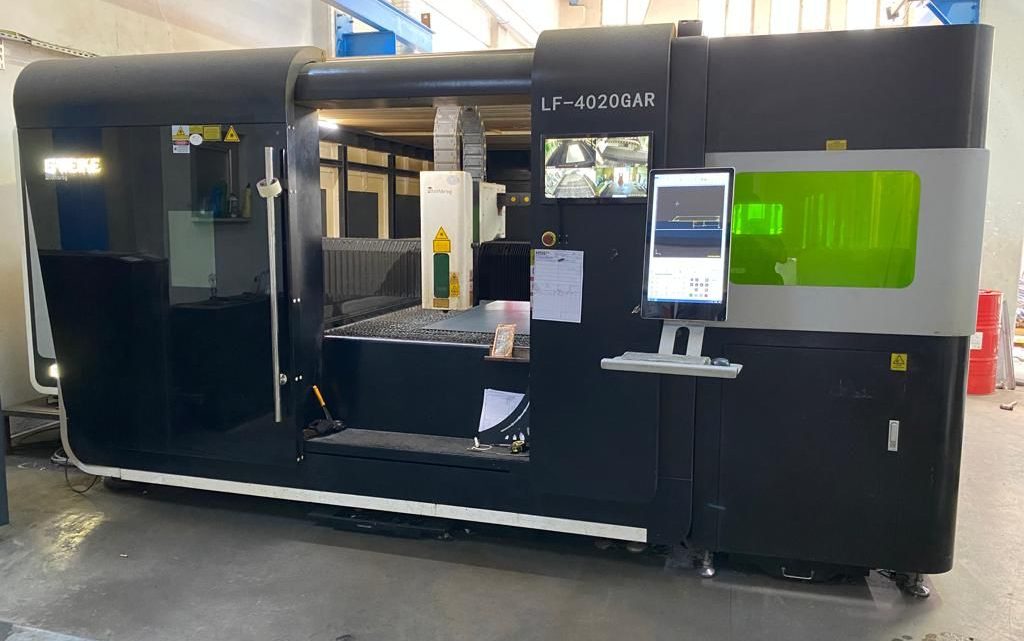
From Factory Floor to Your Workshop: Evaluating a Pre-Owned, Used, Secondhand, Surplus CNC Machine Before Purchase GWEIKE TECH LF-4020GAR Profile and pipe laser cutting machine made in China
This includes technical details, inspection checkpoints, and what to verify before buying — focused on practical machine assessment and workshop readiness.
From Factory Floor to Your Workshop
Pre-Owned Inspection & Evaluation Checklist
GWEIKE TECH LF-4020GAR
Profile and Pipe Laser Cutting Machine
Made in China
1. PRODUCT OVERVIEW
- Model: LF-4020GAR
- Brand: GWEIKE TECH (GWEIKE Laser Technology Co., Ltd.)
- Machine Type: Fiber Laser Cutting Machine for flat sheet profiles and round/rectangular pipes
- Origin: Made in China – typically manufactured in Jinan, Shandong Province
- Laser Type: Fiber laser (usually from Chinese or international laser source like IPG/Max)
- Control System: CNC motion control with digital panel and motion axes for X, Y, Z, additional rotary axis for angle cutting
2. GENERAL TECHNICAL SPECIFICATIONS
(Typical for LF-4020GAR; actual machine may vary slightly)
| Category | Specification |
|---|---|
| Laser Power | Commonly 2 kW / 3 kW / 4 kW Fiber Laser Source |
| Cutting Table Size | 4000 mm × 2000 mm (4m × 2m) |
| X Axis Travel | ~4000 mm |
| Y Axis Travel | ~2000 mm |
| Z Axis (Focus Up/Down) | ~200 mm |
| Max Cutting Thickness – Mild Steel | ~25–30 mm (with high power) |
| Max Cutting Thickness – Stainless Steel | ~15–22 mm |
| Max Cutting Thickness – Aluminum | ~12–15 mm |
| Positioning Accuracy | ±0.03 mm/m (typical CNC spec) |
| Repeatability | ±0.02 mm |
| Drive System | Servo motors + gear rack & pinion on axes |
| Control Interface | CNC Panel with graphical cutting program |
| Cooling Unit | External industrial chiller included |
| Dust/Smoke Extraction Ports | Provided at rear/exhaust side |
| Material Support | Flat plate + pipe/station fixtures |
| Electrical Power Requirement | Typically three-phase 380V ±10%, 50/60Hz |
3. PRE-PURCHASE INSPECTION CHECKLIST
A. MECHANICAL CONDITION
✔ Guide Rails & Linear Motion
- Check for wear, rust, vibration, and lubrication condition.
- Slide movement should be smooth and backlash-free.
✔ Drive System (Servo & Motors)
- Inspect belts, couplings, and motor mounts.
- Run axes manually to confirm accurate positioning.
✔ Cutting Table & Clamps
- Verify the table surface is not bent, cracked, or uneven.
- Confirm clamps open/close properly and grip securely.
✔ Rotary Pipe Fixture
- Inspect pipe fixture positioning accuracy.
- Ensure rotation axis is tight and stable with minimal backlash.
B. LASER SYSTEM & OPTICS
✔ Laser Source
- Check hours of use on the laser generator.
- For sources like IPG/Max or Chinese fiber: low hours = longer life.
✔ Optics & Beam Delivery
- Inspect protective windows, mirrors, and fiber connectors.
- No visible contamination on optics; clean as needed.
✔ Nozzle & Focusing Lens
- Look for contamination, wear, or damage.
- Confirm clean focus lens and nozzle condition.
✔ Cooling System
- Verify chiller is included and operational.
- Check coolant cleanliness, no leaks, proper temp maintenance.
C. CNC & ELECTRICAL SYSTEM
✔ CNC Control
- Test LCD panel, buttons, emergency stop, and machine controls.
- Confirm all axes respond correctly to commands.
✔ Electrical Cabinet
- Inspect wiring, terminal integrity, heat sinks, and cleanliness.
- No burnt parts, no melted insulation.
✔ Sensors & Safety
- Limit switches, door interlocks, light curtains (if installed).
- All must operate and shut down properly.
4. TEST CUTTING & PERFORMANCE VERIFICATION
Cutting Tests
Mild Steel Plate
- 12 mm, 16 mm, 20 mm tests at different speeds
- Check edge quality: smooth, minimal dross, uniform kerf.
Stainless Steel Plate
- 8–15 mm at recommended power
- Inspect edge discoloration and heat effects.
Pipe Cutting
- Round & square tubes of different diameters
- Verify alignment and rotation consistency.
Metrics to Evaluate
| Metric | What to Check |
|---|---|
| Edge Finish | Sharp, consistent edges; minimal slag |
| Cut Speed vs Quality | Balance between feed rate and quality |
| Bevel Accuracy | Angle corners true after cut |
| Pierce Time | Acceptable for material thickness |
| Heat Affected Zone | Minimal distortion near cut |
5. SAFETY & COMPLIANCE
- Confirm presence of laser safety enclosure and protective interlocks
- Emergency stop buttons easy to reach
- Proper grounding and electrical safety
- Exhaust ventilation or fume extraction provision
6. DOCUMENTATION TO REQUEST
Always ask the seller for:
- Maintenance history & service records
- Laser source operating hours
- Original manuals (mechanical, electrical, CNC)
- Bill of sale or previous usage documentation
- Video of machine running under power
7. OPERATION READINESS CHECK
Before final acceptance:
- Power On & Warm-Up
- No abnormal noise or faults after startup
- Axis Homing
- All axes must home correctly with no errors
- Test Program Execution
- Run a small test program from USB/CNC panel
- Laser Activation Under Supervision
- Engage laser with eye protection and fume extraction
- Full Dry Run
- Without cutting, run full motion cycle to confirm travel limits
8. WHAT THIS MACHINE IS BEST SUITED FOR
Good choice for:
- Profile cuts of sheet steel and plate parts
- Pipe cutting & fabrication applications
- Light-to-medium industrial production
- Fabrication metal workshops
- Structural and ornamental metal cutting
9. COMMON ISSUES SEEN ON USED LASERS
| Issue | What to Check |
|---|---|
| Dirty Optics | Reduces laser power at work surface |
| Misaligned Beam | Uneven cutting speeds and edges |
| Coolant Contamination | Can damage laser or optics |
| Damaged Guide Rails | Causes poor cutting precision |
| Electrical Wear | Loose connectors, oxidized terminals |
10. FINAL PURCHASE DECISION FACTORS
✅ Machine condition vs price
✅ Laser hours and optical health
✅ Spare parts availability
✅ Support for control system
✅ Inclusion of chiller and fixtures
✅ Safety compliance