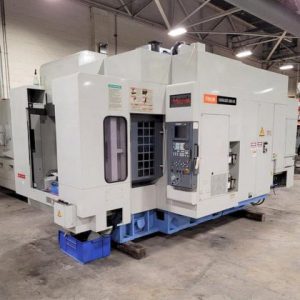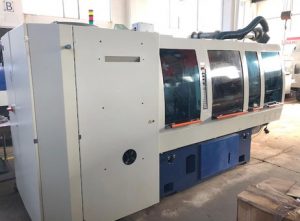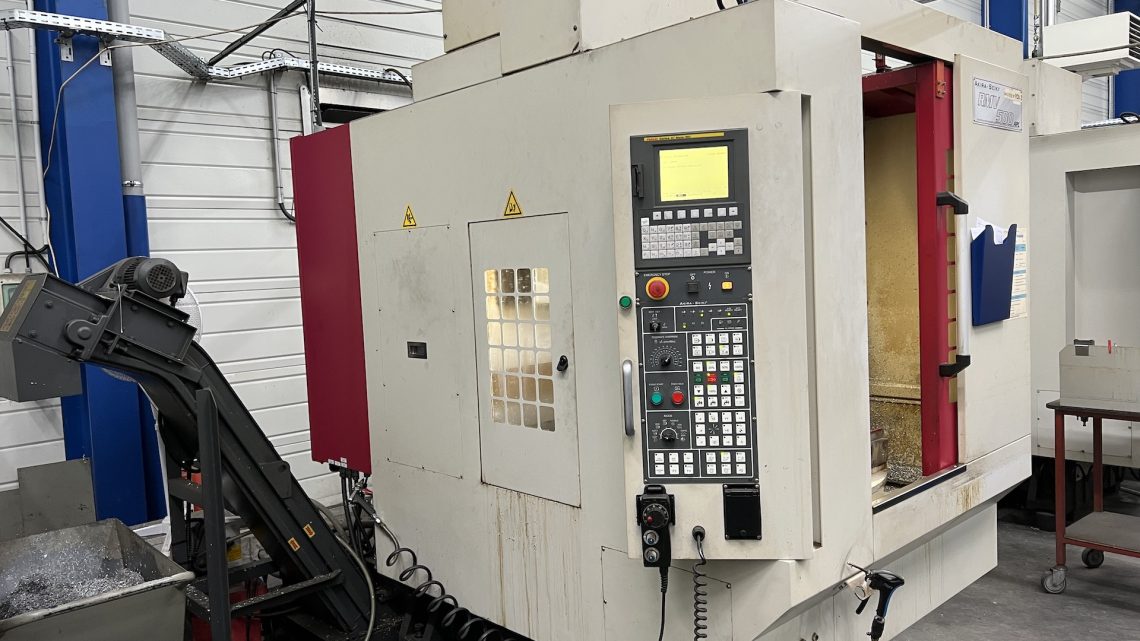
From Factory Floor to Your Workshop: Evaluating a Pre-Owned, Used, Secondhand, Surplus CNC Machine Before Purchase AKIRA SEIKI RMV 500 APC made in Taiwan
In today’s competitive manufacturing landscape, acquiring a high-quality CNC machining center at the right price can significantly impact profitability. Pre-owned machines—whether described as used, secondhand, or surplus—offer a compelling alternative to new equipment, provided they are evaluated with technical rigor and commercial awareness.
The AKIRA SEIKI RMV 500 APC is a vertical machining center known for its rigidity, precision, and production efficiency, especially when equipped with an Automatic Pallet Changer (APC). Before integrating such a machine into your workshop, a structured evaluation process is essential to mitigate risk and ensure long-term performance.
1. Machine Background & Application Suitability
The first step is understanding whether the machine fits your production requirements.
The RMV 500 APC is typically designed for:
- High-speed vertical machining
- Medium to high-volume production environments
- Reduced idle time through pallet automation
- Precision machining of steel, aluminum, and alloys
Ask yourself:
- Does your workflow benefit from pallet automation?
- Is your production batch-based or continuous?
- Are your tolerances aligned with the machine’s capabilities?
A mismatch here leads to underutilization or inefficiency.
2. Mechanical Integrity Inspection
A CNC machine’s mechanical condition determines its true value far more than its age.
Key Areas to Inspect:
Guideways & Linear Rails
- Check for scoring, uneven wear, or corrosion
- Listen for abnormal noise during axis movement
Ball Screws
- Evaluate backlash and positioning accuracy
- Inspect lubrication condition
Spindle Assembly
- Measure runout using a dial indicator
- Listen for bearing noise at high RPM
- Check spindle taper condition
APC System
- Ensure smooth pallet exchange without vibration or misalignment
- Verify locking mechanisms and repeatability
A machine with worn mechanical components will require costly refurbishment, often eliminating the price advantage of buying used.
3. Control System & Electronics
Most RMV 500 APC machines are equipped with advanced CNC controls (commonly Fanuc or Mitsubishi).
Verify:
- Boot-up time and error logs
- Servo drive performance
- Axis interpolation accuracy
- Backup battery condition
- Availability of parameters and ladder programs
Outdated or unsupported control systems can create long-term service challenges, especially if spare parts are scarce.
4. Tooling System & ATC Performance
The Automatic Tool Changer (ATC) is critical for productivity.
Check:
- Tool change speed and consistency
- Tool holder condition (BT40 / CAT40 typically)
- Magazine capacity and indexing accuracy
- Sensors and alignment
Any misalignment or sensor fault can cause downtime or tool damage.
5. Lubrication, Cooling & Auxiliary Systems
Neglected auxiliary systems are often early indicators of poor maintenance.
Inspect:
- Central lubrication system (is it functioning and clean?)
- Coolant pump, tank condition, and filtration
- Chip conveyor operation
- Air pressure system and pneumatic valves
A well-maintained auxiliary system reflects disciplined previous ownership.
6. Accuracy & Test Cuts
A machine’s true condition is revealed under cutting conditions.
Perform:
- Positioning accuracy test (ballbar if available)
- Circular interpolation test
- Surface finish inspection
- Dimensional repeatability checks
Request a live cutting demonstration whenever possible. Static inspection is not sufficient.
7. Maintenance History & Documentation
A complete service history significantly increases confidence.
Look for:
- Preventive maintenance records
- Spindle replacement history
- Control backups
- OEM manuals and electrical diagrams
Machines with transparent histories are far less risky acquisitions.
8. Logistics, Installation & Integration
Moving a CNC machine is a technical operation.
Consider:
- Machine weight and dimensions
- Disassembly requirements (especially APC systems)
- Power compatibility (voltage, phase, frequency)
- Foundation requirements
- Alignment and calibration after installation
Improper installation can degrade machine accuracy even if the machine itself is in excellent condition.
9. Total Cost of Ownership
The purchase price is only one component.
Include:
- Transport and insurance
- Installation and commissioning
- Tooling and fixtures
- Potential repairs or retrofits
- Operator training
A low purchase price with high hidden costs can quickly become an expensive mistake.
10. Supplier Credibility & Transaction Structure
Finally, evaluate the seller as carefully as the machine.
- Is the seller a reputable dealer or end-user?
- Can they provide inspection access or video proof?
- Do they offer loading support or limited warranty?
- Are payment terms secure and traceable?
Professional sourcing reduces both technical and financial risk.
Conclusion
The AKIRA SEIKI RMV 500 APC represents a strong opportunity for manufacturers seeking efficiency and automation without the capital expense of new equipment. However, the benefits of purchasing a pre-owned CNC machine are realized only when due diligence is applied across mechanical, electrical, and operational dimensions.
A disciplined evaluation transforms uncertainty into a calculated investment—allowing a machine that once served on a factory floor to deliver reliable performance in your own workshop for years to come.
AKIRA SEIKI RMV 500 APC – Technical Specifications
(Vertical Machining Center with Automatic Pallet Changer – Taiwan)
Below are the core technical specifications compiled from OEM data and verified machine listings. These are the details buyers and engineers typically expect during a professional evaluation.
General Machine Overview
- Machine Type: Vertical Machining Center (VMC)
- Configuration: Twin Pallet (APC – Automatic Pallet Changer)
- Origin: Taiwan
- Axes: 3 Axis (X / Y / Z)
- Typical Control: Fanuc / Mitsubishi / AKIRA Mi (G-code compatible)
Travels & Working Envelope
- X Axis Travel: 500 mm (19.69″)
- Y Axis Travel: 300 mm (11.81″)
- Z Axis Travel: 280 mm (11.02″)
- Spindle Nose to Table: 150 – 430 mm (5.91″ – 16.93″)
Table & Pallet System
- Table Size: 500 × 300 mm (19.69″ × 11.81″)
- Max Table Load: 100 kg (220 lbs)
- Pallet Type: Twin pallet system (APC)
- Pallet Change Time: ~1.5 sec (180° rotation)
Spindle Specifications
- Spindle Taper: BT30 / HSK40A (optional)
- Spindle Speed:
- Standard: ~12,000 RPM
- Optional: up to 20,000 – 24,000 RPM
- Spindle Power:
- Approx. 6 HP (peak higher acceleration power)
- Cooling: Air-cooled spindle
Feed Rates & Performance
- Rapid Traverse (X/Y/Z):
60 / 60 / 72 m/min (2362 / 2362 / 2834 IPM) - Cutting Feed Rate:
10 m/min (394 IPM) - Acceleration Capability:
1.6 – 2.0 G high-speed acceleration
Accuracy
- Positioning Accuracy:
0.012 mm (0.00047″) - Repeatability:
±0.005 mm (±0.0002″)
Tooling System (ATC)
- Tool Magazine Capacity:
24 tools + 1 (standard)
Optional: 40 tools - Tool Change Time:
- Tool-to-Tool: ~0.7 sec
- Chip-to-Chip: ~1.9 sec
- Max Tool Diameter: 50 mm (1.97″)
- Max Tool Length: 175 mm (6.89″)
- Max Tool Weight: 2.5 kg (5.5 lbs)
Coolant & Utilities
- Coolant Tank Capacity: 150 liters (39.6 gal)
- Air Requirement: 0.5 MPa (72.5 psi)
- Power Requirement: ~10 kVA
Machine Dimensions & Weight
- Footprint: approx. 1500 × 2777 mm (59″ × 109″)
- Height: approx. 2400 mm (94″)
- Weight: approx. 4200 kg (9,260 lbs)
Key Engineering Advantages
- Twin pallet system minimizes idle time (load/unload during machining)
- High-speed spindle (up to 24,000 RPM) for aluminum and light alloys
- Ultra-fast tool change (~0.7 sec) for production environments
- Compact footprint with high acceleration design
- Designed for mass production & light chip machining
Important Note for Buyers
Specifications may vary depending on:
- Year of manufacture
- Control system (Fanuc / Mitsubishi / AKIRA Mi)
- Installed options (HSK spindle, ATC capacity, RPM upgrade)
Conclusion
The AKIRA SEIKI RMV 500 APC is not a general-purpose machining center—it is a production-oriented, high-speed compact VMC optimized for efficiency, especially in aluminum and light material machining.
From a buyer’s perspective:
- It excels in cycle time reduction
- It requires good maintenance discipline (high-speed spindle + APC)
- It is ideal for automated or semi-automated production lines