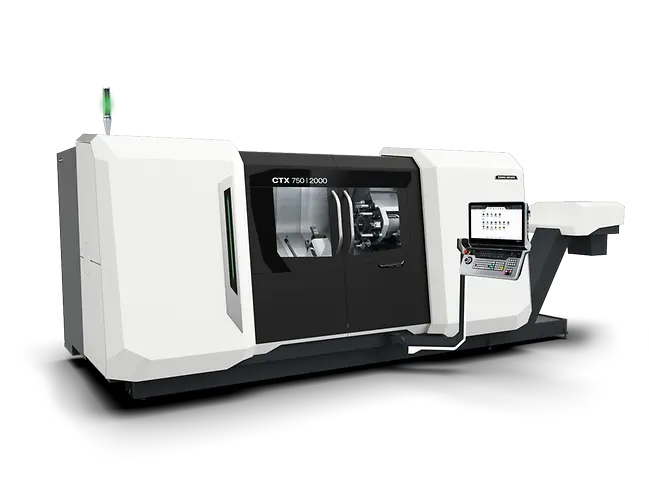
From Factory Floor to Your Workshop: Evaluating a Pre-Owned, Used, Secondhand, Surplus CNC Machine Before Purchase DMG MORI CLX 750 CNC Turning Center made in Germany
In today’s competitive manufacturing landscape, acquiring a pre-owned CNC machine is not simply a cost-saving decision—it is a strategic investment. Machines like the DMG MORI CLX 750 CNC Turning Center, manufactured in Germany, represent high-end engineering designed for precision, durability, and long-term productivity.
However, purchasing a used machine without proper technical evaluation can introduce significant risks. This guide provides a professional, engineering-level checklist for evaluating a secondhand CLX 750—from the factory floor to your workshop.
1. Understanding the Machine: CLX 750 Technical Profile
Before evaluating condition, you must fully understand what the machine is capable of.
Key Technical Specifications
- Maximum turning diameter: up to Ø700 mm
- Turning length: approx. 1,290 mm
- Workpiece weight capacity: up to 600 kg
- Main spindle power: ~46–48 kW
- Torque: up to 2,000 Nm
- Max spindle speed: ~2,000 rpm
- Bar capacity: Ø127 mm
- Y-axis travel: ±80 mm (optional)
- Turret: 12-position VDI 50
Engineering Highlights
- Integrated counter spindle for full 6-sided machining
- High rigidity 45° slant bed casting
- Linear guideways for dynamic accuracy
- Compatibility with SIEMENS or FANUC control systems
- Built-in IoT connectivity for digital manufacturing
These features position the CLX 750 as a heavy-duty, high-precision universal turning center, ideal for shafts, large components, and complex parts.
2. Mechanical Condition Assessment
Visual Inspection & Structural Integrity
What to Check:
- Bed casting condition
- Look for cracks, deformation, or poor repairs
- Guideways (X, Z, Y axes)
- Excessive wear → loss of precision
- Turret indexing accuracy
- Misalignment indicates backlash or servo issues
- Chuck and spindle nose condition
- Check runout and clamping reliability
Critical Insight
A worn mechanical structure cannot be economically restored—even if electronics are upgraded. Structural rigidity is the core value of a used CNC machine.
3. Spindle & Drive System Evaluation
The spindle is the “heart” of the CLX 750.
Key Tests:
- Spindle runout measurement (µm level)
- Vibration analysis at different RPM ranges
- Thermal stability after long operation
- Load test under cutting conditions
Red Flags:
- Abnormal noise at high torque (2,000 Nm class machines must run smoothly)
- Overheating bearings
- Reduced torque under load
Remember: A spindle rebuild on a machine of this class can cost tens of thousands of euros.
4. CNC Control & Electrical System
Control Panel & Automation Check
Evaluate:
- Control type: SIEMENS or FANUC
- Software version and upgrade availability
- PLC logic integrity
- Alarm history logs
Important Checks:
- Axis positioning accuracy (ballbar test recommended)
- Servo drive condition
- Electrical cabinet cleanliness (dust = overheating risk)
Older software may limit integration with modern Industry 4.0 systems.
5. Accuracy & Precision Testing
Mandatory Tests:
- Ballbar test (circular interpolation accuracy)
- Laser calibration (axis positioning error)
- Repeatability test (micron-level consistency)
The CLX 750 is designed for high precision machining with direct measuring systems , so deviations from specification indicate wear or calibration loss.
6. Tooling, Options & Automation Value
A used CNC machine’s value is heavily influenced by included options.
High-Value Options:
- Y-axis (±80 mm capability)
- Counter spindle (complete machining)
- Driven tools (live tooling)
- Bar feeder or automation interface
- Steady rest (for long shafts up to Ø430 mm)
A fully equipped CLX 750 can be 2–3x more valuable than a basic version.
7. Maintenance History & Usage Profile
Request Documentation:
- Maintenance logs
- Service records (especially spindle and drives)
- Operating hours (spindle hours vs. machine hours)
Usage Scenarios:
| Usage Type | Impact |
|---|---|
| Light precision work | Low wear |
| Heavy roughing (steel shafts) | High mechanical stress |
| 24/7 production | Accelerated fatigue |
Machines used for heavy-duty shaft machining experience significantly more stress.
8. Test Cutting: The Final Decision Step
Never buy without a live cutting test.
Recommended Test:
- Material: Steel (e.g., C45 or equivalent)
- Operation: Rough + finish turning
- Measure:
- Surface finish (Ra value)
- Dimensional accuracy
- Tool wear behavior
This is the only way to validate real-world performance, not just specifications.
9. Transportation & Installation Considerations
- Machine footprint: approx. 8.9 m²
- Weight: heavy-duty industrial class
- Check:
- Foundation requirements
- Power supply compatibility
- Rigging and transport costs
10. Final Risk Evaluation Checklist
Before Purchase, Confirm:
✔ Mechanical integrity (bed, guides, turret)
✔ Spindle condition (noise, heat, runout)
✔ CNC control reliability
✔ Precision test results
✔ Included tooling and options
✔ Verified maintenance history
✔ Successful test cutting
Conclusion
The DMG MORI CLX 750 CNC Turning Center is a premium German-Japan-engineered turning center capable of heavy-duty machining with exceptional precision and flexibility. When properly evaluated, a pre-owned unit can deliver near-new performance at a significantly reduced investment cost.
However, the key difference between a profitable purchase and a costly mistake lies in technical due diligence.
A disciplined evaluation—combining mechanical inspection, precision testing, and real cutting validation—ensures that your transition from factory floor to your workshop is both successful and profitable.