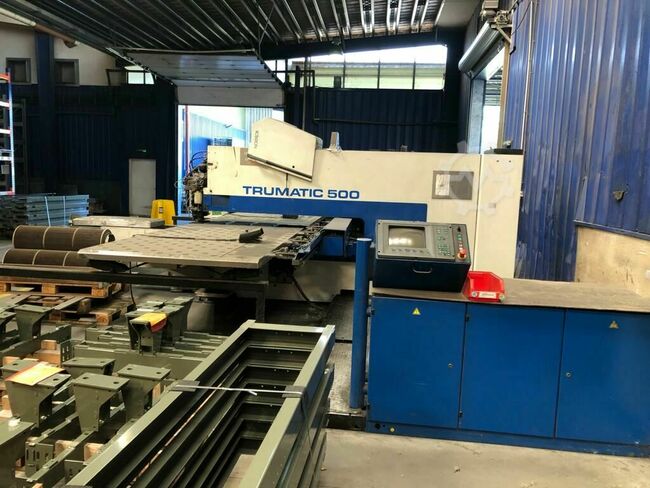
CNC Specialist’s Guide: Selecting the Right Used, Surplus, Secondhand, Pre-Owned Trumpf TC 500 – 1600 Large Stamping & Punching Machine made in Germany
Here’s a detailed specialist-guide to selecting a used, surplus or pre-owned TRUMPF TC 500-1600 (or TC 500-R/1600) large-format punching machine (made in Germany). While some specs differ by exact variant and year, the following covers what you should look at, what to verify, and how to evaluate risk and value.
1. What this machine is, and key baseline specs
Machine type & positioning
- The TRUMPF TC 500 series (sometimes listed as TC 500-R / TC500-R-1600) is a large format CNC punch/contour machine originally built in Germany (by TRUMPF GmbH + Co. KG, Ditzingen) and used for heavy sheet-metal punching and forming.
- The “1600” in TC 500-1600 often refers to the Y-axis working width (≈1,600 mm) or sheet width for the 3000×1600 variant.
Key technical specs to expect
From available data for the TC500R-1600 and similar machines:
- Max punching force: ~ 220 kN.
- Max sheet thickness: ~ 8 mm (for usual punching tasks).
- Max punch diameter: ~ Ø 76.2 mm.
- Working area: around 3,000 × 1,600 mm for the 1600 variant.
- Motion speeds: X-axis ~90 m/min, Y ~60 m/min, simultaneous ~108 m/min, C-axis rotation up to 360°/s.
- Weight and footprint are large: e.g., ~13,800 kg weight for one listing.
Why these specs matter
- The punch force and sheet thickness tell you what material gauge and what kind of jobs it can still handle.
- Working area defines how large the sheet you can process without repositioning or table change.
- Motion speeds and tool change speeds influence throughput and cycle time (important for productivity).
- The machine’s mass and footprint affect installation cost and floor/foundation requirements.
2. Pre-purchase inspection checklist
When evaluating a used/surplus machine of this size and complexity, you’ll want to inspect both structural/mechanical condition, electrical/control systems, and auxiliary support systems. Here’s a detailed checklist:
Structural / mechanical
- Check the frame and support structure (C-frame, punching head housing) for any visible cracks, welding repairs, or distortion. Heavy-duty machines like this can be subjected to stress over many years.
- Examine the ram/punch head: look for signs of oil leakage, scoring of the guide surfaces, hydraulic oil contamination, worn seals. These mean upcoming maintenance.
- Measure the punch tool taper or adapter condition — worn tool adapters produce run-out and reduce accuracy.
- Inspect the linear motion rails (X, Y axes) and guideways: wear, chips, debris, improper lubrication. The speed and accuracy will degrade over time.
- Evaluate the turret or tool magazine: check number of tool stations, condition of the magazine mechanism, pockets missing or damaged, how smoothly it cycles.
- Check the table or bed: large sheet machines often have load/unload tables, skeleton removal chutes — examine for wear or damage.
- Check for good anchoring/leveling: Has the machine been leveled properly? Are the vibration isolators intact? The service manual (for TC 500R) emphasises proper installation.
- Check for wear on clamp systems: Many such machines have sheet clamps (including retractable clamps) — look for wear, missing sensors, binding. The service manual notes detailed procedures for clamp replacement.
Electrical / control / software
- Verify the control system: many are equipped with Bosch or TRUMPF’s own “TRUMAGRAPH CC 220S” control for the older machines. For example one listing notes “Control type BOSCH CC 220 S”.
- Check the software version and any legacy modules: older controls might have limitations or require special spare parts.
- Inspect the electrical cabinet: Check for overheating, corrosion, burnt wires, dust accumulation, whether the cabinet has been kept clean and dry. These large machines suffer when used in a dirty environment.
- Check that all safety interlocks, light curtains (if any) and emergency stops are functional and documented.
- Check for any logged alarms, error codes — ask for history of downtime and fault logs.
Auxiliaries / maintenance history
- Check the hydraulics (for punch drive), pneumatic systems (for clamps, small‐part removal), coolant/fluids, lubrication systems. The service manual for the TC500R lists many such items.
- Ask for maintenance history: How many hours of operation, how many hours of actual punching (not idle), any major rebuilds (ram rebuild, hydraulic unit replacement, tool magazine replacement).
- Look at fluid cleanliness (hydraulic oil, lubrication oil) — dirty fluid indicates poor maintenance.
- Check for tooling condition: Are tool sets included? Are they worn? The machine’s value often is enhanced if tooling is included.
- Check automation or material handling options: If the machine has e.g., material loading/unloading systems, sheet master, skeleton removal etc — verify their condition. For example one listing mentions “Trumalift with sheetmaster”.
Performance/accuracy test
- If possible, ask for a test run: Make a sample part, check cycle time, surface finish, hole quality, repeatability.
- Check positioning accuracy & repeatability: older machine specs show positioning accuracy ~±0.1 mm, repeatability ~±0.03 mm for the TC500R-series.
- Check the punch run-out and tool alignment, check magazine change time, check tool change functionality.
- Check sheet handling: Does the machine load/unload large sheets smoothly? Are sheet clamps holding properly, is skeleton removal functioning?
Installation / relocation considerations
- Machine size & weight: such machines are heavy and large (10-14 tonnes plus), so floor load capacity, crane/lift and transport cost matter.
- Foundation/anchoring: Many large machines require proper foundation or anti-vibration pads, correct leveling. The service manual stresses installation conditions.
- Power & utilities: Check electrical supply (voltage, phase, amperage), hydraulic/pneumatic requirements, exhaust/ventilation, chip removal.
- Spare parts and local support: For a machine originally made in Germany, ensure you can source spare parts locally or arrange import.
- Warranty or liability: Since it’s used, check what terms are offered by the seller (if any) for wear/hidden defects.
3. Specific risk areas & what to ask
Here are some weak points you should pay particular attention to in the TC500-1600 context:
- Ram/hydraulic drive wear: Because the punch head uses hydraulic ram drive, over time the seals wear, oil contamination increases, accuracy drops. Ask when it was last rebuilt.
- Tool magazine & turret wear: If the tool magazine is worn or missing pockets, your tool change times will suffer and replacement magazine cost is high.
- Sheet clamp dead-zones and retractable clamps: Some models have retractable clamps; if these are worn or malfunctioning, you’ll have more dead‐area limitations. Service manual mentions clamp dead areas.
- Machine accuracy drift: Given the heavy usage and sheet sizes, the guides/rails may have wear, bearings may have play — which reduces precision and may affect profitability.
- Control/legacy electronics: Older controls may have spare parts scarcity, obsolete modules — you’ll want to check how “open” the controls are for program/data transfer.
- Idle vs actual hours: A machine may show low spindle hours but lots of idle time — ask specifically for “cutting/production hours” rather than just run hours.
- Transport/relocation risk: These machines are large; if many relocations, the machine may have misalignment or damage due to moving.
- Parts availability & consumables: Some components (tool adapters, hydraulic components, magazines) are expensive when replacement is needed; factor that risk into price.
Questions you should ask the seller:
- What is the year of manufacture and serial number?
- How many hours/production strokes has the machine performed? How many of these were cutting/punching?
- What is the condition of the tool magazine (how many pockets, any missing/damaged)?
- When was the last ram/hydraulic head service done?
- Is all the original tooling included? Or what condition are the tools in?
- Is any automation (sheet loading/unloading, skeleton removal) included? If yes — condition and maintenance history?
- Has the machine been relocated or re‐installed recently? If so, by whom and what was done (alignment, leveling)?
- Are all original manuals, service history logs, parts lists included?
- What is the condition of the control system? Are any warnings or errors recorded? Has the control software been updated?
- Are there any known defects, upcoming maintenance needs, or parts that are “in need of replacement soon”?
4. Valuation and cost of ownership
When buying a used machine of this size and capability, consider the following cost factors:
- Purchase price: The base used cost will depend on machine year, condition, tooling included, hours, and location.
- Transport & installation: Including shipping (if imported), crane/forklift, floor preparation, leveling, anchoring, commissioning.
- Re‐alignment / re‐commissioning: After move, you may need to have precision alignment done (machine tool service), which can cost significantly.
- Spare parts and consumables: Consider budget for replacement of punch adapters, dies, tool adapters, hydraulic seals, filters, etc.
- Downtime risk: A used machine may be more prone to breakdowns; plan for service support and possible downtime cost.
- Upgrades and retrofit needs: If control is old, you might want to upgrade the control/automation to improve productivity, which adds cost.
- Resale value: When you eventually want to sell it, older machines may have lower residual value; factor that in your investment decision.
A good used machine in sound condition with tooling and automation may deliver strong value — but if you buy a machine with significant unknown risks, you may face hidden costs that eat into profitability.
5. Fit for your business / machine portal use case
Since you are running a second‐hand machinery portal (for example your website sells used machines), here are questions to help you decide if this TC 500-1600 is a good listing and how you could evaluate it for your customers or for yourself:
- Does the machine fit typical customer demand? If your clients need large-sheet punching (approx 3m × 1.6m) and thickness up to ~8mm, it is relevant.
- Is the tooling and automation included? A used TC500 with no tools or with missing automation may be less valuable to the buyer — you might need to list those details clearly.
- Geographic and logistic viability: Since it’s large, check shipping logistics (to Türkiye, for example), customs, import duties, transport.
- Service support in region: If your customers are in EU or nearby, can parts/support for a German-made TRUMPF be sourced locally or will lead times be long? You should indicate in the listing.
- Condition disclosure: Provide transparent condition report (hours, wear, maintenance, photos) — large buyers will expect this.
- Installation requirements: Provide foundation/installation details: floor load, anchoring, power requirements. Buyers of used machines often underestimate installation costs.
- Actual business case: If your customer plans to use it for production, cycle time, productivity (tool change time, sheet reposition, automation) matter. So ensure the listing emphasises productivity features (e.g., tool magazine size, magazine change time, automation options) and notes any deficiencies (e.g., missing automation, old control).
- Upgrade potential: If the machine is older but with good structure and mechanics, highlight potential for control/automation upgrade, so buyers see value.
- Resale/back-market: For you as the portal owner, consider how quickly you can move it and what price range is realistic given condition and age.
6. Summary: What you should look for when inspecting a TC 500-1600
| Item | Why it matters |
|---|---|
| Year, serial number, hours, usage history | Tells you how “used” it is and the remaining life potential. |
| Ram/hydraulic head condition | Major component; expensive to repair; wear affects accuracy. |
| Tool magazine & tooling condition | Affects productivity immediately; missing or worn tools reduce value. |
| Control system & software | Older controls may limit use/flexibility, or require future investment. |
| Accuracy and alignment | Critical for quality parts; wear may increase scrap or require corrective investment. |
| Mechanical wear (rails, guides, clamps) | Wear reduces machine life and increases maintenance cost. |
| Installation/logistics feasibility | Big machine = big transport & installation cost; buyers must consider total cost. |
| Spare parts/support availability | German machine, so ensure parts are still available/adaptable in buyer location. |
| Productivity features vs buyer’s needs | Buyer must know if the machine meets their sheet size, thickness, speed, tooling needs. |
| Transparent condition & any upcoming maintenance | Hidden costs undermine return on investment. |