CNC Specialist’s Guide: Selecting the Right Used, Surplus, Secondhand, Pre-Owned Shibaura Machine BF-130B CNC Floor Type Horizontal Boring Machine 7.5 Meters made in Japan
When you’re considering buying a used, surplus or second-hand Shibaura BF-130B horizontal floor-type machining centre (boring/milling) from Japan, there are many details you should check thoroughly. Below is a detailed specialist-level evaluation checklist, tailored for heavy horizontal floor machines like the BF-130B.
1. Understanding the machine & key baseline specs
Before inspection, know what you’re dealing with. The BF-130B is a high-capacity floor-type horizontal milling/boring machine designed for large workpieces. Key specs (from manufacturer data) include:
- Spindle diameter: 130 mm (≈5.1″) for boring spindle.
- Quill diameter: 360 mm (≈14.2″) for large quill extension.
- X-axis travel: from ~4,500 mm up to 12,000 mm depending on configuration.
- Y travel: variants ~2,500 / 3,000 / 3,500 mm (98″/118″/138″) for the spindle head movement along Y axis.
- Z (spindle depth or extension) ~450 mm for quill extension in many specs.
- Control: CNC system e.g., TOSNUC 999 (Toshiba/Shibaura) or FANUC options.
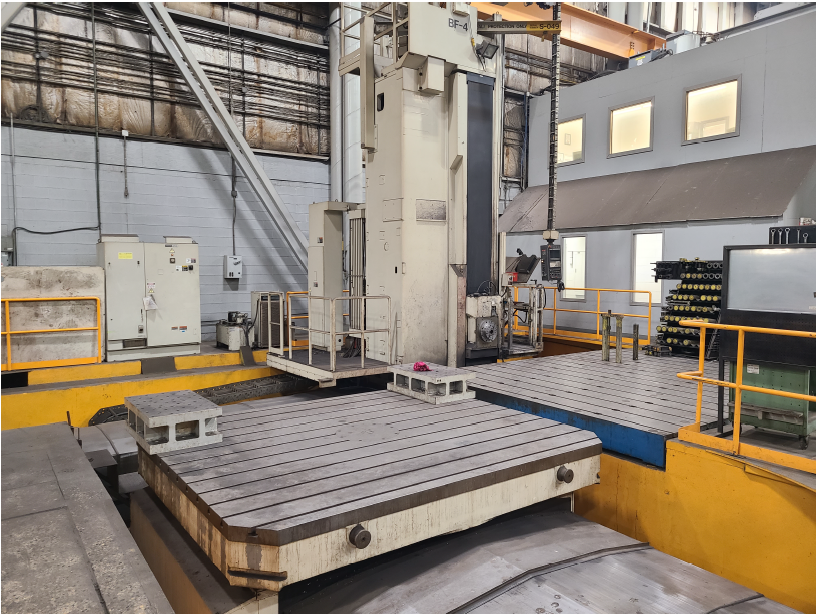
- Floor-plate / rotary table capability: Designed for large workpieces, heavy loads, and flexible setups (floor plates or rotary table configurations) which permit large part machining.
Why this matters:
- The travel dimensions define the size of the workpiece you can handle. If your intended workpiece is near the upper limit, any wear or reduced travel on the used machine becomes critical.
- Spindle/quill size and extension determine rigidity and capability for heavy boring, large diameter holes, long spindle reaches. These are expensive to repair if compromised.
- The control system (and its condition) influences ease of use, capability (5-axis, probing, tool changer) and future serviceability.
- Large machines like this consume significant floor area, require strong foundations/floor plates, heavy duty anchoring, and logistics (transport, installation) are substantial.
2. Key inspection checklist for used purchase
When examining a used BF-130B, focus on structural, mechanical, control/electrical, auxiliary systems and logistics/installation readiness.
Structural & mechanical condition
- Inspect the machine base, floor-plate assembly, column and saddle for visible cracks, repairs or distortion. Being a floor type, the base often takes heavy loads and may have stresses from large parts or past over-loading.
- Check the spindle/quill assembly: examine for wear, excessive backlash, smoothness of quill extension/retraction, spindle face/taper condition. A worn taper or spindle bearings severely impact accuracy.
- Examine axes for wear: the X and Y axes (large travel) must be smooth, without excessive play. Check guideways/rails, ball screws, service history.
- Check large workpiece handling components: floor plates, rotary tables (if equipped), clamps/fixtures. For example, if the unit has a rotary table option, check table indexing, B-axis, load capacity, bearing condition.
- Check the condition of the chip removal/chip conveyor systems (if present), coolant/fluid systems, and lubrication systems — contamination or neglect in big machines is costly.
- Measure/verify travel limits: For used machines, sometimes travel may be limited due to damage, wear or missing components.
- Check for correct anchoring and leveling of the machine. A horizontal boring machine of this size must be properly installed to maintain accuracy over time.
Control / electrical systems
- Identify the CNC system: confirm model (TOSNUC 999, FANUC, etc), verify software version, number of axes controlled, presence of probing/tool-setting systems.
- Check the electrical cabinet: look for signs of overheating, dust/slag ingress, water/coolant damage, corroded wiring. A neglected cabinet often signals broader maintenance issues.
- Try jogging each axis manually (if possible) and via the CNC: listen for unusual noises, measure speed, check for smoothness and consistent slaving.
- Check safety systems: interlocks, emergency stops, covers, guards, limit switches. Large machines often are “grandfathered” and missing some safety retrofits—this may affect compliance.
- Ask for alarm/fault history: electrical faults, axis errors, spindle overloads.
Auxiliary systems & tooling readiness
- Check tool changer (if fitted): capacity (many listings show 60 tools for BF-130B) and condition. From listings: ATC 60 tools was specified.
- Check attachments: e.g., attachments for milling/boring, quill head options, rotary table, pallet changer etc. The manufacturer states a “vast array of accessories such as ATC, AAC, AAI and AATC” available.
- Check condition of tooling and fixtures included: Are they worn? Missing? Will you need to invest heavily after purchase?
- Check maintenance history: Ask for hours of operation, actual machining hours vs idle hours, history of major rebuilds (e.g., spindle bearing replacement, table bearing replacement).
- Check hydraulic/pneumatic systems (if any): For large machines, sometimes supporting systems (clamps, lifts) are hydraulically or pneumatically actuated – leaks or poor condition reduce value.
- Check floor plates/fixtures: Because this machine supports large workpieces, ensure plates are flat and free of major wear or gouging.
Performance / accuracy test
- Request a test machining if possible: create a sample bore or surface, inspect finish, measure deviation, repeatability.
- Ask for or perform alignment/accuracy measurement: Large floor type machines may drift over time, so verifying readings or alignment certificates is beneficial.
- Test spindle run-out: Excessive run-out indicates bearing wear or taper damage.
- Check for repeatability of moves and indexing of rotary table (if used).
- Verify that the machine’s size and capacity match your planned usage, and that the used condition allows you to still achieve acceptable tolerances for your work.
Installation / logistic / cost of ownership considerations
- Floor space & foundation: A machine this size may require specialized foundation or floor reinforcement. Manufacturer literature states “As a workpiece is secured on the floor plate, no limitation is imposed on the shape and weight of workpiece”. That also means large mass and dynamic loads—foundation is critical.
- Transport and rigging: Moving such a machine (often >30 tonnes) is expensive; ensure the seller has correct de-installation, shipping plan, re-installation plan.
- Power & utilities: Confirm electrical supply, control system compatibility, coolant supply, possible rotary table motors, etc.
- Spares availability & service: Since it’s a Japanese make (Shibaura Machine Co., Ltd.), verify local service network in your region, parts lead-times, whether the key components are still supported.
- Upcoming maintenance or major rebuilds: Ask about likely upcoming major service intervals (e.g., spindle rebuilds, large axis drive replacement, table bearing wear).
- Hidden cost risk: Because big machines are expensive to move/repair, even moderate wear becomes costly. Factor potential refurbishment cost into purchase price.
3. Specific risk areas for BF-130B and what to ask
When dealing specifically with BF-130B used machines, some areas present higher risk. Ask targeted questions such as:
- What is the actual X/Y/Z travel specification of this machine (the variant). For example, some BF-130B machines are configured for X up to 12,000 mm. Confirm you have proper travel for your intended work. (Spec sheet: X Stroke 4,500 ~ 12,000 mm)
- What is the table/floor-plate configuration and what is the maximum load previously used on it? Large loads mean large stresses on axes and bearings.
- When was the spindle and quill head last serviced or rebuilt? Because the machine is heavy duty, the spindle/quill head wear matters.
- What tool changer capacity (ATC) and what attachments (AAC, AATC) are included? Since the machine could have optional attachments, missing or partial attachments reduce value.
- What is the control system version (e.g., TOSNUC 999) and is the software up to date? Older controls may limit functionality or have spare parts risk.
- Has the machine been relocated? If yes, who performed the move, how was it aligned and levelled afterwards? Relocations cause risk of misalignment, base distortion.
- What kind of workpieces were processed previously? Were they large heavy castings, plates, welded structures? This affects wear.
- Are there any known issues with the machine: unusual noises, vibration, drift in axes, excessive backlash, worn axis ways?
- What is the condition of fixtures, floor plates, clamps, rotary table (if included)? If these are worn, your cost to refurbish will be high.
4. Valuation & cost of ownership considerations
As part of your buying decision, evaluate the total cost (purchase + installation + commissioning + future maintenance) versus expected productive life and return on investment. Consider:
- Purchase price: Must reflect year, hours, condition, included accessories/tools, travel size, market demand for used BF-130B machines.
- Transport & installation: The cost of moving a large floor type boring machine can be significant—cranes, rigging, floor work, foundation, leveling.
- Commissioning/alignment: After installation you may need machine tool service to certify geometry/accuracy—budget for this.
- Future service/spare parts: Large machines like this will eventually require major service (spindle rebuild, large bearing replacement) which is costly.
- Downtime risk: If the machine is used in production, breakdowns or misalignment quickly eat profitability.
- Productivity: Is the machine sized and specification suitable to your intended parts? If it’s over-spec or under-spec you waste money or limit throughput.
- Resale value: Consider how long you will use the machine and what resale market looks like for a large Japanese horizontal boring machine.
- Fit with your business: Are you buying for your own production or as a listing on your portal? If listing, include detailed condition, travel specs, accessories, maintenance history so buyers understand value.
5. Fit for your business / listing considerations on your portal
Given you run a second-hand machinery platform, here’s how to present a BF-130B listing (or evaluate one for purchase):
- Provide full specification: model (BF-130B), variant (travel size X/Y/Z), control system type, table size/load capacity, ATC/capacity, included accessories (rotary table, attachments).
- Clearly show condition: hours, service logs, any recent rebuilds, photos of base, spindle taper, tool magazine, control cabinet, and large workpiece table or floor plates.
- Highlight logistics/installation requirements: weight, foundation requirement, floor plate arrangement, anchoring, power supply – bulky machines require planning.
- Note tooling/fixtures included or excluded: large machines often need large custom fixtures; if included that’s a value add.
- Mention service/support parts availability: For Japanese makes in your region (Europe/Türkiye), buyers want to know about parts lead time, local support.
- Provide transparent condition disclaimers: any known wear, upcoming service needs, missing accessories.
- Present realistic pricing: Because large floor type machines have high moving costs, price accordingly and mention “Ex-works” or transport cost separate.
- Offer view/test: Encourage video or live demonstration of axis motion, tool change (if present), probe/test cut if possible.
- For buyers: Suggest job suitability: e.g., large heavy components, heavy duty boring, long bed work, large castings/structures rather than small precision parts. Set correct expectations.
6. Summary: What to check & what to ask
Here’s a concise summary of top priorities when selecting a used Shibaura BF-130B:
- Travel and size: Ensure the X, Y, Z travel of the machine meets your workpiece size requirements.
- Spindle/quill condition: Big bore/quill machines must have maintained spindle head; check taper, bearings, smoothness.
- Axes wear and alignment: For a large machine, any drift/wear is amplified; verify condition and alignment history.
- Tooling accessories and magazine: Large machines may have attachments; missing ones reduce productivity.
- Control and electronics condition: Older controls may have spare-parts issues; ensure functionality.
- Installation & logistics implications: The bigger the machine, the bigger the move/install cost and foundation requirements.
- Maintenance/service record: A strong service history substantially reduces risk on a used large machine.
- Spare parts/support availability: Especially for a Japanese machine in international market, confirm parts and service network.
- Value vs risk: Weigh purchase cost + refurbishment + installation + risk of breakdowns versus expected productivity and lifespan.
- Transparent listing and condition disclosure: Essential if you list this machine on your portal—big machines attract informed buyers.