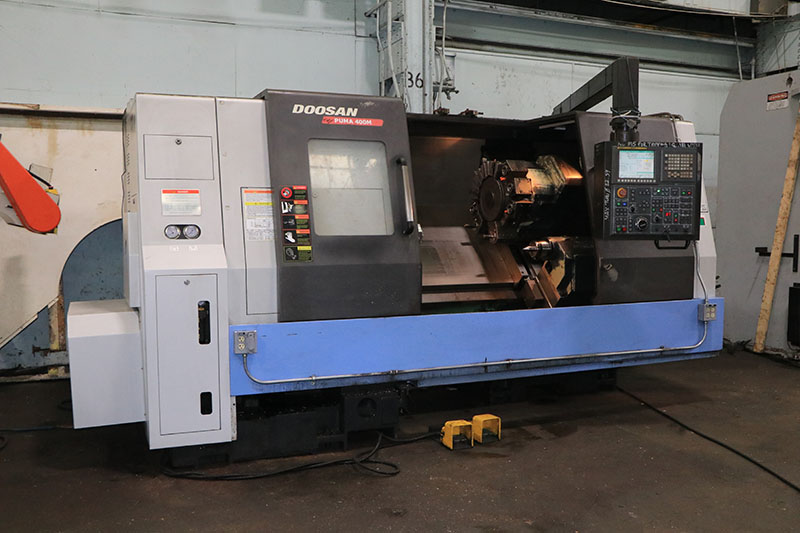
CNC Specialist’s Guide: Selecting the Right Used, Surplus, Secondhand, Pre-Owned Doosan Puma 400MB CNC Turning Center made in South Korea
Here’s a CNC specialist’s lens on buying a used / surplus Doosan Puma 400MB (Korea-made) turning center. I’ll walk you through how to evaluate condition, avoid hidden pitfalls, and negotiate smartly. Use this as your on-floor checklist.
1. Know the “normal” spec benchmarks
Before you go see any candidate machine, arm yourself with published or typical specs for the Puma 400MB. That way, you can spot deviations that may signal trouble (or deception).
Here are typical specs and variants found in listings:
| Parameter | Typical / published value | Notes & sources |
|---|---|---|
| Max turning diameter | ~ 533 mm (21.0 in) | Machinetools lists swing “Turning Dia 533.4 mm” for Puma 400MB |
| Swing over bed | ~ 762 mm (30 in) | Machinetools data |
| Machining / turning length | ~ 988 mm (38.9 in) | Clark Machinery listing for 2008 machine |
| Spindle motor power | ~ 50 hp (37.3 kW) | Clark Machinery spec (2008) |
| Spindle max rpm | 2,000 rpm | Clark Machinery listing |
| Bar / bore capacity | ~ 114 mm (4.5 in) bar / ~116 mm bore | Machinetools: bar capacity 114.3 mm |
| Control & turret | FANUC 21i-TB, 12-station turret | Many Puma 400MB machines use this control / turret setup |
When you inspect a machine, see how close it is to these values. Large deviations are not always fatal, but you want a plausible explanation (e.g. retrofits, modifications).
2. Pre-inspection: documentation, photos & history
Before even setting foot in the workshop, request:
- Maintenance logs / repair history (dates, parts, who did the work)
- Actual running hours / cycle count / “cutting hours”
- Original manuals (mechanical, electrical, hydraulics), wiring and parts diagrams
- Control parameter backups / saved programs
- Records of major replacements or retrofits (spindles, turrets, control upgrades)
- High-resolution photos (spindle, bed ways, turret, interior, wiring)
- Reason for sale
If the seller cannot or will not provide credible history, that’s a red flag to discount heavily or walk away.
3. Structural & visual walkaround
With flashlight, camera, measuring tools:
- Base, bed, frame
- Look for cracks, weld repairs, distortions or bending.
- Inspect the base for signs of shifting, re-leveling, structural modifications. - Bed ways & slide surfaces
- Check for scoring, wear grooves, pitting, corrosion.
- Are the gibs intact? Are protective covers in place? - Headstock, tailstock, turret housing
- Examine for damage, alignment deviations, or “rough work” evidence. - Guards, covers, safety shields
- Missing, bent, or poorly repaired guards sometimes hint at harder abuse. - Corrosion / moisture damage zones
- Especially under the coolant tray, base internals, underside, cable trays.
Structural issues (frame cracks, bed warpage) are among the costliest to fix — often not worth the investment unless heavily discounted.
4. Spindle & headstock
The spindle is the heart. Many used lathe failures trace back here.
Check / test:
- Can you rotate the spindle (by hand or slow jog)? Listen/feel for roughness, binding, noise.
- Use a dial indicator (or test bar) to check radial runout and axial play at the nose.
- Inspect the spindle bore (if through). Look for scoring, ovality, damage.
- Examine headstock lubrication: oil lines, filters, seals.
- Any signs of overheating (discoloration), seal leaks, oil stains.
- If there is a gearbox or drive train (e.g. belt/gear reduction), check backlash, noise, smoothness.
- Check the spindle nose taper, look for damage or wear in the nose seat and mounting surfaces.
If the spindle shows significant play, noise, or damage, expect high repair costs (bearing replacement, regrind, etc.).
5. Axis movement, slideways & precision
Even if the spindle is perfect, poor axes kill precision.
- Jog X and Z axes (manual or via control). Note any binding, jerkiness, rough segments.
- Feel for backlash in each axis.
- Inspect guideways, slides, gibs for wear, damage, missing lubrication.
- Check ball screws or lead screws, nuts, coupling play.
- Observe alignment: is the tailstock coaxial with the spindle? Is the cross slide moving true?
- Check lubrication / oiling on slides and screws; missing lubrication systems are a warning.
Axes that are sloppy, misaligned, or poorly maintained will degrade accuracy and require rebuilds.
6. Turret / tooling / live tooling
The Puma 400MB often comes with a 12-station turret and options for live tooling.
- Test turret indexing — does it move quickly and lock solidly? Any misindex alarms?
- Inspect tool holders: no excessive play, wear, damage.
- Test tool change cycles several times.
- If live tools exist, check their speed, runout, torque behavior.
- Inspect wiring, coolant through tooling, sensors, switches associated with tooling.
- For driven tools, listen for vibrations, overheating.
A bad turret or failing live tooling system can cripple productivity.
7. Control, electronics & CNC systems
Because it’s a CNC machine, the electronics can be make-or-break.
- Power on the unit — note boot sequence, errors, alarms.
- Test operator panel (keys, screen, switches, emergency stop).
- Inspect all wiring, junction boxes, connectors, cables: signs of heat damage, splices, non-OEM wiring, corrosion.
- Check limit switches, home/reference switches, sensors.
- Load and run a simple test program if possible, or command basic moves.
- Review control software, backups, parameter memory.
- Check I/O modules, drives, power supplies — are they OEM or replaced?
- Verify connectivity (USB, network, etc.) if applicable.
If control boards are faulty, or the software is missing or corrupt, replacement may be very costly.
8. Functional testing under load & trial cuts
Seeing it run is non-negotiable.
- Start with no-load / idle running to check for smooth motion, drift, vibration.
- Execute a test part (material, dimensions similar to your actual work).
• Measure part accuracy, surface finish, deviations.
• Exercise extremes of travel (near ends of X & Z).
• Repeat cuts to test repeatability. - Cycle turret changes, tool changes, live tooling operations (if present).
- Trigger emergency stop / fault recovery mid-cycle and verify recovery.
- Run with coolant, chip evacuation, verify coolant pressure, leaks, chip flow.
If it can’t consistently produce to your tolerance under real load, it’s not worth much.
9. Precision checks, calibration & measurement validation
Bring quality measuring tools and conduct:
- Spindle runout (internal and external)
- Linear axis accuracy over stroke
- Backlash measurement
- Tool offset repeatability
- Concentricity, taper, perpendicularity checks
- Compare results to published specs or calibration history (if provided)
If you find large deviations, estimate what it would take (time, parts, labor) to restore.
10. Spare parts & support ecosystem
A used machine is only as good as your ability to maintain it going forward.
- Confirm availability of spare parts: bearings, ballscrews, turret parts, spindles, electronics, tooling components.
- Check whether Doosan or third-party support is active in your region.
- Evaluate whether support houses can refurbish critical subsystems (spindle, axes, electronics).
- Ask seller whether any spare modules, tooling, consumables, or parts come with the sale.
- Estimate lead times and cost for parts you might need soon.
- Assess whether retrofits or control upgrades are feasible in case control electronics die.
If spares or support are rare or expensive, what seems like a bargain might become a liability.
11. Pricing negotiation & risk buffer
By this point, you should have a “defect list” with cost estimates. Use it wisely in negotiation.
- Get quotes for necessary repairs (rebrushing, spindle rebuild, turret servicing)
- Subtract those from the asking price — aim to leave your repair margin intact
- Include transport, rigging, leveling, installation, and commissioning costs in your total bid
- Leave a contingency (10–20 % or more) for surprises you didn’t catch
- Try to negotiate a short acceptance or test period (if contract allows)
Don’t let excitement override technical skepticism.
12. Post-purchase commissioning & setup
Once you own it, do it right from the start:
- Proper base / foundation, leveling, anchoring
- Clean, flush, replace lubricants, coolant, filters
- Re-check alignment (spindle, axes, turret, tailstock)
- Break-in with light loads; gradually escalate
- Verify accuracy, repeatability under load
- Train operators, define maintenance schedule & logs
Really monitor for drift or emerging issues early — you may have recourse in contract if problems show early.
13. Red-flags & deal-breakers in order of severity
Here are the strongest warning signs that may make a purchase too risky (or demand massive discount):
- Excessive spindle play, noise, or bearing damage
- Faulty or non-indexing turret, mis-indexing, tool change errors
- Control or electronics missing, corrupted, or obsolete beyond repair
- Severe wear, damage or repair in frame, bed, or structural parts
- Sloppy axes (excess backlash, binding, misalignment)
- Missing or nonfunctional safety interlocks / covers / guards
- No tooling, chucks, or essential attachments
- Poor or missing maintenance history
- No or very high-cost spare parts or support options
- Seller unwilling to allow test cuts or full inspection