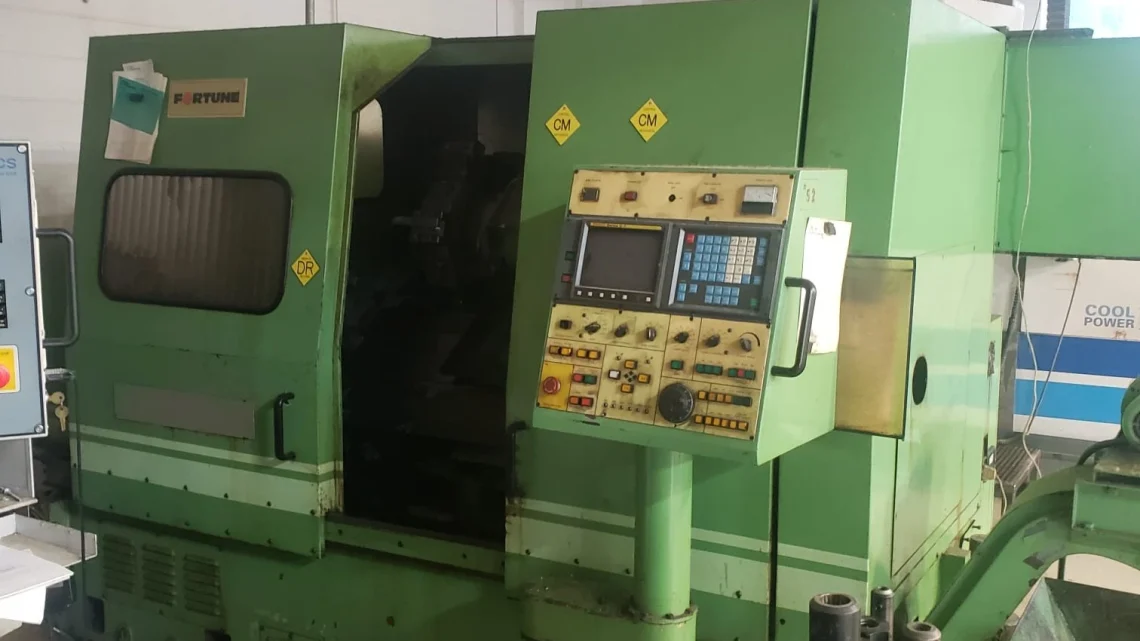
Buy Like a Pro: What to Look For Before Acquiring a Used, Secondhand, Pre-Owned, Surplus FORTUNE TNS-5 CNC Lathe
Buying a used FORTUNE TNS-5 (Victor / Fortune / Taichung lineage) CNC lathe can give you great value — if you inspect it like a pro. Below is a structured, field-ready checklist and tips to spot trouble and negotiate intelligently. (Some info is inferred from known Victor TNS-5 specs)
Know the baseline spec / expectations
Before you visit, arm yourself with “ideal vs typical” numbers to compare against:
From a used listing:
- Max swing: 27.6 in (~700 mm)
- Swing over carriage: ~ 18.1 in
- X travel: ~ 13.8 in
- Z travel: ~ 42.1 in
- Spindle bore: ~3 in
- Spindle motor: 30 HP
- Spindle speed range: 30–2500 rpm
- Turret tool positions: 12
- Typical control: Fanuc OT-B
Another listing (European site) gives metric specs:
- Swing over bed: 700 mm
- Swing over cross-slide: 460 mm
- Z-axis travel: 1070 mm
- X-axis travel: ±130 + 340 mm (i.e. total)
- Spindle bore ~ 77 mm
- Spindle power: ~22 kW
Use these ranges as your “red-flag thresholds.” If the machine you’re inspecting deviates wildly (e.g. very small spindle motor, gross wear, missing turret) — demand justification.
Pre-Visit / Document Review
Before going to see the machine, ask the seller to send:
- Maintenance / service records — what was done, when, by whom
- Usage / run hours or cycle history
- Original manuals, electrical and mechanical schematics
- Control software / parameter backups
- History of major repairs, retrofits or component replacements
- Photos & video in operation, especially spindle, turret, axes
- Reason for sale
If the seller can’t or won’t provide meaningful documentation, treat that as a warning.
Visual / Structural Inspection
With flashlight, camera, measuring tools in hand, walk around and scrutinize:
- Frame, bed, base — check for cracks, welding repairs, distortions
- Bed ways / slideways — look for heavy wear, scoring, pitting
- Guards, covers, enclosures — missing or badly repaired panels are red flags
- Symmetry & alignment — both sides of turret / headstock should appear balanced
- Signs of corrosion, moisture damage — in footings, underside, enclosures
Structural integrity is foundational. A bent bed or frame is extremely difficult and costly to correct.
Spindle & Headstock
This is one of the most critical areas:
- Rotate spindle (if possible) manually — listen/feel for roughness, binding, noise
- Test radial and axial play with a dial indicator
- Inspect spindle bore for wear, scratches, pitting
- Check condition of spindle bearings (look for oil leakage, discoloration, overheating signs)
- Review spindle drive, gearbox (if applicable), lubrication, housing
- Check spindle nose taper and mounting condition
If spindle bearings are worn or there is excessive play, repairs are expensive or may render the lathe unusable.
Axis Motion, Slideways & Precision
- Jog or move X and Z axes (manual or under control) — note smoothness, any binding, jumps
- Feel and measure for backlash in both axes
- Check guideways for wear, unevenness, lubrication state
- Inspect screws (ball screws or lead screws), nuts, couplings, bearings for play
- Confirm alignment: tailstock should align with spindle axis, cross slide moves true
If the axes are sloppy or badly worn, achieving good tolerances will be very hard.
Turret / Tooling System
Many used-CNC pitfalls hide in the turret area:
- Check turret indexing and tool change reliability
- Inspect tool holders for wear or looseness
- Test the clamp / unclamp mechanism, sensors, switches
- Cycle through a full set of tool changes under load (or test)
- Ensure turret drive motor, gearing, alignment all look correct
If the turret misindexes or is erratic, it can heavily suppress productivity or require significant repair.
Control System, Electronics & Wiring
Because the control is essential, inspect carefully:
- Power on the machine; note bootup time, alarms, error messages
- Test operator panel, screen, buttons, switches, e-stop
- Inspect wiring, connectors, junction boxes for signs of overheating, splices, modifications
- Check limit switches, home datum switches, sensors, interlocks
- Check control software / parameters / backups
- Test axes motion, program loading, command moves (if possible)
- Look at I/O modules, drives, power supplies — are they original or changed
- Verify connectivity (USB, serial, network) if applicable
If the controller is partly dead, missing modules, or obsolete, fix cost may exceed machine value.
Functional Testing & Trial Runs
You must see the machine working under as close to real conditions as possible:
- Run in no-load / idle mode first — check for smooth motion, drift, vibration
- Perform a test cut using stock material in thicknesses you plan to use
- Measure part dimensions, tolerances, surface finish
- Test across full ranges (near ends of travel)
- Run multiple parts to evaluate repeatability
- Test tool changes repeatedly
- Test tailstock (if present) for alignment, smoothness
- Trigger emergency stops / safety interlocks during a cycle — see how machine responds
- Run with coolant / chip flow — check for leaks, clogs, coolant pump health
If the machine can’t produce consistent parts within your spec tolerances, its value is limited.
Precision / Measurement Verification
Bring measuring tools (micrometers, dial indicators, gauge blocks) to verify:
- Spindle runout (internal & external)
- Linear axis accuracy over travel
- Backlash measurement
- Tool offset repeatability
- Concentricity, taper, perpendicularity
- Compare against any known calibration or spec sheets
If you find large deviations, factor in repair or reconditioning cost — often substantial.
Spare Parts, Support & Lifecycle Risk
A machine is only useful if you can maintain it:
- Confirm availability of spare parts for TNS-5 (bearings, spindle parts, tool holders, electronics)
- Ask whether local service houses or support exist for Victor / Fortune machines
- Check whether the control boards / modules are still produced or available used
- Ask seller to include spare modules, tooling, or consumables
- Estimate cost and lead time of likely future repairs or wear items
If parts are obsolete or support is weak, what looks like a bargain can turn into a money pit.
Price Negotiation & Risk Buffering
- Create a list of deficiencies or “as-found” defects and get quotes for repairs
- Use those as leverage in negotiation (e.g. “this spindle bearing will cost X to replace”)
- Include costs for rigging, transport, leveling, installation, commissioning
- Leave a buffer (10–20 % or more) for hidden surprises
- If possible, secure a short acceptance period or conditional guarantee
Don’t let excitement override the cold technical risks.
After Purchase: Installation & Commissioning
Once you acquire the machine, do:
- Proper foundation, leveling, anchoring
- Electrical / power supply checks & grounding
- Flush / replace lubrication / coolant systems, filters
- Full alignment & calibration (spindle, axes, turret, tailstock)
- Break-in runs: start light, gradually ramp up
- Re-check tolerances under load
- Train operators and set up maintenance logs
If you catch drift or instability early, you may have recourse (if contract allows).
Red Flags / Deal Breakers
Be especially wary if you find:
- Spindle with excessive play or noise
- Turret misindexing, errors or erratic behavior
- Control system partially dead or missing modules
- Severely worn guides/ways / slides
- Structural repairs (welds, distortions) to bed or frame
- Missing safety interlocks or guards
- No tooling, chucks, or essential accessories
- Seller refuses test cuts / demo
- Spare parts for critical subsystems seem unavailable
If several of those appear together, the risk often outweighs the cost savings.