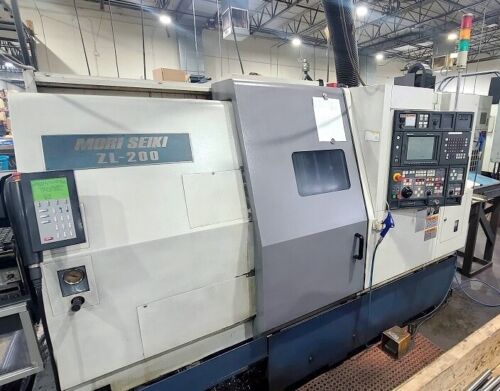
Before You Buy: Essential Criteria for Evaluating a Used, Second-Hand, Pre-Owned, Surplus Mori Seiki ZL-200 CNC Lathe made in Japan
When considering buying a used / second-hand / surplus Mori Seiki ZL-200 (or variant, e.g. ZL-200 SMC) CNC lathe (Japanese origin), you need to be rigorous. Mori Seiki machines are well made, but age, usage, maintenance, and retrofit history can make a big difference in their remaining value and reliability. Below is a detailed checklist + guidance on tolerances, red flags, risks, and negotiation points.
Basic Specs & What to Know Up Front
Before you visit or inspect, gather as much baseline data as possible (spec sheet, original capabilities, configuration). Some known specs for the ZL-200 / ZL-200SMC series:
- Swing over bed: ~ Ø 680 mm (depending on variant)
- Swing over carriage / cross slide: ~ Ø 510 mm
- Distance between centers: ~ 752 mm
- Spindle speed: up to ~ 4,000 rpm (range 40–4000)
- Axis travels (X, Z) in many listings: ~ 235 mm on X (upper turret) / ~ 520 mm Z (main)
- Control: Mori Seiki / MSD-501 II (or similar)
Having the “from-factory” specs gives you the benchmark against which to detect wear or deviations.
What to Inspect & Test In Person
Here’s a structured evaluation checklist. Bring measuring tools (dial indicators, test bars, runout gauges, micrometers, laser interferometer if possible, alignment tools, vibration analyzer). If needed, bring a machining/metrology expert.
| Subsystem / Area | What to Check / Test | Acceptable Range / Warning Levels | Why It Matters / Notes |
|---|---|---|---|
| Machine identity & documentation | Confirm model, serial number, build date, configuration (SMC, dual spindle, live tooling) | Discrepancies may indicate swapped parts or mis-representation | Helps with parts sourcing and verifying what was originally installed |
| Structural frame / bed / saddle / cross slide | Inspect for cracks, weld repairs, misalignment, corrosion, deflection under load | Any obvious bowing or structural repair is a red flag; deflection under moderate test load should be minimal | The rigidity of the bed and slide structure underpins machining accuracy |
| Guideways / slideways / alignment surfaces | Visual & tactile inspection for scoring, pitting, rust; measure wear, flatness, parallelism, sag | Deep grooves, uneven wear, or inability to re-scrape are serious issues | Worn ways contribute to poor surface finish, chatter, and lost accuracy over time |
| Ballscrews / leadscrews / feed drives | Check backlash, axial/radial play, reversal error, “lost motion,” test motion at different speeds, measure wear in nut | Backlash beyond tolerable limits (for your precision need) is problematic | Worn nuts or screws degrade positional accuracy and repeatability |
| Spindle / chuck / bearings | Mount a precision test bar; measure runout, vibration; listen for noise; test for axial / radial play; test full rpm; monitor temperature | Runout > 10 µm (depending on application) is concerning; any knocking, noise, or drift is red flag | The spindle (and chuck) is critical for turning accuracy and finish |
| Sub-spindle (if present) | Same checks as main spindle: runout, play, indexing, reliability of shifting | Any misalignment or sloppiness between main and sub-spindle is a problem | The relative alignment of main and sub-spindle is critical for part transfer precision |
| Tool turrets / live tooling / driven tools | Inspect turret indexing accuracy, runout of driven tool spindles, stability under load, check for backlash or vibration in driven tools | Inaccuracy or instability in tool holders or live tooling degrades machining quality | If the machine has live tooling, the condition of those mechanisms is very important |
| Control / electronics / servo system | Power up the machine; jog axes; check error codes; test manual and automatic modes; test homing, limit switches, M-codes; inspect wiring, connectors | Any intermittent faults, encoder errors, dead axis, or unstable reads are serious | Aging electronics or unsupported control units can be a major maintenance risk |
| Axis motion / accuracy / repeatability | Use calibration equipment: laser interferometer, ballbar, straightness test, circular interpolation, reversal/contour test | Deviation beyond your intended machining tolerance is not acceptable | These tests reveal cumulative error and drift under dynamic motion |
| Thermal stability & cooling | Warm up the machine; run a test cut; monitor temperature drift, thermal growth; check spindle cooling, motor cooling, coolant system | If the machine drifts more than your tolerances over 30–60 min, it’s risky | Thermal control is often one of the biggest hidden issues in used machines |
| Coolant / chip handling system | Inspect pumps, nozzles, filters, piping, coolant lines; run coolant flow; test chip conveyor / removal mechanisms | Leaks, clogging, weak flow, or failing chip removal are maintenance burdens | Good coolant and chip handling is essential for stable machining and cleanliness |
| Workholding / spindle interface / chucks | Check chuck mounting, taper fits, surface condition, clamping forces, flatness of mounting, condition of adapter plates | Poor chuck condition or sloppy taper fit degrades alignment and finish | Chucks and interfaces often wear and get damaging over time |
| Tailstock (if present) | Check alignment, taper, travel, quill condition, locking | Misalignment or looseness is a problem for long workpiece support | Useful when the lathe is used for bar work or long parts |
| Foundation / mounting / leveling | Check how the machine was mounted (bolts, base, shims), inspect base flatness, anchor points, ability to re-level | If the base was damaged or improperly installed, realignment may be impossible | Correct foundation and leveling are prerequisites for precision |
| Test machining trial / load test | If seller allows, run a “real” part or test cut (rough + finish); measure surface finish, tolerance, chatter, stability | If under real cutting the machine cannot hold tolerances or shows chatter or drift, value is low | A “demo” under no load may hide serious problems |
| Maintenance history & records | Ask for logs, rebuild history, parts replaced, downtime history, calibration records | No history increases risk; missing key parts is costly | Knowing how the machine was treated gives insight into its actual condition |
| Parts / consumables / supportability | Check whether critical spares, electronics modules, bearings, control units, tool holders, etc are still obtainable | If many parts are obsolete or custom, cost and downtime risk are higher | A machine is only as good as your ability to maintain it |
| Safety / guarding / interlocks | Ensure all guards, shields, emergency stops, interlocks are present and working | Missing or nonfunctional safety gear is a cost & liability | You might have to invest to bring machine to compliance |
| Cost to refurbish / recondition / install | Estimate cost to rebuild or recondition worn parts, transport, reinstall, realign, calibrate, control retrofit | If refurbishment costs approach or exceed a better alternative, reconsider | Always work through a “worst case” total cost scenario |
Tolerances & Guidelines / What You Should Expect
Because different users will have different precision needs, I’ll offer a rough guideline. For finishing or high-precision production, you’ll want tighter margins. For general turning work, looser ones might suffice.
- Axis backlash / reversal error: Ideally < 0.01 mm; up to 0.02 mm may be tolerable depending on application
- Repeatability / positioning precision: ±0.005 mm to ±0.01 mm is a solid target for many precision parts
- Straightness / flatness / linear accuracy over travel: Depends on axis length; drift or error more than a few tens of microns (0.02–0.05 mm) can be troublesome
- Spindle runout: Preferably under 0.01 mm at the nose / test bar; more than that degrades finish
- Thermal drift: Over an hour of operation, try to keep drift within the tolerance envelope you need
- Wear on ways: A few tenths of a mm might be acceptable if compensation / re-scraping is possible—but check how much adjustment margin is left
Key Red Flags & Deal-Breakers
- Severe damage, cracks, or heavy repairs to the main castings, bed, saddle
- Excessive wear, pitting, or scoring on guides or slideways
- Spindle with large runout, play, knocking, or bearing damage
- Control/electronics that are obsolete, nonfunctional, or unsupported
- Tool turret or live tooling system malfunctioning or excessively worn
- Excessive backlash, play, or slop in axes beyond acceptable limits
- Thermal instability such that the machine cannot maintain tolerances over time
- Leaky coolant or hydraulic systems, failing pumps, clogged coolant lines
- Missing or heavily worn chucks, tool holders, or mounting hardware
- No maintenance records, no parts support, undocumented modifications
- The cost to restore the machine (mechanical, electronic, alignment) exceeds your acceptable margin or makes other newer machines more cost-effective
Negotiation & Purchase Strategy Tips
- Insist on “under power” demo and ideally a load cut test before committing
- Structure conditional acceptance — e.g. “if axis error > X or drift > Y, seller must compensate / rebuild”
- Get commitments on spares / parts — see what’s included (chucks, holders, spares)
- Compare competing machines (other ZL-200s, or similar class lathes) to benchmark pricing
- Account for hidden costs — transport, disassembly / reassembly, alignment, calibration, retrofit electronics
- Bring or hire a metrologist / experienced technician during evaluation
- Request full documentation — schematics, parts lists, wiring diagrams, calibration records, operator manuals
- Evaluate control / retrofit upgrade possibilities (if the control is outdated)