15/10/2025
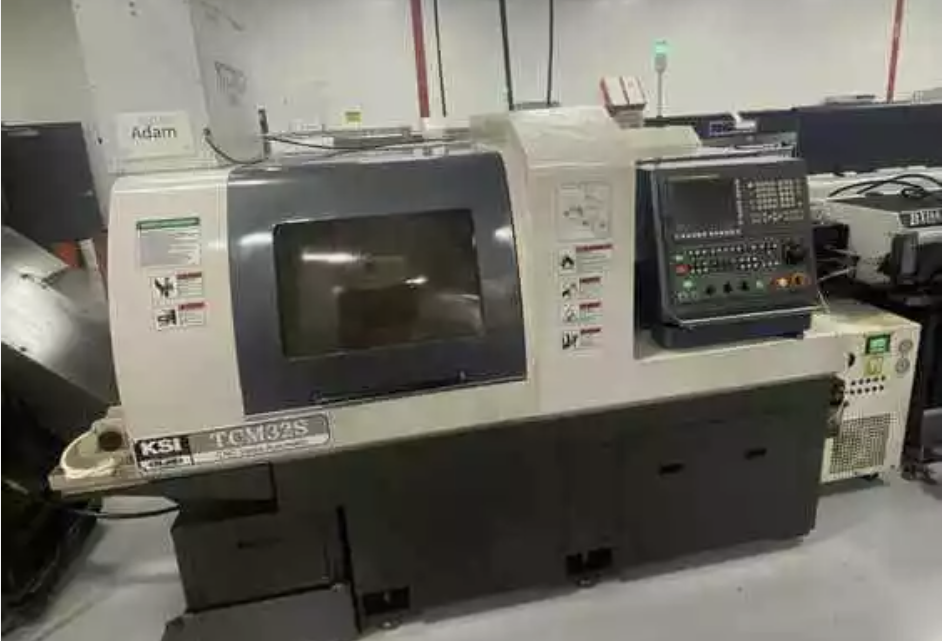
Before You Buy: Essential Criteria for Evaluating a Used, Second-Hand, Pre-Owned, Surplus KSI TCM32S CNC Swiss Automatic Lathe made in USA
Below is a specialized due-diligence checklist you can use when evaluating a used / surplus KSI TCM32S CNC Swiss-type automatic lathe (USA origin). Use this to catch hidden flaws, estimate rework cost, and negotiate more confidently.
Before diving in, here are some baseline specs and design features (from KSI’s published brochure) to anchor your expectations:
- It is part of the KSI TCM S series (models 20S, 26S, 32S, 38S)
- For the 32S model: spindle bore ~ 43 mm (1.692″)
- Max spindle speed: up to 10,000 rpm (for some variants)
- Power: up to ~7.5 kW (10 hp) for main spindle in many configurations
- It is typically a 7-axis machine (some configurations)
- Weight (shipping / machine) around 3,500 kg (≈ 7,700 lbs) in many spec sheets of the series
- Power up the control, verify that the user interface (screen, buttons, LEDs) etc. function correctly.
- Check memory backups, parameter files, programs stored, and whether you can upload/download programs (USB, Ethernet, RS-232, etc.).
- Ensure all drives, servo amplifiers, I/O modules, and control boards are installed, unmodified, and in working condition.
- Review error logs, historical alarms, maintenance logs stored in the control (if accessible).
- Check safety interlocks, limit switches, emergency stop circuits, and whether they are functioning properly.
7. Utilities & Auxiliary Systems
- Lubrication / way lube system: Check pump function, oil lines, filters, flow, and whether the automatic lubrication mechanism (if present) works.
- Coolant / coolant supply: Inspect coolant pump, plumbing, filtration, nozzles, and whether coolant reaches the cutting zone cleanly.
- Chip removal / conveyor: Ensure chip conveyor or chip removal system is operational and sufficient for the volume of production.
- Air / pneumatic systems: For actuators, collet clamping, tool changes, etc., check filter/regulator, moisture, lines, valves.
- Chiller / temperature control: If a spindle chiller or thermal control system is used, verify its condition.
- Mist / fume extraction: If applicable, check that mist collector or fume collection is functioning.
8. Safety & Compliance
- Ensure safety guards, interlocks, and covers are present and unmodified.
- Test emergency stops, limit switches, door interlocks.
- Ensure electrical panels are properly enclosed, grounded, and wiring insulation is intact.
- Verify local safety or machine directives compliance (e.g. CE, OSHA, etc., as relevant).
9. Maintenance History, Documentation & Spares
- Obtain maintenance logs, service history, parts replacements, usage data (hours, cycles).
- Ask about any known repairs, crashes, or refurbishments.
- Confirm whether original manuals, wiring diagrams, spare parts lists, control manuals, and drawings are included.
- Verify whether spare parts for key wear items (bearings, tool holders, spindle belts, electronics) are still available.
10. Trial Run / Performance Testing
- Perform a no-load run first — power up, move axes, engage tools, test spindle rotation, etc.
- Then do test cuts on a suitable test bar or sample material. Inspect part tolerances, finish, spiral error, deflection, etc.
- Run under sustained load (a soak test) to detect thermal drift, vibration, unstable behavior, or faults.
- Run through full speed / feed ranges, reversals, tool changes, and turn cycles to stress all subsystems.
11. Measurement & Benchmarking
- Record runout, backlash, positional deviations, thermal drift, and vibration amplitudes.
- Compare with tolerances required for your parts.
- Use that data to negotiate, or to decide whether refurbishment cost is acceptable.
12. Transport, Installation & Site Requirements
- Confirm machine weight, footprint, center of gravity, and how it must be rigged and shipped.
- Confirm your floor load capacity and structure for supporting ~3,500 kg (or whatever the machine weight is).
- Plan installation logistics: crane capacity, access paths, disassembly/reassembly cost, leveling and alignment cost.
- Check site utilities: power, air, coolant, drainage, electrical capacity, grounding, etc.
13. Price Adjustment & Risk Contingency
- Based on discovered defects or measurement deviations, estimate refurbishment or repair costs (bearings, control, spindle, guide repair).
- Negotiate price reductions or allowances for known defects.
- Insist on a test / acceptance period (e.g. provisional run period) before final payment.