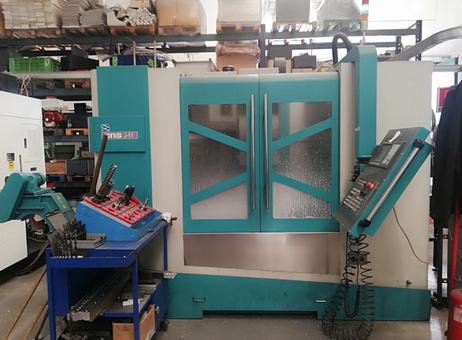
Before You Buy: Essential Criteria for Evaluating a Used, Second-Hand, Pre-Owned, Surplus CNS JAZZ J11 CNC Vertical Machining Center?
Purchasing a pre-owned CNC vertical machining center can be an excellent way to expand capacity while controlling investment costs — but only if the machine is evaluated with the same rigor applied to a new equipment purchase. The CNS JAZZ J11 is known for compact footprint, strong spindle design, and reliable cutting performance. To ensure you select a machine that delivers long-term productivity, the following criteria should be examined in detail.
1. Machine Hours, Usage History & Operating Environment
Understanding how the machine was used provides early signals about future reliability.
- Spindle running hours vs. total power-on hours
High spindle hours typically indicate heavy cutting cycles. - Single-shift vs. multi-shift operation
- What materials were machined
Hard materials (stainless, tool steel) create more wear than aluminum. - Workshop environment
Machines previously used in clean, temperature-controlled facilities generally retain better accuracy.
Request maintenance logs and check for consistent lubrication and scheduled servicing.
2. Spindle Health & Powertrain Condition
The spindle is the most expensive component on any machining center.
- Check for abnormal spindle noise, especially at mid-to-high RPM.
- Measure spindle runout with a test indicator.
- Review past spindle rebuilds, bearing replacements, or crashes.
- Verify that spindle taper (BT40/BT30) is clean and free from pull-stud wear marks.
- Inspect drawbar force if data is available.
A healthy spindle dramatically reduces future repair costs.
3. Linear Guideways, Ball Screws & Mechanical Accuracy
The CNS JAZZ J11 relies heavily on the condition of its mechanical transmission system.
Focus on:
- Backlash on X / Y / Z axes
- Condition of ball screw nuts and linear guides
- Servo motor noise and acceleration behavior
- Axis thrust force & smoothness of travel
- Alignment of column, table, and spindle center
Run a circular interpolation test if possible — it reveals wear patterns and positioning errors.
4. Controller, Electronics & Software Reliability
The CNC control system determines machine responsiveness and precision.
Verify:
- Controller boot time and alarm history
- Condition of I/O boards, servo drives, and power supply modules
- Smooth execution of G-code programs
- Status of handwheel, panel keys, and touchscreen (if applicable)
Ensure the machine supports the required communication formats (USB, Ethernet, RS232).
5. Tool Magazine & ATC (Automatic Tool Changer) Performance
A smooth tool change mechanism is essential for efficient machining.
Check:
- Magazine arm operation — no vibration or hesitation
- Tool pocket condition
- Carousel alignment
- Correct ATC sequence execution without alarms
- Air pressure stability for tool unclamp/clamp
A misaligned or worn ATC unit can cause downtime and tool crashes.
6. Coolant, Lubrication & Pneumatic Systems
These subsystems influence long-term durability.
- Confirm auto-lubrication system is functioning and not leaking.
- Inspect coolant tank, pump pressure, and filtration quality.
- Check pneumatic lines, solenoid valves, and air pressure stability.
- Examine chip evacuation performance.
Efficient fluid management prevents corrosion and premature wear.
7. Table, Workholding Surfaces & Machine Geometry
Physical surfaces provide a clear view of how the machine was treated.
- Check for T-slot damage or milling marks on the table.
- Verify table flatness using a precision straightedge.
- Inspect guarding, way covers, and bellows for breaks or deformation.
Machines with intact surfaces typically indicate careful use.
8. Power Requirements, Footprint & Installation Costs
Match the machine to your facility.
- Verify electrical compatibility (voltage, phase, frequency).
- Check overall dimensions and doorway clearance.
- Review cooling and air pressure requirements.
Unexpected installation modifications can add significant cost.
9. Test Cut & Performance Verification
Whenever possible, request a live cutting demonstration.
Evaluate:
- Surface finish
- Dimensional accuracy
- Toolpath stability
- Noise and vibration during heavy cuts
A test cut often reveals issues not visible during idle motion.
10. Included Accessories & Upgrade Options
Evaluate the value of additional components:
- Toolholders and tool chucks
- Vises, rotary tables, probing systems
- Coolant-through-spindle option
- Chip conveyor
- Spare part inventory
- Manuals and backup parameters
Well-equipped machines reduce start-up costs.
Final Recommendation
The CNS JAZZ J11 can be a highly capable machining center when sourced carefully. Prioritize machines with low mechanical wear, clean maintenance records, and strong spindle performance. A structured technical inspection — combined with a controlled test cut — will significantly minimize risks and ensure that your investment delivers productivity from day one.