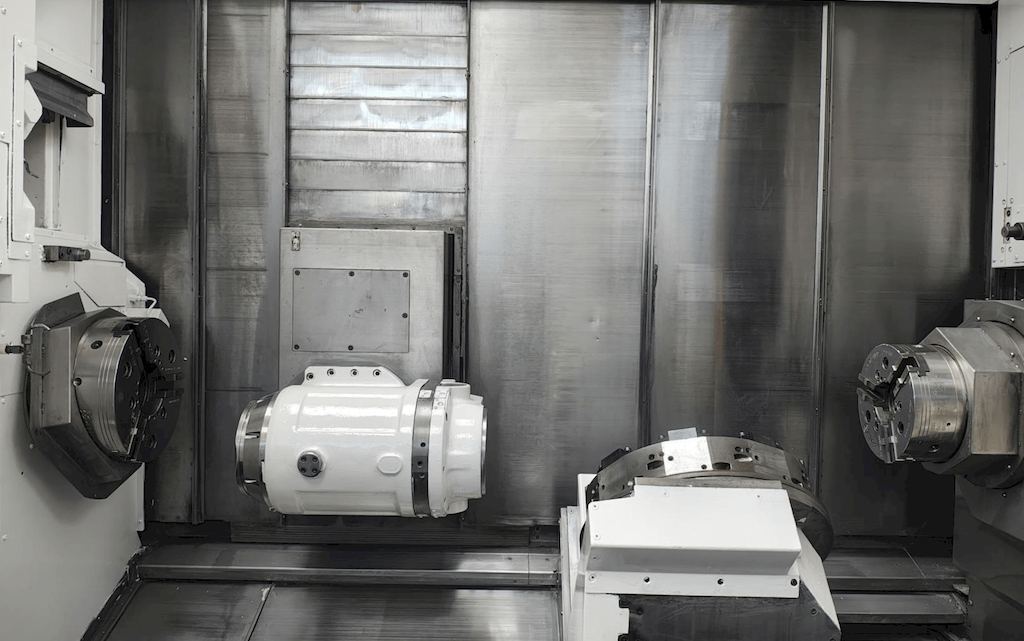
Avoid Costly Mistakes: Professional Tips for Purchasing a Pre-Owned / Surplus / Second-Hand / used Mazak Integrex i-400 ST CNC MultiTasking Turn-Mill Center made in Japan
Buying a high-end, multi-tasking CNC machine like a Mazak INTEGREX i-400 ST used is a high-stakes investment. Done right, you can get many years of reliable production. Done poorly, you could expose yourself to expensive repairs, downtime, or obsolescence. Below is a (non-exhaustive but battlehardened) checklist of “gotchas,” pitfalls, and professional tips to avoid costly mistakes.
1. Know What You’re Getting: Technical Baseline
Before inspecting, arm yourself with the correct specs and what they imply. Here are some reference / nominal specs for the i-400 ST:
| Parameter | Typical / Nominal Value* |
|---|---|
| Maximum machining diameter | ~ 658 mm (~ 25.9″) |
| Maximum machining length | ~ 1,519 mm (59.8″) |
| Main spindle speed | 3,300 rpm |
| Main spindle power | ~ 30 kW continuous / ~ 40 hp (30 min rating) |
| Sub / second spindle speed | ~ 4,000 rpm |
| Milling spindle speed | ~ 12,000 rpm (integral motor) |
| Y-axis travel (milling head) | ~ 260 mm (≈ 10.24″) |
| Lower turret / tool count | Standard 36 tools, expandable to 72 or more |
* These are “as designed / typical” specs. A used machine may deviate or have been modified.
By knowing these, you can immediately detect inconsistencies in the vendor’s claims. If someone claims “this unit does 20,000 rpm milling,” you know something is off (or severely altered).
Also: check whether the machine still uses the original controller (e.g. Mazatrol Matrix or Smooth / SmoothX variant), or whether it’s been retrofitted with something else (which can affect parts, programming compatibility, support, etc.).
2. Assess the Usage, Service History & Provenance
The mechanical condition is heavily affected by how the machine was used, maintained, and what materials it cut.
- Total hours / cycles / cuts: Ask for the machine’s ‘odometer’—how many machining hours, spindle hours, tool changes, and axis movements.
- Type of work done: If it mostly cut cast iron, or harsh, abrasive materials, that leads to faster wear on guideways, spindles, ball screws, etc. As one machinist put it: “avoid machines that ran predominantly cast iron or cast stainless”
- Frequency & quality of maintenance / service logs: A machine with a well-kept service history (lubrication logs, scheduled preventive maintenance, parts replaced, alignment checks) is far safer.
- Upgrades, refurbishments, or retrofits: Some sellers may have refurbished or upgraded spindles, drives, or CNC controllers. That can be good—but you must verify who did it, with what parts, and whether documentation exists.
- Ownership chain & usage environment: Was it used in a clean shop or in a corrosive, dusty, or damp environment? Was it moved often? Has it been idle for long periods?
Lack of good documentation is a red flag. The more traceable the history, the lower your risk.
3. Visual & Mechanical Inspection: The 7-Step Guide & More
A methodical inspection is critical. Many used-machine dealers and blogs offer checklists; e.g. the “7-step guide to inspecting a used CNC machine” is a good starting reference. Below is a tailored, more detailed version for a complex multi-tasking turn-mill like the i-400 ST.
A. Visual & Structural Condition
- Exterior body, castings & base: Look for cracks, warpage, significant dents, corrosion, or repairs. Pay attention to welded repairs (especially near stress points).
- Way covers, guards, chip panels, enclosures: Damaged, missing, or deformed covers indicate neglect or previous crashes.
- Linear guideways & ways: Look for scoring, gouges, rust, or discoloration. Scratches or wear patterns may signal past misuse.
- Ball screws & pre-load conditions: Check for backlash, binding, or noticeable backlash at various positions. Move axes manually (if possible) to feel for binding or uneven friction.
- Spindle taper and nose: Inspect the inner taper, tool contact surfaces, key slots, and sealing surfaces. Use a check (gage) tool holder to see how well it seats; uneven discoloration (blueing) can show uneven contact. This is a known inspection trick for the spindle taper.
- Coolant system, tanks, piping, filters, and pumps: Are coolant tanks clean or full of sludge? Are pumps and piping intact?
- Chip conveyor, brushes, coolant nozzles, splash pans: Ensure they are functioning and not abused.
- Access to the milling head: Check the B-axis joints, gibs, seals at the pivot, and lubrication lines.
B. Spindle & Bearing Health
- Power up the spindle(s), run them at various speeds (low, medium, high). Listen for:
- Grinding noises, knocking, or whining (bearing issues)
- Excess vibration or oscillation
- Unstable or jumping RPM
- Temperature behavior (does the spindle overheat quickly?)
- Check radial and axial play (if the machine allows measuring). Any detectable play in spindle bearings is costly to fix.
- Inspect oil (if the spindle is oil-lubricated or uses circulating oil) for contamination, metal particles, or poor oil condition.
C. Axis Drives, Motors & Amplifiers
- Operate each axis (X, Y, Z, secondary axes) through full travel, at different feedrates. Listen for:
- Squeaks, rumbles, or chatter
- Hysteresis or dead zones
- Stiction or binding in some segments
- Test acceleration and deceleration—spot any lag, overshoot, or backlash at direction reversals.
- Check connectors, cables, and for signs of overheating or burned insulation near drives or motors.
D. Control / CNC / Software
- Boot up the controller. Let the vendor show you:
- The NC programs stored
- The alarm / error history (check for recurring fault codes)
- Whether editing, backup, and restore functions work
- Tool offset tables, compensation settings, macro settings etc.
- Look for “memory full,” outdated firmware, or unauthorized modifications
- If possible, load one of your own programs and run a dry (no-cut) test
- Verify whether the controller is genuine, licensed, and whether spare parts / replacements are still available. Older or obscure CNC upgrades are expensive.
E. Auxiliary Systems & Subsystems
- Hydraulics / pneumatics: chucks, turrets, clamping systems, chucking cylinders, solenoids, pressure switches. Test for leaks, slow response, or pressure instability.
- Coolant & lubrication (way lube, spindle lube): Evaluate whether the automatic lubrication system works, and whether the flow is clean and consistent.
- Tool changer(s) & turrets: Operate tool changes, indexing, movements. Check speed, slop, misalignment, and correct tool pick/place. For the i-400 ST, the lower turret must work reliably for “done-in-one” operation.
- Probing / sensor systems: If there’s a touch probe or tool setter, test its functionality and repeatability.
4. Alignment, Accuracy & Test Cuts
Even if everything seems fine mechanically, the real test is: can it still meet tolerances?
- Ask the seller to perform a laser interferometer test on each axis (X, Y, Z). This will verify straightness, squareness, pitch error, etc.
- Do a ballbar test (circular interpolation) to check servo and axis dynamics.
- Perform test cuts on a sample part (ideally one reflecting your own future work). Inspect key dimensions, surface finish, concentricity, repeatability over cycles.
- Run simultaneous axes operations (turn + mill combined) to stress the machine’s multi-task synchronization.
- If possible, run at full feed and full speed to see how the machine behaves under real load.
If the vendor resists performing these, consider that a serious risk.
5. Spare Parts, Support, and Obsolescence Risk
One of the biggest hidden costs of used CNC machinery is part obsolescence.
- Spindle bearings, encoders, motor drives, amplifiers: Are they still manufactured or stocked? Ask for part numbers, and try to source quotes.
- CNC controller modules, memory boards, power supplies: Many older modules are discontinued and often expensive to source secondhand.
- Software / firmware support: If the control is old (Mazatrol Matrix, older Smooth, etc.), is software support still available?
- Consumables & wear parts: rails, gibs, seals, belts, seals, couplings—these must remain serviceable.
- Local service & support in your region: In Türkiye, how easily can you get genuine Mazak spares, or a qualified Mazak technician? If you have to fly in someone from abroad often, your “low cost” used machine can turn expensive.
Negotiate at least an initial spares package (bearings, seals, belts, or backup modules) as part of your purchase.
6. Logistics, Installation, Commissioning & Hidden Costs
Many people forget that the “purchase price” is just the start.
- Transport / rigging / shipping: Large dual-spindle, 5-axis machines are heavy and require careful rigging. Sometimes, the cost of moving and reinstalling exceeds the machine’s value.
- Foundation / mounting / leveling: Does your floor support the weight? Does it need a special foundation, anchor bolts, base grouting, vibration isolation?
- Electrical / power requirements: Verify voltage, phase, transformer needs, cabling, power quality (clean, stable, proper grounding).
- Commissioning & calibration: Expect to pay for professional installation, alignment, calibration, and perhaps tuning.
- Training & documentation: Does the machine come with manuals, wiring diagrams, and part lists? Will the vendor help you get up to speed?
- Downtime during integration: Account for time lost while integrating into your workflow, programming, trial runs, and possible repair of wear items discovered after you buy.
7. Contractual & Warranty Safeguards
To protect yourself:
- “As-is” but with conditional acceptance: The sale should allow you to inspect, test, and reject or renegotiate if major defects appear.
- Escrow / retention: Hold a portion of the payment back until the machine proves itself (e.g., successful cuts over X hours).
- Limited warranty / parts guarantee: Try to get at least a short-term (30–90 day) parts & labor coverage, especially on the spindles, drives, or control.
- Acceptance criteria in writing: Define in the contract the tolerances, test cuts, alignment specs, or functional tests you expect.
- Transfer of software / licenses: Ensure the CNC / control / firmware is legally transferred to you, and that you have backups and rights to restore/upgrade.
- Spare parts list handed over: The seller should provide parts catalogs, schematics, and a list of spare modules.
- Liabilities & disclaimers: Clarify who bears the cost if an undisclosed repair is needed immediately after delivery.
8. Red Flags & Deal Killers
- The seller refuses a live demonstration, test cuts, or interferometry calibration.
- The machine has long idle time (years of non-use), especially in poor environments (damp, dusty).
- The controller has been hacked or heavily modified with non-standard electronics without documentation.
- There is no serial number, or the identification plate is missing or defaced.
- The spindle has noticeable play, or sounds bad on test spin.
- The axes are “clattery,” have backlash, or fail to move smoothly.
- The parts to refurbish key components (spindle bearings, drives) are obsolete, unavailable, or exorbitantly expensive.
- The machine has been subjected to major repairs after a crash or flood, without proper proof or engineering records.
- The quoted price is “too good to be true” relative to comparable used machines in your market.
9. Post-Purchase: What You Must Do Immediately
If you decide to proceed:
- Overhaul lubrication systems (flush oil, replace filters, check lines).
- Replace all belts, seals, coolant (if needed)—refresh wear items.
- Realign and level the machine (foundation, anchor bolts).
- Run full calibration, compensation, encoder checks, and error mapping.
- Build a preventive maintenance schedule (you’ll want to chart vibration, temperatures, wear over time).
- Keep spares of critical items (especially bearings, seals, consumables).
- Document any deviations or quirks you find, so you or your maintenance team can track and correct.