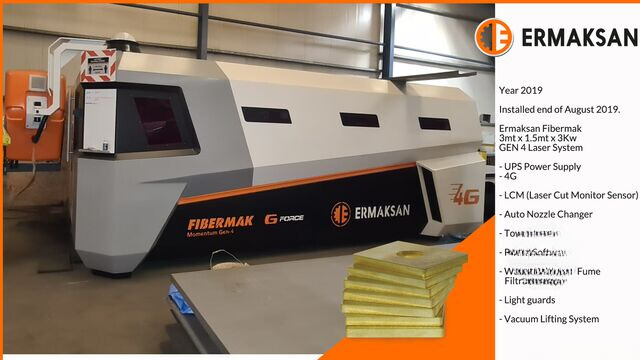
Avoid Costly Mistakes: Professional Tips for Purchasing a Pre-Owned, Surplus, Second-Hand, Used ERMAKSAN FIBERMAK MOMENTUM GEN-4 CNC Fiber Laser Machine made in Türkiye
This guide is written for industrial buyers, sheet-metal manufacturers, job shops, and investors who want to minimize risk and avoid hidden costs when purchasing a used ERMAKSAN FIBERMAK MOMENTUM GEN-4 CNC Fiber Laser Cutting Machine manufactured by ERMAKSAN.
1. Understand the Machine You Are Buying
The FIBERMAK MOMENTUM GEN-4 is a modern CNC fiber laser cutting system designed for high-speed, high-precision sheet metal processing. Depending on configuration and year, the machine may include:
- High-power fiber laser source
- CNC motion control system
- Precision linear guides and servo drives
- Automatic pallet changer (optional)
- Sheet support, extraction, and safety enclosure
Knowing the exact configuration is essential before evaluating condition and price.
2. Verify Machine Identity and Documentation
Always request and verify the following:
- Original purchase invoice or factory delivery documents
- User manual and electrical diagrams
- Service and maintenance history
- Laser source serial number and operating hours
- Software licenses and CNC backups
Lack of documentation often indicates poor maintenance, unauthorized repairs, or unclear ownership.
3. Inspect the Laser Source Carefully
The laser source is the most valuable component of the machine.
Key points to verify:
- Laser brand and model
- Total cutting hours (not just power-on hours)
- History of optical alignment and servicing
- Cooling system condition
A laser source with high cutting hours and no documented service history significantly increases future replacement risk.
4. Evaluate CNC Control System and Software
Check the following:
- CNC controller brand, version, and language support
- Operator panel functionality
- CAD/CAM compatibility
- Availability of software updates
Older or unsupported control software can create workflow limitations and unexpected upgrade costs.
5. Mechanical System Inspection
Inspect all motion components in detail:
- Linear guides and rails for scoring or wear
- Ball screws for backlash
- Servo motors and drives for noise or vibration
- Machine frame for cracks or deformation
Run the machine at different speeds to detect mechanical instability.
6. Electrical Cabinet and Safety Systems
Electrical inspection should include:
- Clean wiring and labeled components
- Original electrical parts (no improvised modifications)
- Functional emergency stop system
- Laser safety enclosure, interlocks, and grounding
Electrical and safety problems are common hidden expenses in used fiber lasers.
7. Analyze Real Usage Conditions
Ask detailed usage questions:
- Typical material thickness processed
- Continuous production or low-volume usage
- Shift pattern (single shift vs 24/7 operation)
Machines used in heavy production environments usually experience accelerated wear.
8. Perform Live Cutting Tests
Never purchase without a live demonstration.
During testing:
- Cut materials and thicknesses similar to your production
- Check cut quality, kerf consistency, and edge finish
- Observe cutting head movement and autofocus behavior
- Monitor cooling and exhaust performance
Live cutting tests reveal optical, alignment, and control issues that visual inspection cannot.
9. Inspect Optics and Beam Delivery Path
Check:
- Protective lenses and cutting head condition
- Evidence of thermal damage or contamination
- Correct optical alignment
Optical components are consumables, but neglected optics can indicate improper operation and reduced laser life.
10. Review Auxiliary Equipment and Accessories
Confirm what is included in the sale:
- Pallet changer
- Dust extraction and filtration system
- Chiller unit
- Spare lenses and consumables
Missing or incompatible auxiliary systems often represent significant additional cost.
11. Benchmark Price and Ownership Cost
When evaluating price, consider:
- Machine year and generation
- Laser power and brand
- Total cutting hours
- Included accessories
In used fiber lasers, the laser source and control system account for most of the machine’s real value.
12. Negotiation Strategy
Use these factors to negotiate:
- High laser operating hours
- Missing service records
- Aged optics or wear parts
- Required software updates
Every undocumented risk should directly reduce the purchase price.
13. Professional Pre-Purchase Inspection
If possible, hire a certified laser technician for an independent inspection. A short professional inspection can prevent major post-purchase expenses.
14. Transport, Installation, and Commissioning Planning
Fiber laser machines require specialized handling:
- Optics and cutting head must be protected
- Laser source handling requires expertise
- Re-alignment and calibration after installation are essential
Relocation and commissioning costs may reach 10–20% of the purchase price.
15. Purchase Agreement and Risk Protection
Your contract should clearly state:
- Machine condition at time of sale
- Responsibility for transport damage
- Included accessories and spare parts
- Return or compensation terms for misrepresentation
16. Red Flags That Justify Walking Away
- No service or maintenance records
- Unverified laser source brand
- Excessive cutting hours with no overhaul
- Missing software licenses
- Poor cut quality during testing
These issues often lead to long-term operational losses.
This section provides technical machine details only, written for industrial buyers evaluating a used / surplus / second-hand ERMAKSAN FIBERMAK MOMENTUM GEN-4 CNC Fiber Laser Cutting Machine manufactured by ERMAKSAN.
1. Machine Classification
- Machine Type: CNC 2D Fiber Laser Cutting Machine
- Manufacturer: ERMAKSAN
- Series: FIBERMAK MOMENTUM
- Generation: GEN-4
- Country of Origin: Türkiye
- Application Area: Industrial sheet metal cutting
- Typical Industries: Sheet metal fabrication, automotive, machinery manufacturing, contract cutting services
2. Laser Source – Technical Specifications
- Laser Type: Solid-state fiber laser resonator
- Laser Wavelength: Approximately 1,070 nm
- Laser Power Options:
- Common configurations: 2 kW, 3 kW, 4 kW, 6 kW
- Higher configurations available depending on build year
- Laser Brands (depending on order):
- IPG Photonics
- Raycus
- nLIGHT
- Cooling System: External industrial water chiller
- Beam Delivery: Fiber optic cable
Laser source condition, cutting hours, and maintenance history directly determine the residual value of the machine.
3. Working Area and Table Configuration
Typical GEN-4 configurations include:
- X-Axis Travel:
- 3,000 mm
- 4,000 mm
- 6,000 mm
- Extended versions up to 12,000 mm and above
- Y-Axis Travel:
- 1,500 mm
- 2,000 mm
- 2,500 mm
- Z-Axis (Focus Travel): Approx. 150 mm
- Table Type:
- Single fixed table
- Automatic shuttle table (dual pallet)
- Max Sheet Size (typical):
- 3000 × 1500 mm
- 4000 × 2000 mm
- 6000 × 2000 mm
4. Motion System and Mechanical Structure
- Controlled Axes: X / Y / Z
- Drive System: AC servo motors
- Guide System: Precision linear guideways
- Transmission: Rack & pinion (X/Y), ball screw (Z)
- Maximum Cutting Speed: Up to approx. 100,000 mm/min
- Acceleration: Up to approx. 2.5G – 4G (configuration dependent)
- Positioning Accuracy: ±0.05 mm
- Repeatability: ±0.03 mm
Machine rigidity and motion stability are critical for cut quality and long-term accuracy.
5. CNC Control System
- Control Type: PC-based CNC control
- Controller Platform: Industrial CNC system (commonly Beckhoff-based in later builds)
- Operator Interface: Touch screen HMI
- Programming: G-code and integrated CAD/CAM
- Software Compatibility: Lantek, Metalix or equivalent (license dependent)
- Network Capability: Ethernet / USB / optional Industry 4.0 connectivity
Always confirm software licenses and backups when purchasing a used machine.
6. Cutting Head and Optics
- Cutting Head Type: Autofocus fiber laser cutting head
- Focus Adjustment: Automatic
- Collision Protection: Yes
- Optical Components:
- Protective lens
- Nozzle system
- Assist Gas Support:
- Oxygen (O₂)
- Nitrogen (N₂)
- Compressed air
Optical wear is expected, but damage or contamination may indicate improper operation.
7. Material Cutting Capacity (Typical)
Cutting capacity depends on laser power and gas selection.
Approximate industrial reference values:
- Mild Steel: up to 20–25 mm
- Stainless Steel: up to 15–20 mm
- Aluminum: up to 12–15 mm
Higher thickness capability requires higher laser power and optimized optics.
8. Electrical System and Safety
- Electrical Cabinet: Industrial grade, air-conditioned
- Power Supply: 380–400 V / 50 Hz (region dependent)
- Safety Features:
- Full laser safety enclosure
- Emergency stop system
- Interlock doors
- Protective laser shielding
- Compliance: CE compliant (original factory configuration)
9. Auxiliary Systems (Optional Equipment)
Depending on configuration, the machine may include:
- Automatic sheet loading system
- Automatic unloading system
- Dust extraction and filtration unit
- Slag and scrap removal system
- Gas control panel
- Height sensing system
Missing auxiliary systems should be considered in total investment cost.
10. Technical Summary Table
| Parameter | Typical Specification |
|---|---|
| Laser Power | 2–6 kW (higher optional) |
| X Axis | 3,000–12,000 mm |
| Y Axis | 1,500–2,500 mm |
| Z Axis | ~150 mm |
| Max Speed | ~100,000 mm/min |
| Acceleration | Up to ~4G |
| Accuracy | ±0.05 mm |
| Repeatability | ±0.03 mm |
| Control | CNC PC-based |
Technical Note
When evaluating a used ERMAKSAN FIBERMAK MOMENTUM GEN-4, the laser source condition, motion system wear, CNC software licensing, and optics status are the most critical technical factors affecting reliability and value.
Final Summary
A used ERMAKSAN FIBERMAK MOMENTUM GEN-4 CNC Fiber Laser Machine can be an excellent investment when properly inspected. The most critical factors are laser source condition, documentation, mechanical integrity, and realistic total ownership cost.