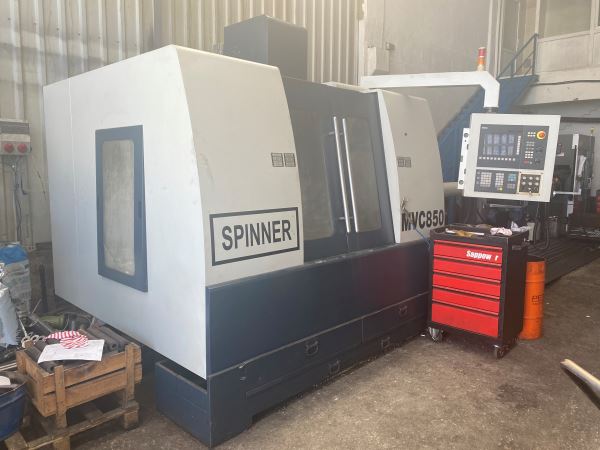
Avoid Costly Mistakes: Professional Tips for Purchasing a Pre-Owned / Second-Hand / used SPINNER MVC850 CNC Vertical Machining Center
Here are professional, experience-based tips and checks to help you avoid expensive mistakes when buying a pre-owned SPINNER MVC850 (or similar Spinner vertical machining center). Because Spinner machines tend to be well made, many used units survive well—but only if you vet carefully.
I’ll break this down into:
- What the “normal spec envelope” is (to spot exaggeration)
- What you must inspect / test on site
- Hidden costs / common failure points
- Deal structuring & negotiation tips
- Red flags that suggest walk-away
1. Know the Baseline “Normal Spec Envelope”
Before you go to inspect, get a feel for reasonable specs. Here are published data for the Spinner MVC 850 (very similar variant) which give you guardrails:
| Parameter | Typical Value |
|---|---|
| X travel | 850 mm |
| Y travel | 510 mm |
| Z travel | 510 mm |
| Table size / work surface | ~ 1000 × 510 mm |
| Max workpiece load (on table) | ~ 700 kg |
| Spindle taper / holder | SK-40 |
| Max spindle speed | 8,000 rpm |
| Tool magazine capacity | 24 tools in many listings |
| Rapid traverse (X/Y/Z) | 18 / 18 / 15 m/min |
| Total power demand | ~ 30 kW |
| Compressed air need | ~ 6 bar |
| Machine footprint / weight | ~ 6,000 kg mass |
Use these as reference lines. If the seller claims far more (e.g. 12,000 rpm without retrofit, or 40,000 kg machine mass, or 400 tool capacity) you should demand proof, test it, and treat claims with strong skepticism.
Also note: Spinner also offers “VC850” models (VC = vertical machining) with different features (e.g. higher rpm, variant tool chucks). Ensure the unit you’re inspecting is indeed the MVC850 (or known variant) and not misrepresented.
2. On-Site Inspection & Testing (What You Must Do)
Here’s a structured approach to checks and tests when you inspect a Spinner MVC850 (or similar):
A. Documentation & History (before doing anything else)
- Get service / maintenance records, parts replaced, spindle rebuilds, etc.
- Ask for historical hours / runtime, tool change counts, usage pattern (light, heavy, continuous).
- Request backups, parameter files, control configuration files.
- Get schematics, wiring diagrams, parts catalogs (Spinner OEM documents) if possible.
- Learn whether any retrofits / upgrades have been done (spindle, control, tooling, guards).
- Ask what tooling / fixtures / chucks / spares come with the machine.
If there is no credible documentation, you should discount heavily or walk away.
B. Visual / Structural Inspection (before powering up)
- Inspect the column, base, frame castings for cracks, welds, distortions.
- Check way covers, bellows, guards for damage or missing parts. Damaged covers often correlate to way / slide wear.
- Look for rust, pitting, corrosion especially in slide surfaces, dovetails, joints.
- Inspect spindle hood / head area for coolant or oil leakage stains.
- Examine the tool magazine, tool arm, pockets for wear, misalignment, chipped pockets.
- Observe the control cabinet, wiring trays, cable ducts — look for corrosion, water ingress, burnt wiring, discoloration.
- Check that panels, guards, fasteners are all intact and properly secured.
C. Power On & Basic Checks (without heavy cutting)
Once you are allowed to power up and run the machine (ideally with seller’s cooperation):
- Boot the control and watch for any alarm, fault messages, or missing modules.
- Check that all panels, screens, buttons, emergency stop, indicators, and safety interlocks work.
- Jog all axes (X, Y, Z) through their full travel, in both directions, at slow and moderate speeds. Feel for binding, uneven motion, dead spots, stiffness changes.
- Use a dial indicator (or test indicator) to measure backlash in X, Y, Z axes by reversing direction. Excessive backlash = worn screw nuts, damaged guides.
- Monitor noise during motion — listen for “scraping,” “rubbing,” or “metallic contact.”
- Shift speeds / feeds modes (if the machine has multiple traverse / feed ranges) to see if transitions are smooth.
- Test tool magazine / ATC arm: cycle through all tool changes. Every pick / drop should be consistent, positive, without hesitation.
- Run the spindle (no cutting), through its speed ranges, and listen carefully for smoothness, bearing hum, vibration.
- Mount a test bar or mandrel and measure runout (radial and axial) while rotating through 360°.
- If the machine has auxiliary systems (coolant, chip conveyor, flood wash, high-pressure coolant, blower, etc.), test them: turn them on, watch flow, leaks, noises.
D. Precision & Test Cut Checks
These are essential to see whether the machine still meets usable tolerances.
- Use a known reference bar / ground master and mount it in the spindle. Run through the length, use dial indicators to check straightness, taper, runout at multiple positions along its length.
- Retract and return to the same position; test repeatability (are you returning to the same reading).
- Perform at least a light finishing cut (say 0.1 mm or less, depending on material) on a sample workpiece. Measure the finished part’s diameter, surface finish, straightness.
- Do test cuts at multiple zones: near the center of travel and near the ends to see if there is degradation near limits.
- Test whether heavy tool loads / heavier cuts cause vibration or instability beyond acceptable levels.
- After running for 20-30 minutes, check for thermal drift (measure if dimensions shift due to heating).
3. Hidden Costs & Common Failure Points (Plan Upfront)
Even a machine that looks “good” may hide wear or need refurbishment. Budget and anticipate these:
- Spindle bearing wear / re-building the spindle (a big cost)
- Worn ball screws / screw nuts, especially if backlash is observed
- Slideway / guide wear, scraping or reconditioning
- Tool magazine / ATC arm wear or cam / gear wear
- Control / PLC / electronics going obsolete or failing
- Cable harness issues, connector corrosion, aging insulation
- Cooling / hydraulic / pneumatic systems needing overhaul
- Chip conveyor, guards, coolant filtrations needing rebuilding
- Calibration, alignment, fine tuning after transport
- Transport, rigging, leveling, foundation works
- Downtime during repair / commissioning
- Spare part availability (some Spinner model parts may be rare)
It’s prudent to allocate a “refurbish reserve” (e.g. 10-20% of the machine’s price) for unseen repairs.
4. Negotiation & Deal Structuring Tips
Use your inspection leverage to protect your purchase:
- Insist on a test / acceptance period during which you run full motions, test cuts, etc. before making full final payment.
- Retain a portion of payment until all acceptance criteria are satisfied.
- Require the seller to provide all documentation (manuals, wiring diagrams, parameter backups, parts lists).
- Ask seller to disclose known defects or wear issues in writing (so you’re not surprised later).
- If possible, request a short-term warranty (30–90 days) on critical systems (spindle, drives, ATC).
- Specify who is responsible for transportation, rigging, leveling, site preparation, installation.
- Request spare parts, tooling, collets, fixtures, spare batteries or control modules to be bundled.
- Ask seller to assist with initial alignment, calibration, test cuts at your site if possible.
5. Red Flags & Walk-Away Criteria
These are warning signs that the machine may cost far more than it’s worth:
- Seller refuses full access, limits motion testing, or restricts inspection time
- Excessive backlash or binding in any axis
- Spindle noise, vibration, or unacceptable runout
- Tool change failures, misindexing, hesitation in ATC arm
- Control / PLC faults, missing modules, corrupted parameter files
- Electrical enclosure with burn marks, water damage, corrosion, missing wiring
- Missing or severely damaged way covers, guards (leading to internal contamination)
- Structural damage: cracked castings, distortion, poor repairs
- Major components missing (drive amplifiers, control boards, tool changer parts)
- Parts for this specific Spinner model are unobtainable or obsolete
If you see multiple red flags, demands for heavy discount or better yet, walk away.