Avoid Costly Mistakes: Professional Tips for Purchasing a Pre-Owned / Second-Hand / used Haco TS 3006 CNC Shears?
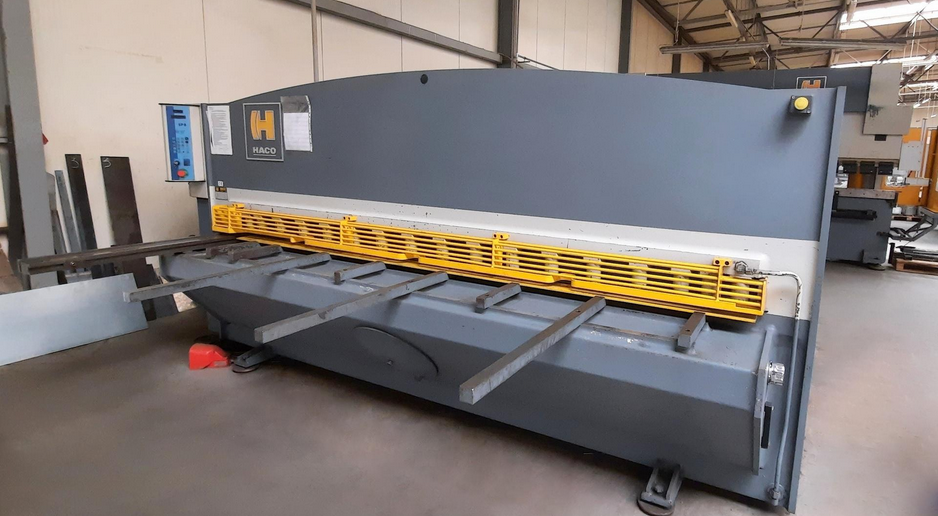
Buying a used Haco TS-3006 hydraulic / CNC guillotine / shearing machine can be a great investment, but there are many potential pitfalls. This type of machine has mechanical, hydraulic, control-system, safety, and consumables issues that often only show up after purchase. Below is a detailed guide with what to inspect, what to test, typical problem areas & red flags, and what to budget for.
What to Know First — Specs & Expectations
Before you inspect, get clear on what the TS-3006 should deliver so you can spot deviations. Based on multiple sources:
| Parameter | Typical/Published Value for TS-3006 |
|---|---|
| Maximum Sheet Width / Cutting Length | ~ 3,100 mm (≈ 10 ft) |
| Maximum Sheet Thickness (Mild Steel / S355) | ~ 6 mm |
| Cutting Angle (Rake) | Adjustable from ~ 0.5° up to ~ 3° |
| Hold-downs / Number of Clamps | ~ 18 hold-down clamps on cutting beam |
| Strokes per Minute | ~ 8-14 strokes/min depending on angle / thickness |
| Backgauge Travel | Motorised backgauge, ~ 750-1000 mm typical. |
| Blade Gap / Clearance & Angle Adjustability | Blade gap adjustable (manual or hydraulic depending on model/option); rake (cutting angle) is adjustable (electro-hydraulic) |
| Hydraulic System | Dual pull-down cylinders; motor-pump group; manifold block; possibly oil tank, hoses, reliefs etc. |
What to Inspect / Test On-Site
Here are what I’d absolutely check, with tests & observations. Bring measuring tools, sample sheets, maybe even a checklist.
| Area | What to Inspect / What Test to Run | Why It Matters / What Can Go Wrong |
|---|---|---|
| Blade Condition & Alignment | * Inspect upper & lower blades: any nicks, wear, crown damage, unevenness. * Check blade sharpness & edge quality. * Measure blade alignment (are blades parallel across full width?) * Check clearance (“blade gap”) setting: should be adjustable, consistent, correct for different materials. * For multi-edged blades, check all edges (if rotating) for uniform condition. | A dull or misaligned blade causes burrs, ragged edges, poor cut, greater force required, damaging other components. Blade gap out of spec causes tearing or deformation. Replacing/sharpening blades can be expensive. |
| Cutting Angle / Rake Adjustment | * Check rake (angle) adjustment: does the mechanism work smoothly? Is the rake adjustable from minimum to maximum? * Test that the SP8 / SP control (or whatever controller) reflects the set angle and responds to changes. * Check cutting at different angles and thicknesses to see if angle setting gives expected quality (less deformation). | The rake angle helps avoid defects like twist, bow, or rolled edges. If the angle mechanism is jammed, worn, or misaligned, cuts in thicker or thin material may be poor. |
| Hold-downs / Sheet Clamping | * Inspect hold-down clamps: number, spacing, condition (are they flat, not worn, clean, moving correctly). * Check the pressure & adjustment of hold-downs: do they lift/retract cleanly? Is pressure even? * For small sheets: hold-downs need to clamp well to prevent lifting/vibration. * Check fingers / guards between hold-downs for safety. | Poor hold-down leads to vibration, warping, slipping during cut, imprecise cuts. Uneven or low pressure causes edges to deform. Guarding is safety-critical. |
| Hydraulic System | * Check for oil leaks: hoses, fittings, cylinders, at pump unit, at pull-down cylinders. * Inspect the condition of hydraulic oil: cleanliness, smell, presence of sludge or water. * Check pump motor operation: is the pump functioning smoothly, not noisy, overheating? * Test actuator speed and consistency in cuts: if speed falters, system may be weak or leaking. * Pressure relief valves working, safety functions intact. | Hydraulic failures are among the costliest repairs. Leaks or worn cylinders reduce clamping or cutting force. Dirty oil damages pumps, valves. A weak hydraulic system leads to slower or inconsistent cuts. |
| Backgauge & Controller / CNC / Electronic Control | * Check backgauge (motorised if equipped): travel, responsiveness, repeatability, whether it’s driven generously with guides. * Activate CNC/NC / controller (SP8, SP9, or whatever is fitted): check that readouts (angle, backgauge position, stroke counter, etc.) look correct. * Check electrical panels: wiring, connectors, whether display is clean, buttons working, screens lit. * Test control for modes: manual, automatic, presets if existing. * Check if the control remembers settings; no parameter loss; presence of manuals / wiring diagrams. | A mis-behaving backgauge makes repeat jobs hard. Control electronics are frequent failure points; if the display or buttons fail, operation is hampered. Obsolete or unsupported controls increase risk. |
| Frame / Structural Integrity | * Inspect the shear frame for warping, cracks, weld repairs. * Check alignment and squareness of frame; beams should be straight; sides parallel. * Inspect the cutting bed / table support for sagging or deformations. * Check base mounting / leveling; see whether floor is flat, machine mounted stably. | Any structural distortion compromises cutting accuracy over width / length. Warped frame or sagging table leads to uneven cuts, twist, distortion. Poor foundation increases wear and may amplify vibration. |
| Stroke / Ram Motion & Mechanical Components | * Observe the ram (upper blade holder) motion: smooth, without binding; does it have backlash or wobble? * Inspect guide rails, ways for wear or scoring. * Check mechanical linkages: shafts, bearings, pivots. * Test full stroke cycles at different angles / gaps to see if motion remains consistent. | Wear in the ram or guides causes chop marks, inconsistent cuts, wobble, vibration, reduced life of components. Poor motion increases stress on blades and frame. |
| Safety Features & Guards | * Check presence & condition of safety guards: finger protection, light barriers if applicable. * Check emergency stop buttons, safety interlocks. * Check operator access: are controls usable without hazard. * Check if there are protective covers for moving parts, hydraulic fittings, cylinders. | Safety isn’t negotiable: poor or missing guards risk accidents; non-compliance can lead to regulatory issues. Also, lack of safety features often indicates neglect. |
| Cut Quality / Test Cuts | * Perform test cuts on sheet materials of varying thicknesses (especially at the max rating and commonly used thickness). * Examine edge quality: burrs, deformation, twisted or bowed parts. * Check consistency across width: do cuts at left, middle, right of width look similar? * Try long cuts, shorter cuts; monitor machine behavior as parts move through backgauge or hold-downs. * Warm up machine and then test again to see whether thermal effects or oil temperature affect performance. | Cuts often look decent cold, but rough or wavy after warm-up. Blade wear, misalignment or hydraulic issues often show up under load or over repeated operations. Poor edge quality costs in finishing downstream. |
| Maintenance History & Parts / Consumables | * Ask about past use & maintenance: how heavily used; hours of operation; whether blades have been replaced or rotated; whether hydraulic oil changed; maintenance logs of cylinders, pumps, gauges. * Check availability of spare blades, hydraulic components, control electronics (SP8, SP9 controllers), backgauge parts locally. * See whether operator manuals or parts diagrams are present. * Ask if past repairs or modifications (upgrades / changed parts) have been done. | Knowing prior maintenance helps predict future issues. If parts or consumables are rare or expensive, ownership cost increases. Absence of documentation increases downtime when something fails. |
| Electrical & Power / Infrastructure | * Confirm voltage, phase, power draw required; whether your shop can support the machine. * Check wiring quality, condition of electrical cabinets, connectors. * Check control / relay modules: any overheating signs, burnt smell. * Ensure lighting / illumination of cut line works. * Check that grid / table supports (slide in front and rear if any) are intact to support material. * Check floor capacity & space for machine movement, front and rear access. | Underpowered supply or unstable voltage causes failures or poor performance. Electrical issues cause unplanned downtime. Inadequate support for sheet metal handling slows work or causes safety issues. |
Typical Problem Areas & Defects in Shears / What to Look For
These are common defects or weak spots that show up often in used shears, including Haco TS series:
- Blade wear / dullness / nicks → results in burrs, rough edges, or require reworking.
- Blade misalignment / uneven overlap → cut quality suffers; edges are twisted or uneven; causes excess wear on one side.
- Incorrect blade gap or failure of adjustment mechanism → deformation, tearing instead of clean cut.
- Hydraulic leaks / worn seals in cylinders or hoses → reduced pressure, weaker cut, slower cycles, variable performance.
- Backgauge inaccuracy or drift → parts out of tolerance, mis-cuts, waste.
- Worn or damaged hold-downs (pads, feet, tilting feet etc.) → sheet slipping, vibration, warping during cut.
- Worn guides / rails for ram or backgauge → binding, nonuniform stroke, misalignment.
- Frame sag / mis-leveled base → poor cut over length, difference in cut height or edge quality from left to right.
- Control panel / sensor issues (display or feedback errors, angle or gap readouts wrong ) → inconsistency, risk of operator error.
- Safety guard / interlock failure or missing → hazard risk; regulators may require certain features.
- Power / hydraulic pump fatigue or noisy operation → indicates wear; may fail under load.
- Material handling / support arms or table supports weak or missing → heavy sheets may overhang, distort, or damage machine.
Red Flags — When to Walk Away or Severely Negotiate
If you find any of these, either demand a big price reduction or avoid unless seller is willing to fix:
- Blade edges are badly chipped or worn, and sharpening / replacement cost is high.
- Blade alignment so bad that cuts drift or one side is clearly different quality than the other.
- Hydraulic cylinder leaks, or pump noise/vibration – where hydraulic pressure or motion is inconsistent.
- Backgauge drift / inaccurate or inconsistent, or poor motion in gauge.
- Ram or guide wear: ram motion has play, binding, or visible damage.
- Manufacturing of frame welds done poorly or having cracks; any sagging or warping of table or frame.
- Control / electronics have dead or failing panels; sensor or button malfunctions; display issues.
- Safety features compromised: missing guards, broken covers, missing interlocks.
- Machine operates but test cuts show serious deformation, twist, bow, or burrs even after adjusting.
- Difficult or expensive parts / consumables (blades, hold-downs) might be hard to source locally.
Negotiation & What Hidden Costs / Upgrades to Budget For
Even with a good machine, expect to invest a bit to get it working well in your shop. Here are cost items to build into your offer / budget:
- Replacement or sharpening of blades; possibly chilling or proper machining of blade edges to meet your material specs.
- Repair or replacement of hydraulic seals, hoses, possibly cylinders if worn or leaking.
- Backgauge recalibration or servo motor replacement if motorised gauge is included.
- Adjustment / replacement of wear components like hold-down pads, guide rails, pivot points.
- Possible structural alignment / leveling of the machine, especially if floor or base is bad.
- Control / electronics spares: display, control panel, sensor modules.
- Safety upgrades if required: better guards, light curtains, emergency stops, interlocks.
- Cleaning / preventive maintenance: oil & filter replacement, hydraulic oil refresh, lubrication of ways.
- Transport / rigging / installation costs: TS-3006 is large and heavy (capacity and physical size), moving it may require crane, rigging, etc.
- Power supply considerations: ensure your workshop supports the voltage/phase; may need electrical upgrade.
- Operator training & initial setup: test cuts, setting blade gaps, adjusting angle, perhaps some scrap during setup.