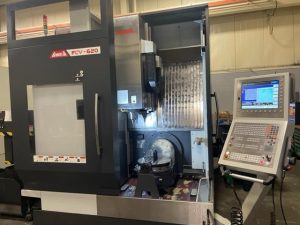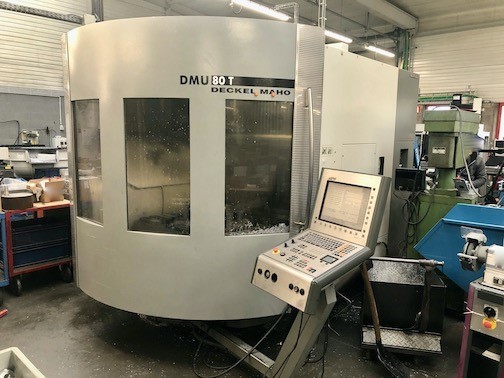
Avoid Costly Mistakes: Professional Tips for Purchasing a Pre-Owned / Second-Hand / used DMG DECKEL MAHO DMU 80 T
When evaluating a used / second-hand DMG / Deckel Maho DMU 80 T (or similar 5-axis / tilting‐head machining center), there are many “hidden” risk factors that can turn a bargain into a money pit. Below is a professional-grade guide: what to check, red flags, and negotiation safeguards. You should ideally bring along a trusted machinist / service engineer who knows DMG / Deckel machines.
Baseline Specs & Reference Values (What Should Be True)
Before inspection, acquire the original spec sheet or a trusted datasheet. Some example specs of DMU 80 T machines:
- From a 2004 listing: X / Y / Z travels ~ 34.6″ × 24.8″ × 24.8″ (≈ 880 × 630 × 630 mm)
- Spindle speed: 12,000 rpm (in that example)
- Spindle motor: ~ 20 HP in that same example
- Tool changer: e.g. 32 ATC in that listing
- Tilt / swivel head / B-axis capability (on “T” variant)
- Rapid traverse / feed rates expected (e.g. > 20–30 m/min in linear axes)
- Use of direct measuring systems / linear scales or glass scales (on more premium builds)
- Machine weight / footprint: heavy and large; structural rigidity
These “fingerprint” numbers should guide your evaluation: if a candidate machine is far off in travel, spindle spec, or lacks crucial axes, dig into why.
Inspection & Evaluation Checklist
Below is a structured roadmap from documentation through testing to negotiation.
1. Documentation & History
- Service / maintenance records: Request all logs of calibration, spindle rebuilds, axis repairs, lubrication, way maintenance, head rebuilds, etc.
- Original manuals, electrical wiring / circuit diagrams, mechanical drawings: These help immensely during repair or maintenance.
- Machine parameter backups, control backups, program libraries: You must get the control files, backup of CNC parameters, custom macros, offsets, etc.
- Modifications / retrofits: Ask what has been changed—spindle rebuild, head swap, control upgrades, drive changes. Ensure modifications were done by competent personnel with records.
- Usage duty / hours under load: Not just “on hours,” but how intensively it was used (heavy cuts, long continuous operation, high spindle loads).
- Parts / spare availability: Some models or components (tilting heads, B-axis parts, direct measuring scales) may be hard to source. Check whether spares are still available for your region.
- Guarantees / warranties / spares inclusion: If possible, include in the deal fresh spares or limited warranty on major components (e.g. spindle, B-axis, direct scales).
2. Visual & Mechanical (Power Off) Inspection
These checks often reveal wear, neglect, or damage.
- Overall cleanliness and signs of abuse: Excessive corrosion, coolant deposits, chips inside casing, coolant leaks, rust in critical areas are red flags.
- Machine base, column, casting integrity: Look for cracks, repairs, weld marks, distortion or previous damage.
- Guideways, linear rails, slide surfaces: Remove way covers / guard boots if possible and inspect along full travel lengths for wear, scoring, pitting.
- Ballscrews, lead screws, nut assemblies: Check for backlash, looseness, wear grooves, inconsistent friction.
- Tilt / swivel head (B axis) & its bearings / drives: Check for play, unusual stiffness, binding, backlash in the B axis motion.
- Spindle taper, nose, drawbar, tool interface: Inspect for damage or discoloration, check for wear or misfit.
- Encoders, scales, glass scales, direct measuring systems: These are delicate. Examine for scratches, chips, contamination, misalignment.
- Way covers, bellows, wipers, seals: These protect critical axes; if these are damaged or missing, internal contamination is likely.
- Coolant / lubrication systems: Inspect tanks, filters, lines, pumps for sludge, leaks, contamination, corrosion.
- Tool changer mechanism, magazine, grippers: Manually inspect for looseness, alignment, binding, damage.
- Electrical cabinet, wiring, connectors, drive modules: Open panels and look for burnt wires, poor wiring practices, ad hoc splices, cleanliness, dust accumulation.
- Motors / servo amplifiers / drives: Check whether these modules are original or replaced; missing or suspect modules are risk points.
- Limit / home switches, sensors, wiring harness: Check for broken sensors, missing covers, loose or brittle wiring.
3. Power-Up & Basic Functional Tests
Proceed with caution. Always have a person familiar with machine safety and the particular brand.
- Controlled power-on & system health diagnostics: Look for alarms, error messages, fault logs, drives status.
- Homing / reference moves: Run the machine’s homing cycle for all axes; ensure it completes cleanly without alarms or inconsistencies.
- Axis jogging / motion test: Move each axis (X, Y, Z) at several speeds (slow to moderate) and feel/listen for smoothness, stiction, binding, jitter.
- Rapid traverse test: Move axes at full rapid speed across full travel to detect lag, hesitation, resonance, or lost steps.
- Backlash / reversal error test: Reverse small moves and check whether the machine returns accurately (either using internal diagnostics or external measuring devices).
- Combined / interpolated axes motion: Run diagonal or combined movement (e.g. X + Y), or head tilt with motion, to see if axes coordinate properly or any lag / axis synchronization issues.
- Tilt head (B axis) dynamic test: Rotate the B axis through its tilt range under motion; check for smoothness, backlash, rigidity, vibration.
- Spindle ramp-up / vibration test: Bring the spindle up to various speeds (low, mid, high) and listen / feel for vibration, bearing noise, temperature rise.
- Tool change cycles: Execute tool-change routines, check magazine pick/release, tool alignment, time to change, misgrips or collisions.
- Coolant / coolant-through-spindle (if equipped): Test coolant flow, pressure, leaks; test through-spindle coolant lines under various RPMs (if relevant).
- Warm-up / drift: Let the machine run or idle for ~30–60 minutes, then retest axes / return-to-zero to see if drift or creeping occurs over time.
4. Accuracy / Metrology / Performance Validation
This is the “make or break” phase—only if the machine holds tolerance should you proceed.
- Benchmark test part / job: If possible, run a known geometry program (holes, faces, features) and measure the part. This gives real-world performance data.
- Laser interferometry / straightness / pitch / yaw tests: If available, bring in a calibration instrument to measure linear axes error, straightness, squareness, pitch, yaw.
- Grid plate / lattice / artifact test: Use a known grid / artifact and compare measured to known to detect scale errors or axis nonlinearity.
- Back-to-back reversal / hysteresis test: Check positional repeatability under direction reversal.
- Thermal stability & drift: Over time and under continuing operation, monitor whether the machine shows drift in position, or shift in zero points.
- B axis / head indexing accuracy: For the tilt head, test whether the B axis returns to exact tilt positions repeatedly without shift.
- Repeatability / precision test: Use gauge blocks, precision probes, or double-measure specific reference features repeatedly to assess short-term repeatability.
5. Infrastructure & Compatibility Assessment
Even if the machine is perfect, lacking supporting infrastructure can cripple performance.
- Foundation / floor strength / vibration isolation: Ensure your shop floor can handle the machine’s weight and dynamic loads, and that vibration isolation (if required) is adequate.
- Power supply / voltage / phase / frequency match: Confirm the electrical feed, grounding, noise levels, and compatibility with the machine’s requirements.
- Cooling / chiller / HVAC / temperature control: Precision machines require stable ambient temperature. If your shop lacks climate control, performance may deteriorate.
- Compressed air, chip removal, filtration, lubricant systems: Verify that your facility has the necessary systems (air, coolant, chips, exhaust).
- Transport / rigging / access: Ensure you can physically move the machine into place (door widths, overhead crane, rigging clearance) without damaging delicate parts.
- Network / control / software environment: If the machine uses networked controls, DNC, specific CAM interfaces, check compatibility with your setup.
6. Negotiation, Contract & Safeguards
Your contract should protect you against latent defects and poor performance.
- Acceptance / performance testing clause: Insist on a period (e.g. 30–60 days after installation) during which you can run your own tests. If it fails, you must have recourse.
- Escrow / holdback: Hold back part of payment until after acceptance tests are passed.
- Spare parts / consumables inclusion: Negotiate that the seller provides a basic spares kit (e.g. spindle bearings, seals, drive modules) or warranties.
- Warranty / repair guarantee: Even for used machines, try to secure limited warranty on critical systems (spindle, B axis, scales) for a defined period.
- Transport & insurance responsibility: Clarify who bears risk during transport; insist on proper crating, shock-detection, insurance.
- Detailed acceptance test specification: In the purchase agreement, enumerate the tests you will run (positional test, drift test, benchmark part, B-axis repeatability, etc.) and acceptable tolerances relative to spec.
- “As-is / where-is” disclaimers: Be cautious with such clauses. Either remove them or narrow their scope so they don’t preclude your acceptance tests or corrections.
Key Red Flags & Warning Signals to Watch For
- Seller refuses live inspection or only offers photos/videos.
- Missing or incomplete documentation, programs, backup files, wiring diagrams.
- Deviations from expected spec (e.g. much lower travel, missing tilt axis, lower spindle rpm) without clear explanation.
- Excessive wear on guideways or drives visible under cover removal.
- Tilt head / B axis with noticeable play or rough motion.
- Spindle vibration, noise, or inconsistency during ramp-up.
- Backlash, drift, hysteresis in axes motion.
- Tool changer errors, misalignments, collisions in previous use.
- Encoders / scales scratched, damaged, or contaminated.
- Electrical cabinets showing signs of overheating, burned wires, poor wiring modifications.
- No allowance in contract for acceptance testing or recourse on defects.
- Obsolete or unsupported parts (especially for the tilt head or specialty modules).
- Environmental or foundation conditions of current machine placement that suggest it was in a harsh or unregulated shop (vibration, extremes of temperature, coolant contamination).