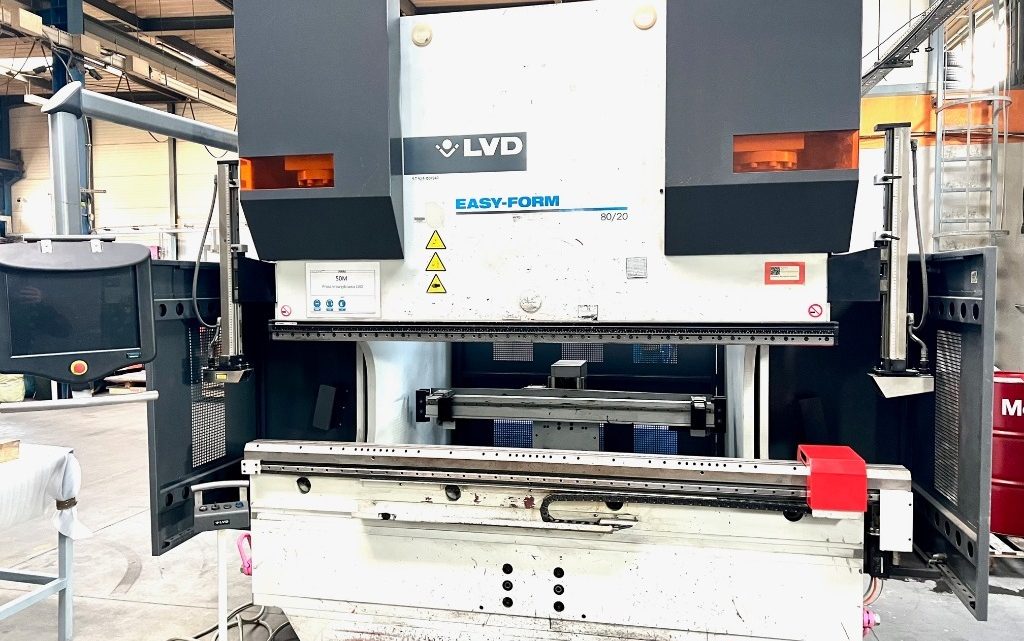
What Should I Pay Attention To When Buying a Second-Hand / used LVD Easy-Form 80/20 CNC Press Brake?
Here is a detailed guide: what to check, what to test, what questions to ask, and red flags, when considering buying a second-hand LVD Easy-Form 80/20 CNC Press Brake. Use this to assess condition, avoid hidden costs, and negotiate better.
What “LVD Easy-Form” Means / Key Features to Understand
Before inspecting, know what distinguishing features the Easy-Form line brings, so you know what should work, and what may have higher wear or failure risk:
- It uses adaptive bending technology: a laser / scanner system that monitors bend angle in real time and corrects for variation in material thickness, springback, etc.
- It has a CNC control which includes back-gauge axes, sometimes multiple axes (X, R, Z1/Z2 etc.), possibly crowning.
- Hydraulic ram / servo-controlled hydraulics; likely with good precision because of the adaptive / real-time feedback feature.
- High accuracy is expected: consistent bend angles from the first part, good repeatability.
Knowing these, you’ll specifically check components tied to those systems: hydraulic cylinders, angle monitoring / sensors, back gauge, control, etc.
What to Inspect / Test
Here are the main mechanical, hydraulic, control, tooling, safety, and performance areas to verify.
| Component / System | What to Check | Why It Matters / Common Problems |
|---|---|---|
| Frame, Bed, Ram (Structure) | • Check for any damage: cracks, welds, deformations. • Bed and ram surfaces must be flat and parallel. • Look for wear or scoring on ram face and bed. • Check alignment: when ram is down, punch meets die uniformly across length. • Visually inspect for signs of “crash” damage (i.e. punch hitting the bed, tooling misalignment). | Structural integrity is foundation of accuracy. If frame bent, weld-repaired, or uneven, bend angles will be inconsistent. Crash damage often misleads about tonnage usage. |
| Hydraulic System | • Inspect hydraulic cylinders: are they leaking? Are the cylinder rods straight and clean (no scoring)? • Check hoses, seals, fittings for leaks. • Check whether hydraulic pump can build correct pressure to spec; see if pressure holds during load. • Inspect hydraulic oil: cleanliness, level, signs of contamination (metal shavings, water, discoloration). • Check how the machine handles “holding” position under load – no drift, stable. | Hydraulic leaks reduce force and precision; worn seals allow internal leaks, reducing response. Dirty oil causes damage downstream. Stability of pressure is essential for repeatable bends. |
| Control & CNC System / Adaptive Bending / Angle Measurement | • Boot up control: check display, buttons, touch screen etc. Do all functions seem responsive? • Check the adaptive bending / angle sensor system (laser or scanner): does it respond when bending? Are sensors clean, aligned, functional? • Back gauge axes: do they move correctly, with accuracy in each axis (X, R, Z1 / Z2 etc.)? • Check software version; check for past errors or alarms related to control or sensor failures. • Homing, limit switches: are they precise, reliable? • CNC crowning if present: does it still function / can it be adjusted? | The adaptive bending is a major value feature. If lasers or sensors are damaged, misaligned, or obsolete, you lose that feature. Back gauge inaccuracies or control issues are costly for precision work. |
| Back Gauge / Gauge System | • Inspect mechanical condition of back gauge fingers / arms: straightness, no bending, play in joints. • Check all axes it has: is motion smooth? Are motors, drives, sensors accurate? • Gauge fingers: ensure they hold firmly, are not loose or misaligned. • Check that the back-gauge position repeatability is good. • Probe for any “lag” or delays when moving. | Poor back gauge accuracy causes errors in flange lengths, inconsistent bends especially when doing multiple bends. Worn or sloppy back gauge is a frequent weakening in used machines. |
| Tooling, Punch & Die Condition | • Check the tooling: punch (upper), die (lower) condition. Are edges sharp, undamaged, aligned? Any heat damage? • Check whether tooling is standard for your sheet materials. • Inspect whether tooling holders, quick change clamping (if applicable) are functioning and tight. • Check if tooling is included, or you’ll need to buy new dies/punches for your jobs. | Damaged or mismatched tooling degrades part quality and increases scrap. Replacing a large set of dies can be expensive. |
| Ram / Bed & Ram Movement | • Move ram up/down: check smoothness, consistency across full stroke. • Check for stick/slippage or “lag” under load. • Inspect ram guides / slide surfaces: wear, scoring, rust. • Check whether ram returns level (no tilt) and that punch enters dies squarely. | If ram is not moving smoothly or tilts, bend precision suffers. Long term wear in ram guides is costly. |
| Crowning / Flattening (if present) | • If the machine has crowning adjustment: test whether it can correct for bed sag or misalignment in longer bends. • Measure bends with and without crowning — does crowning improve consistency? • Check the mechanism for crowning (manual or automatic) for wear or damage. | Without crowning, you may find center of bend out of tolerance in long sheets. The adaptive systems may depend on crowning to achieve homogeneity. |
| Safety Features | • Emergency stop buttons: do they stop ram and all movement immediately. • Guards, light curtains, safety barriers: present and functional. • Presence sensors / safety interlocks. • Foot pedal / hand pedal / two-hand controls: condition and placement. • Any safety devices required by local regulation. | Safety is non-negotiable. Lack of safe interlocks or broken safety devices may force expensive retrofits or fail inspections. |
| Electrical, Wiring & Cabinet | • Inspect wiring: insulation condition, connectors, terminal boards. • Check electrical cabinet: Are components clean of dust / oil / coolant? Any corrosion or water damage? • Control circuits: check for overheating signs, burnt smells, soot. • Verify power supply matches your facility (voltage, phase etc.). • Cabinet cooling (fans, filters) if present: are they working / clean? | Faulty wiring or poor electrical condition causes downtime, possible safety hazard. Electric compatibility matters (else extra cost for transformer). |
| Hydraulic & Mechanical Speeds, Force / Capacity | • Test machine bending known thickness at its rated tonnage or close; see if force is enough. • Check if speed (ram descent, return, back gauge) is acceptable for your production. • Check if hydraulic pressure matches spec. • See if machine slows / leaks under heavy load or hot oil. | If force is degraded, machine may struggle on thicker material. Slow cycle times reduce throughput. Pressure drops or slippage under load hurt precision. |
| Wear, Maintenance History, & Usage | • Ask for operating hours or cycles; more importantly, number of bends and load history. • Maintenance records: hydraulic servicing, filter changes, sensor calibrations, ram guide maintenance. • How the machine was used: types of material, thicknesses, how often. Heavy/high stress jobs cause more wear. • Environment: cool, dry or humid / dusty / corrosive etc. • Whether machine was idle long periods or misused (e.g. punch mis-alignment, overloads). | Well-maintained machines cost far less later. Neglect or overuse leads to hidden damage. Environmental factors can accelerate wear. |
| Footprint / Foundation / Installation Conditions | • Check whether space is sufficient. • Floor load capacity and leveling: does machine sit level, or has it shifted / distorted? • Access for loading/unloading sheets, tooling. • Lighting, overhead clearance, back gauge travel clearances. • Utility requirements: hydraulic oil, power, compressed air (if used), cooling. | Even a good machine may perform poorly if improperly installed. Poor foundation or misalignment degrades precision. Utilities mismatch adds cost. |
| Consumables & Spare Parts | • What is included: dies, punches, tooling, spare sensors, pads etc. • How available are parts for Easy-Form (controllers, sensors, hydraulics) in your region. • Cost of consumables and how often replacement is needed. • Manuals, parts diagrams; support documentation. | Having to order everything from far away increases cost. Missing documentation slows maintenance and troubleshooting. Consumable wear is recurring cost. |
| Performance Tests & Sample Bends | • Do a sample bend job: several bends, thickness/material/flange length representative of the work you’ll do. • Measure angles, flange lengths, consistency across length. • Try both light & heavy bends; see if machine handles both well. • Check angle and dimension repeatability over a sequence. • See if machine warms up and behaviour changes (angle drift, slower movement etc.). | Real job test reveals what specs and visual inspection cannot. It shows how machine behaves under production conditions. |
Questions to Ask the Seller
To gather info that visual inspection might not reveal:
- How many hours or bending cycles has the machine done under load?
- What types / thicknesses of materials has it bent most of the time?
- Any crashes / collisions in punch or tooling? Were repairs done properly?
- Has the angle-sensor / laser in the adaptive system been recalibrated / serviced recently? Any calibration certificates?
- What is the condition of hydraulic oil / when was last changed; have filters been replaced regularly?
- Are there any known issues with hydraulics (leaks, sluggish ram, dropping under pressure)?
- What is the history of the control unit and back gauge maintenance / firmware / software updates?
- Is the tooling included? If so, what kind (type, condition)? Are there spare dies/punches?
- Safety devices: are all present, conforming to current local safety codes? Have safety features ever failed or been replaced?
- What is the condition of the ram guides, bed, crowning system? Has crowning been used / maintained?
- Will the seller allow you to run a full bend test (including thick/heavy material)?
- What support for parts / sensors / electronics is available locally?
Red Flags & What to Be Careful Of
These are issues that may increase your cost, reduce reliability or precision, or may mean you should negotiate heavily or walk away:
- Ram or bed with visible damage, gouged, warped surfaces.
- Hydraulic leaks that have been neglected; seals scored; rods scratched.
- Sensors / laser adaptive system non-functional, missing or misaligned. Replacing these might be expensive.
- Back gauge sloppy or inaccurate; fingers bent or worn.
- Control system old, outdated, possibly unsupported; replacement parts hard to get.
- Tooling absent, damaged, or incompatible with what you plan to use.
- Safety guards / interlocks missing, broken, or not compliant with current regulation.
- Machine that has sat idle for long periods without care (seals drying, rust, hydraulic oil degradation).
- Frame has been welded multiple times or shows signs of structural fatigue.
- Inconsistent bend results (angle variation across length); drift as machine warms up.