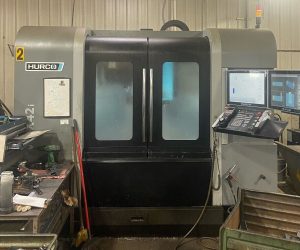
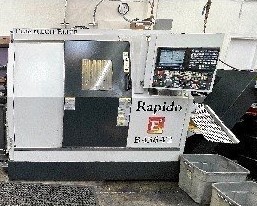
What Should I Pay Attention To When Buying a Second-Hand, Pre-Owned, Surplus, Used EMCO TURN 332 MC CNC Turning Center made in Austria?
A. Typical / Nominal Specifications — What to Expect / Benchmark
Before inspection, collect the spec sheet or what the seller claims, and compare with typical data. Some known specs / ranges for the EMCO 332 MC family:
| Parameter | Typical / reported values |
|---|---|
| Spindle speed | up to ~ 8,000 rpm (or 6,300 rpm in some versions) |
| Travel (X / Z) | ~ 160 mm × 510 mm |
| Turning length / work envelope | 480–580 mm typical in used listings |
| Maximum turning diameter | ~ 140 mm (over cross slide) |
| Turret / tooling | 12 stations, VDI 25 tooling common |
| Control | Siemens (e.g. 840D) is often used in listings |
| Dual spindle / counter spindle option | Some “MC” versions include second spindle / counter spindle |
Knowing these benchmarks helps you test whether the machine still performs close to spec or whether major parts are worn or underperforming.
B. Structural & Visual Inspection
Start with the exterior and structural condition — many issues originate or are signaled here.
- Frame, base, and casting integrity
– Look for cracks, repairs, welds, distortions, or evidence of prior collisions.
– Check mounting points, leveling pads, alignment surfaces. - Way covers, bellows, guards, shields
– Missing, torn, or degraded covers allow chips, coolant, and contaminants to reach sensitive surfaces.
– Inspect the bellows, wipers, and covers for smooth operation and sealing. - Corrosion / rust
– Especially in chip area, coolant sump, interior cavities, slides, tool tunnels.
– Even light rust on bearing or precision areas is a red flag. - Leaks, drips, stains
– Oil stains, coolant leaks, hydraulic fluid drips in and around the machine indicate potential seal, pump, or piping issues. - Doors, panels, access covers
– Check that doors and panels open smoothly, latch properly, are aligned. Bent or forced doors may indicate mishandling or internal damage. - Wiring, cable routes, conduits, cable trays
– Look for frayed wires, patched wiring, missing conduit, loose routing, or evidence of heat damage. - Retrofits / non-OEM modifications
– Note any added sensors, aftermarket modules, nonstandard attachments — these may complicate troubleshooting or part sourcing.
C. Mechanical & Motion Subsystems
These are among the most critical areas: wear here can degrade accuracy or require expensive refurbishment.
- Guideways / linear slides
– Jog axes manually (if possible) and feel for smoothness, binding, or “sticking” zones.
– Use a dial indicator to test for “steps” or unevenness over travel.
– Inspect surfaces visually for scoring, pitting, galling. - Ball screws / feed screws
– Check for backlash, axial play, binding, or rough movement.
– Listen for noise during movement.
– Check straightness / runout over travel. - Turret / tool changer / tooling interface
– Inspect turret indexing: does it index cleanly, firmly, with minimal lag or overshoot?
– Check locking mechanisms, sensors, plungers, tool holder fit.
– If there are driven tools (turn-mill function), test them for runout, vibration, and motor performance. - Spindle(s) & bearings
– Run the spindle(s) at various speeds and listen for abnormal noise, whining, roughness, or vibration.
– Use a test bar or dial indicator to measure radial and axial runout.
– After prolonged operation (say 10–15 min), check spindle housing temperature — overheating is a red flag.
– Inspect spindle taper(s) for wear, nicks, corrosion. - Counter spindle / dual spindle (if present)
– If the machine has a second spindle (common in “MC” dual versions), test its clamping, indexing, synchronization, and repeatability. - Cooling / lubrication / fluid systems
– Test coolant pumps, pressure, flow, hoses, nozzles, filters.
– Check lubrication systems (ways, screws, turret) for function, oil lines, distribution, and cleanliness.
– Inspect coolant tank: sludge, chips, contamination.
– Check chip conveyors, flushing, chip paths. - Tailstock / steady rest / support devices (if any)
– If included, test movement, locking, rigidity, and alignment.
D. Control, Electronics & Software
Even with perfect mechanics, a failing control or electronics system can ruin a purchase.
- Power-up / boot / diagnostics
– Let the machine boot; observe whether any modules are missing, diagnostic errors or alarms appear.
– Inspect the control operator panel: worn keys, display readability, response delays. - Axis referencing, homing, limit switch function
– Test the homing routines and limit switches in each axis.
– Jog axes at different speeds, including near limits, and listen/look for abnormal behavior. - Interpolation, program execution, tool cycles
– Run sample programs (simple and complex) to test sequences, tool changes, canned cycles, turning + milling (if applicable).
– Test feed / spindle synchronization, tool offsets, coordinate transforms. - Servo drives, motors, feedback / encoders
– Inspect drive cabinets: fans, heatsinks, wiring, connectors.
– Listen for hum, vibration, or unusual electrical noise.
– Monitor drive / motor temperatures under operation. - Software / firmware / parameter integrity
– Ask which CNC/firmware version is installed.
– Check for any custom modifications, patches, or nonstandard software additions.
– Verify ability to back up parameters, restore, transfer programs, and system health (I/O status, diagnostics). - Documentation / schematics / manuals
– Ensure the seller includes mechanical and electrical schematics, maintenance manuals, control manuals, parts lists.
– These are essential for future servicing or troubleshooting.
E. Usage History, Maintenance & Operating Hours
How the machine was used impacts its condition more than raw age.
- Ask for actual runtime hours / spindle hours (if recorded).
- Ask about workload profile: was it heavily loaded, in continuous operation, harsh materials, high speed cycles?
- Request maintenance logs: replaced parts (bearings, screws, turrets), rebuilds, alignments.
- Inquire about any collisions, crash events, overloads, or repairs.
- Ask about environment: coolant discipline, chip control, dust, neat vs flooded machining, coolant cleanliness.
F. Trial / Test Machining
Nothing substitutes for seeing the machine produce parts under load.
- Have the seller run a test piece (ideally close to your intended part, in relevant material).
- Observe noise, vibration, tool changes, spindle stability, chatter, error codes, etc.
- Measure the part: dimensional accuracy, concentricity, roundness, surface finish.
- Run longer cycles (e.g. 30 min to an hour) to watch for thermal drift, backlash creep, degradation over time.
- Vary feed, speed, tools to challenge the machine across its operational envelope.
- After testing, re-check backlash, alignment, and check whether performance changed during the run.
G. Spares, Consumables & Support Ecosystem
A used machine is only as good as your ability to maintain it going forward.
- Check availability of spare parts: spindles, bearings, screws, turrets, drive modules.
- Consumable parts: seals, wipers, tool holders, collets, coolant parts.
- Local service support: Are there technicians in your region familiar with EMCO machines or who can import parts?
- Upgrade / retrofit possibilities: If you want to add more capability (e.g. more driven tools, new control) — how feasible is that?
- Ensure you receive parts lists, exploded diagrams, and maintenance documentation.
H. Facility & Infrastructure Compatibility
Even a perfectly functioning machine needs suitable support in your shop.
- Power: Voltage, phase, current requirements, and whether your facility can support them.
- Compressed air, coolant, filtration: Adequate supply, hoses, filters, coolant system.
- Floor / foundation / leveling: The base must be rigid and properly leveled.
- Space, access, crane / rigging: Enough clearance to move the machine in/out, for servicing, etc.
- Safety / guarding / compliance: Check that guards, interlocks, safety covers meet your local regulation standards.
I. Pricing, Risk Assessment & Negotiation
Use your findings to negotiate:
- Estimate costs for any repairs (spindle overhaul, turret rebuild, guide refurbishment).
- Demand some inspection period or “acceptance after test run” clause.
- Ask the seller to include tooling, collets, spare parts, documentation.
- If possible, bring a trusted technician or inspection expert with you.
- Include transport, rigging, leveling, calibration costs in your total acquisition budget.
- Use defects or uncertain items (worn parts, missing documentation) as leverage to reduce price.
J. EMCO 332 MC / MC+ Specific Caveats & Watch Points
Given the known characteristics of the EMCO 332 MC / MC+ series, here are model-specific pitfalls to pay extra attention to:
- Dual spindle / MC variants
Some 332 MC units have dual spindles or counter spindles. The synchronization, load sharing, clamping, and alignment of spindles is critical. Check if both spindles perform equally well and whether one is under more wear than the other. (e.g. listings show “number of spindles: 2” in some MC versions) - Driven tools / turn-mill capability
The “MC” designation suggests milling / driven tool capabilities. These driven tools are subject to high wear, vibration, and thermal loads, so check their runout, rigidity, and motor condition carefully. - Turret indexing & driven tool stations
With many driven tool stations, the turret indexing and locking mechanism see extra stress. Slop, misalignment, or wear here severely degrade precision and repeatability. - Spindle and speed rating differences among units
Some units are quoted at 8,000 rpm; others at 6,300 rpm depending on configuration. Confirm the actual capable spindle speed of the machine you inspect. - Bar passage / bore
Depending on the model, bar passage or spindle bore may vary (e.g. 32 mm, 42 mm). Ensure it supports your required feed stock size. - Turret / spindle interface & taper wear
Worn spindle taper or turret interfaces (VDI-25, etc.) degrade tool positioning accuracy significantly. - Control version & parameter integrity
Because different units may come with different Siemens / CNC firmware versions (e.g. 840D), parameter corruption or mismatches are a potential issue. Ensure the control is healthy, parameter backups are available. - Thermal drift under extended running
In precision machining, drift due to temperature rise is often a killer. Older machines may no longer be stable under long production runs. - Chip evacuation / coolant flow
The more complex / compact the machine, the more critical is chip removal and coolant flushing. Chips lodged in turret mechanisms, slides, or caverns can cause damage over time.