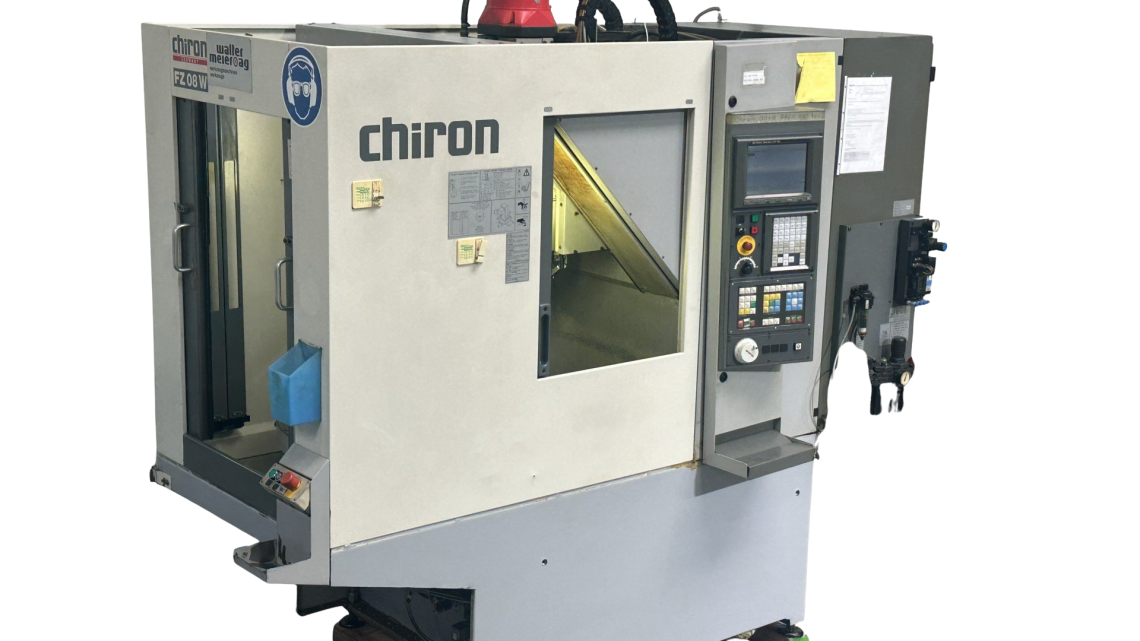
What Should I Pay Attention To When Buying a Second-Hand, Pre-Owned, Surplus, Used Chiron FZ08W CNC Vertical Machining Center made in Germany ?
Know the machine’s nominal specs and variants
Before inspecting, have the as-built spec sheet (or what the seller claims). For Chiron FZ08W machines, typical specs (vary by year / options) include:
- Travel: X ≈ 300 mm, Y ≈ 250 mm, Z ≈ 250 mm
- Rapid traverse: X/Y ~ 40 m/min, Z ~ 60 m/min
- Spindle: HSK-A32 taper, up to ~ 15,000 rpm, with ~3.7 kW drive (nominal)
- Tool magazine: commonly 12 tools (sometimes variants)
- Pallet changer / rotopallet arrangement: many FZ08W machines have dual pallets or some sort of workpiece indexing / rotation scheme
- Control: commonly Fanuc (e.g. 21i-M)
Having those “nominal” values gives you a benchmark to spot deviations or red flags.
1. Visual & structural inspection
Start with a broad visual / structural check to detect neglect, abuse, or modifications.
- Frame, base, column, and casting condition
– Check for cracks, repairs, welds, distortions, or signs of structural damage.
– Ensure the base is rigid and that the machine is properly leveled or mountable. - Way covers, bellows, protective covers
– Missing, torn or degraded covers/wipers allow chips, coolant, and contaminants to get onto slides and ball screws.
– Inspect slide wipers, seals, and protective sheets. - Corrosion, rust, oxidation
– Areas under the machine, coolant sump, chip zones, internal enclosures may show rust; check all. - Leaks / stains
– Oil, hydraulic fluid, coolant stains or drips can indicate seal or plumbing problems. - Doors, guards, access panels, hinges
– Doors should align and operate smoothly; check any slamming / misalignment / bent panels. - Wiring harnesses, cable routing, conduits
– Check for frayed wires, patched wiring, missing conduits or strain reliefs, signs of overheating or burn marks in control cabinets. - Modifications / retrofits
– Note any non-OEM additions (e.g. aftermarket sensors, additional cooling, extra motors). These may complicate service or part sourcing.
2. Mechanical / motion / precision subsystems
This is the heart of the machine. Problems here are costly to repair or may be unrepairable economically.
- Guideways / linear motion (X, Y, Z axes)
– Check for wear, scoring, galling, pitting.
– Move axes manually (jog) and observe for binding, jerks, “steps,” dead zones.
– Feel for smoothness across full travel. - Ball screws / lead screws / feed screws
– Check for backlash, play, uneven motion, noise, binding.
– Use a test indicator or dial gauge to check straightness across travel.
– Listen/feel for resonances or deviations in high-speed feed. - Spindle, bearings, spindle runout
– Run spindle at various speeds; listen for noise, whine, vibration, roughness.
– Measure spindle runout with a test bar or dial indicator, both radially and axially.
– After running for some minutes, check spindle housing temperature — overheating suggests bearing degradation.
– Inspect the spindle taper for wear, nicks, damage, rust. - Tool changer / tool magazine
– Cycle through tool changes: check speed, reliability, misfits, jamming, mis-indexing.
– Inspect contacts, sensors, tool grippers/cam mechanisms.
– Check the magazine rail, carousel, slides for wear, binding, misalignment. - Pallet changer / rotopallet workpiece handling
– If the machine has pallet or workpiece rotation / indexing, test the changeover, indexing, alignment repeatability.
– Check for wear, backlash, positional accuracy of indexing mechanism.
– Ensure synchronization (if multi-axis / multi-stage) is tight and repeatable. - Cooling / lubrication / fluid systems
– Test coolant pump(s), coolant flow, hoses, nozzles, filters, coolant tank.
– Inspect lubrication lines for axes, ways, ball screws — ensure they are functional (auto-lube if present).
– Check fluid cleanliness — sludge, metal chips in reservoirs are bad signs.
– Check coolant recirculation, filtering, whether filtration systems or chip conveyors function.
3. Electrical / control / software
Even if the mechanical parts are solid, the machine is useless if the control and electronics are unreliable.
- Power up and boot sequence
– Watch the control system boot. Are there alarms, missing modules, “no response” errors?
– Check status screens, system diagnostics, error or warning logs. - Axis homing, reference return, software limits
– Test homing and limit switch behavior for each axis.
– Jog each axis at low, medium, and high feed — listen for abnormal behavior.
– Check interpolation, canned cycles, threading functions, coordinate transformations. - Movement tests
– Move single axes independently; then test simultaneous multi-axis moves (if applicable).
– Test extremes: full travel, edges of working envelope.
– Check repeatability: move to a position, retract, return — see how closely it returns.
– Check “backlash compensation” and servo tuning (if accessible). - Servo drives, motors, encoders, feedback loops
– Inspect drive cabinet: fans, heat sinks, wiring, connectors, cables.
– Listen for unusual humming or vibration from drives / motors.
– Check temperature of drives during operation. - Software versions, upgrades, compatibility
– Ask what firmware or software version is installed.
– Are there custom patches, add-ons or modifications?
– Can the system be backed up / restored? Are parameter backups or version control provided?
– Ensure you can upload / download programs (USB, network, RS-232, etc.). - Documentation and schematics
– The seller should supply electrical schematics, wiring diagrams, maintenance manuals, control manuals.
– These are crucial for repairs, trouble-shooting, and spares sourcing.
4. Operating hours, history, usage & maintenance
The usage history gives you insight into how “worn” the machine really is.
- Ask for operating hours, spindle hours, feed hours (if recorded).
- Ask how intensively it was used (single shift, multi-shift, continuous, type of parts cut).
- Request maintenance logs: what components have been replaced (e.g. spindle rebuilds, ball screw replacements, guide way refurbishments).
- Inquire whether the machine ever sustained collisions, misuse, or repairs.
- Ask about the environment: coolant quality, cleanliness, chip handling, dust exposure, etc.
5. Trial / test machining & accuracy validation
This is critical — seeing it run under load is the best indicator.
- Run a test part that approximates your intended workload (materials, tools, feeds/speeds).
- Listen and observe: vibration, noise, chatter, abnormal behavior.
- Measure the part: dimensional accuracy, surface finish, repeatability.
- Run extended cycles (e.g. 30-60 minutes) to see if performance degrades (heating, thermal drift, backlash creeping).
- Test different spindle speeds / feeds to see stability across operating ranges.
- Test tool changes, rapid moves, simultaneous axes, pallet swaps (if applicable).
- Re-measure (or re-test) after the test run to see drift.
6. Spares, consumables & support availability
One of the most overlooked costs is obtaining spare parts and consumables long after purchase.
- Availability of original or aftermarket spares (for Chiron, control system, feed modules, spindle bearings, tool changer parts).
- Consumables: seals, wipers, guide way wipers, tool holders, collets, filters, coolant parts.
- Service & support: Are there local (Turkey / region) service companies familiar with Chiron machines? Can they import parts or provide maintenance?
- Retrofit options: If you need to upgrade controls or add capabilities, how feasible is that?
- Documentation: Spare parts lists, exploded diagrams, maintenance procedures, firmware backups, calibrations.
7. Facility, infrastructure & compatibility
Ensure your shop can support the machine.
- Power supply, voltage, phase, current: Check that your facility matches or that a transformer / power upgrade is feasible.
- Compressed air, coolant, filtration: Ensure you have adequate utility support.
- Floor / foundation / leveling: The machine weight, vibration, anchoring must be accommodated.
- Space & clearance: The machine’s footprint, height, access during transport, removal, servicing.
- Safety / guarding: Compliance with safety standards, guarding, interlocks, chip shields.
- Cooling / HVAC: In hot environments, temperature control matters for precision machines.
8. Pricing, risk & negotiation levers
Use identified defects or depreciation as negotiation points.
- Estimate costs of repairing or refurbishing (bearings, guideways, control modules).
- Ask for some type of warranty or “acceptance after test run” clause.
- Require inclusion of spare parts, tooling, documentation, or ancillary items.
- Use cost and downtime risk as negotiation leverage.
- If possible, have a trusted expert or service technician inspect alongside you.
- Include transport, rigging, leveling, calibration costs in your total acquisition budget.
9. Model-specific caveats for Chiron / high-speed vertical / palletized machines
Because the FZ08W is a high-speed, relatively compact but sophisticated machine, some extra caution points:
- Thermal stability & drift: High-speed machines often contend with thermal expansion; check for drift during extended runs.
- High-speed spindle wear: At high rpm, bearing wear is more critical; older machines may have fatigued bearings.
- Pallet changer repeatability: The pallet / indexer is critical — poor repeatability kills precision.
- Chip clearance / chip flow: Small machines often struggle with chip evacuation — clogging or recirculation can damage slides or spindle.
- Tool shank and clamping integrity: Because high-speed operation puts stress on tool clamping, any looseness or wear is magnified.
- Vibration sensitivity: Check for resonance in certain speed ranges.
- Control speed / servo tuning: The original tuning may have drifted over years; servo parameters may require re-tuning.
- Pallet balance & loading: Uneven loading or unbalanced pallets can introduce errors in indexing or spindle load.