21/01/2023
What is Wide Belt Sander Machine?
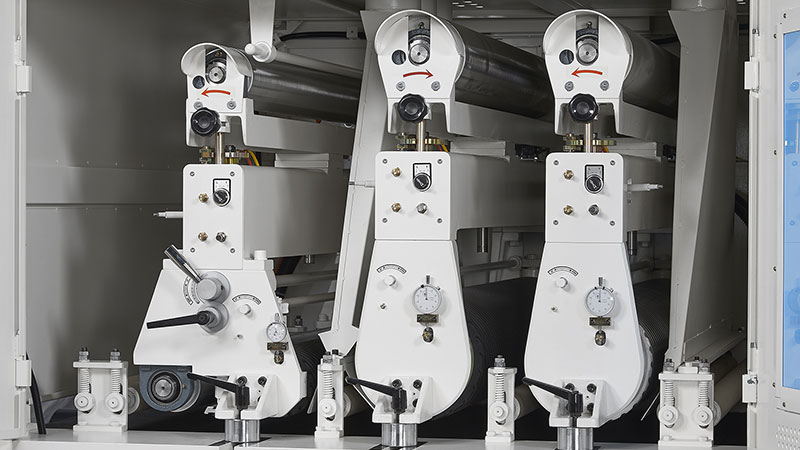
Wide-belt sander — technical overview
A wide-belt sander is a continuous, conveyor-feed abrasive machine that calibrates thickness and/or finishes the surfaces of sheet goods (wood panels, MDF, plywood, veneer, solid boards; and, in metal versions, sheet/plate) using one or more endless abrasive belts 650–3300 mm wide. Parts ride a rubber conveyor under sequential sanding heads; each head removes a controlled amount of stock.
Core architecture
- Abrasive heads (1–4+)
- Contact (calibration) roller: steel or hard rubber 85–95 ShA; aggressive removal and flatness control.
- Combination head: roller + platen (spring/air-loaded shoe) for flattening then smoothing.
- Segmented platen: individually valved air pads (typically 25–50 mm segments) that follow part edges—critical for veneer to avoid sand-through.
- Crossbelt/planetary units (optional): belt runs crosswise/oscillating to erase linear scratch and prep for lacquer.
- Conveyor table: fixed passline; vacuum bed for small parts or metal sheets. Anti-kickback fingers at infeed.
- Belt drive & tracking: 15–90 kW per head; belt speed 15–30 m/s (wood), 8–20 m/s (metal finishing). Pneumatic tracking + oscillation to spread wear.
- Thickness control: digital handwheel or closed-loop lift; many machines auto-calibrate with contact or laser sensors.
- Extraction & safety: high-volume dust collection (e.g., 6000–25 000 m³/h), spark detection/AR suppression (metal lines), E-stop brake, door interlocks, belt break sensors.
Process capability
- Stock removal (wood):
- Calibration: ~0.3–1.0 mm/pass with coarse grit (P36–P80).
- Finishing: 0.05–0.3 mm/pass with P120–P220.
- Finishing quality: governed by last head’s grit and platen type (graphite-faced shoes reduce scratch).
- Metals (deburr/finish variants): add contact drum + Scotch-Brite®/non-woven heads or planetary brushes; can remove laser/oxide scale and break edges.
Abrasives
- Aluminum oxide (general wood), silicon carbide (lacquer, veneer, non-ferrous), zirconia/ceramic (heavy removal, metals). Typical belt sizes: 2620×1100 mm, 3250×1350 mm (varies by OEM).
Key parameters when specifying
- Work width & thickness range vs. product mix; need vacuum table for small/porous pieces?
- Head configuration & order (e.g., R–R, R–C, R–C+segmented platen, add crossbelt for veneer/lacquer).
- Roller hardness & diameter (flatness vs. aggressiveness).
- Feed speed (2–30 m/min) with synchronized power; variable speed for burn control.
- Removal targets and grit sequence needed to hit Ra/spec without swirl.
- Part geometry: segmented platen for veneered panels, through-feed brushes for metal edge rounding.
- Dust/extraction & fire safety capacity; heat and spark management if sanding metals.
- Automation: recipe memory, auto-thickness set, load control, belt wear sensing, power meters.
- Utilities/footprint: electrical kW per head, air for platens/segmentation, collection ducting.
Good practice
- Keep duct runs short and filters clean—dust back-pressure ruins finish.
- Match feed speed to last grit (too fast → deep scratch pattern).
- Use fresh belts and step grits (e.g., P60→P100→P150/P180) to avoid “ghost” scratches.
- For veneer, enable edge masks on segmented zones and limit removal to a few tenths of a millimeter.
Bottom line: a wide-belt sander is a high-power, conveyorized abrasive system that combines calibration (flatness/thickness) and finishing in one pass. Proper head configuration, abrasives, and dust/safety engineering determine throughput, flatness, and surface quality.