What is Trapezoidal Profile Manufacturing?
Technical Explanation of Trapezoidal Profile Manufacturing
1. Definition
Trapezoidal profile manufacturing refers to the continuous production process of cold-formed metal sheets (usually steel or aluminum) shaped into trapezoidal cross-sections. These profiles are widely used for roofing, cladding, formwork, and structural applications due to their high stiffness-to-weight ratio, easy installation, and ability to span larger distances.
2. Raw Material
- Base material: Galvanized steel, aluminum, or stainless steel coils.
- Thickness range: Typically 0.4 mm to 1.2 mm for roofing/cladding, up to 2 mm for heavy structural applications.
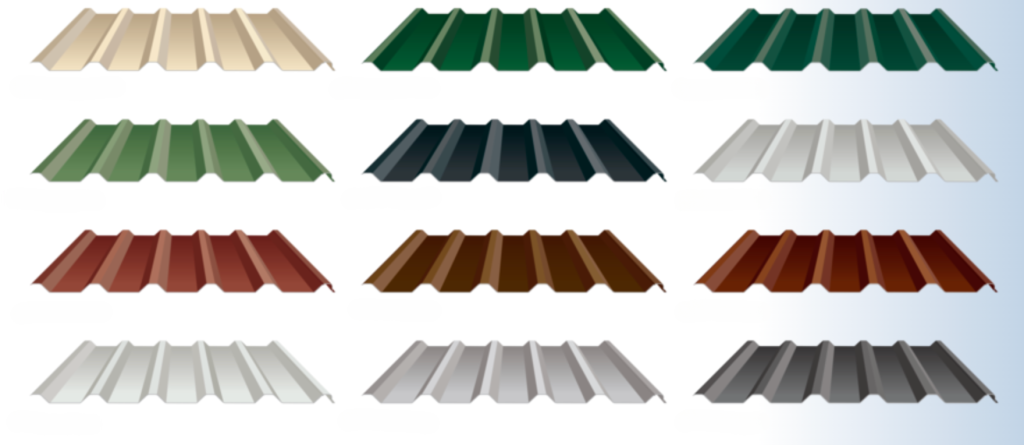
- Coatings: Zinc (galvanization), Al-Zn, or polymer (polyester, PVDF) for corrosion resistance and aesthetics.
- Colors: Applied via coil-coating, as seen in your provided image (green, red, gray, brown, etc.).
3. Manufacturing Process
- Uncoiling: Steel/aluminum coils are loaded onto an uncoiler and straightened.
- Roll Forming:
- The flat strip passes through a series of precisely machined roll forming stations.
- Each station gradually bends the material to achieve the trapezoidal shape without spring-back or cracks.
- The geometry (flange width, rib height, pitch) is controlled by roller design.
- Cut-to-length: A flying shear or hydraulic cutter cuts the continuous profile to the required length without stopping the line.
- Stacking & Packaging: Finished profiles are automatically stacked and prepared for shipping.
4. Key Technical Characteristics
- Rib height: Typically 18–55 mm (affects load-bearing capacity).
- Pitch (distance between ribs): Usually 150–333 mm.
- Span capability: Higher rib heights allow larger spans between structural supports.
- Tolerances: Tight dimensional tolerances according to standards (e.g., EN 1090, ASTM).
- Mechanical properties:
- Tensile strength of steel ~ 280–550 MPa depending on grade.
- Load resistance is determined by sheet thickness + profile geometry.
5. Applications
- Industrial roofing & wall cladding (factories, warehouses, stadiums).
- Composite floor decking (concrete poured over trapezoidal sheet as permanent formwork).
- Agricultural buildings (silos, barns, greenhouses).
- Infrastructure (temporary fencing, sound barriers).
6. Advantages of Trapezoidal Profiles
- High strength with low material consumption (optimized geometry).
- Fast installation with interlocking or overlap joints.
- Corrosion resistance when coated.
- Aesthetic flexibility with multiple colors and coatings.
- Versatility in roofing, wall, and structural applications.
✅ In summary:
Trapezoidal profile manufacturing is a precision cold-roll forming process that transforms flat metal coils into strong, lightweight, ribbed sheets optimized for roofing, cladding, and load-bearing applications. The geometry, rib height, and material grade directly influence load capacity, span, and durability.