What is Straight Side Press?
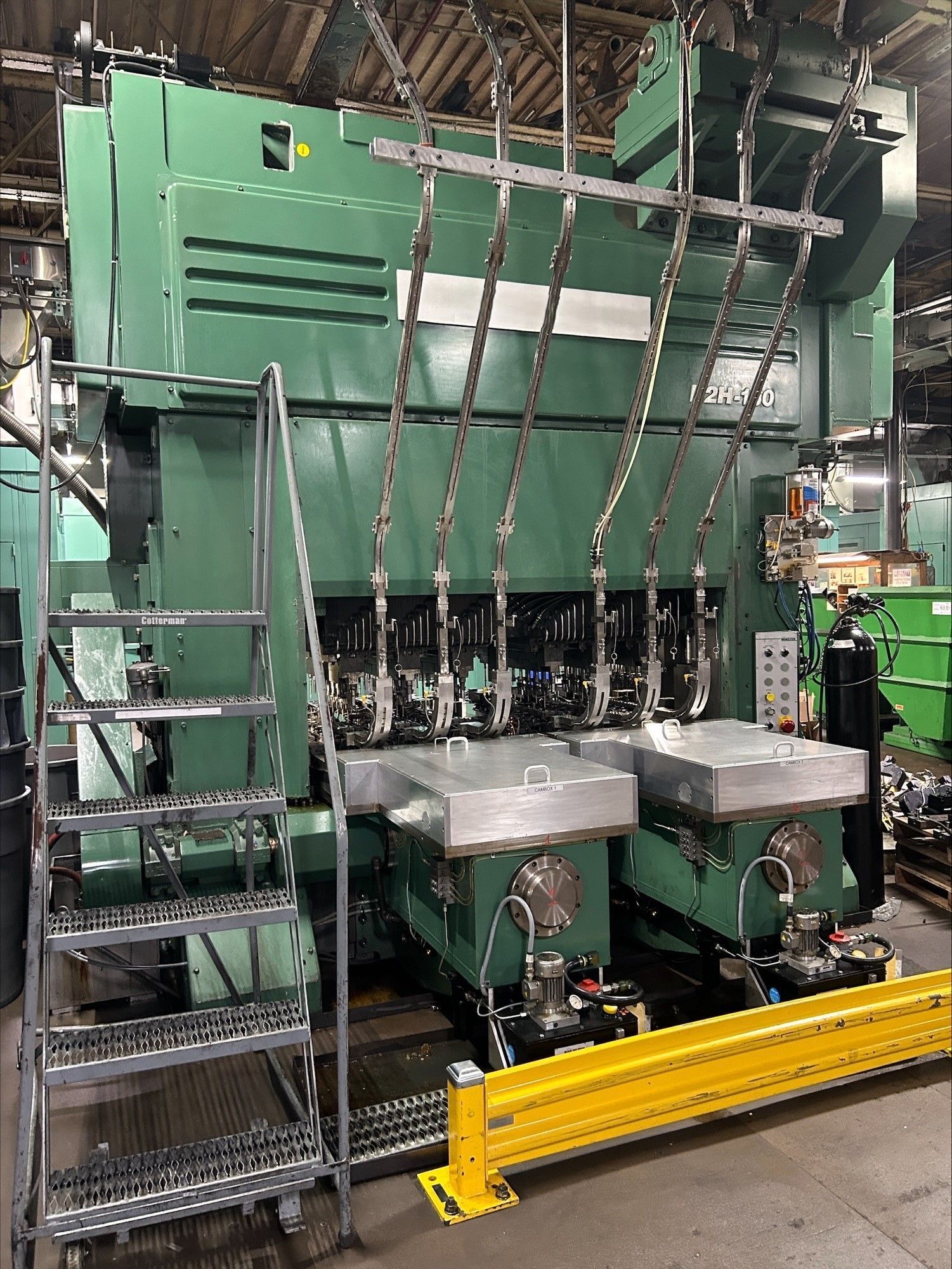
A Straight Side Press (SSP) is a type of mechanical or hydraulic stamping press commonly used in the sheet metal sector for high-precision forming operations. It features a robust, closed-frame design with two vertical, straight-sided uprights (often constructed from thick slab steel or columns) that provide exceptional rigidity and minimal deflection under load. This contrasts with open-frame designs like C-frame or gap-frame presses, which are more prone to bending due to their exposed structure. In the sheet metal industry, SSPs are essential for processing sheet metal coils or blanks into complex components through cold-forming processes, leveraging high tonnage capacities (typically ranging from 100 to several thousand tons) to handle materials like steel, aluminum, brass, and high-strength alloys.Technically, the SSP operates by converting rotational or linear input energy into vertical compressive force applied via a ram (or slide) to a die set, deforming the sheet metal plastically without heating it. The straight-sided frame ensures uniform force distribution, reducing angular deflection (often limited to less than 0.001 inches per foot under full load) and maintaining parallelism between the ram and bolster plate. This makes SSPs ideal for progressive die stamping, where multiple operations occur in sequence across a continuous strip of sheet metal.Technical Components and StructureThe core architecture of an SSP is engineered for stability and precision, with key components including:
- Frame/Uprights: Two parallel, vertical steel slabs or columns (typically 12-24 inches thick) connected by tie rods or a crown (top beam) and bolster (bottom bed). The frame is often pre-stressed using tie rods tensioned to 100-200% of rated tonnage to counteract elastic deformation. This design minimizes frame stretch and breakthrough shock during high-impact operations, achieving deflection rates as low as 0.0005 inches per ton of force.
- Ram (Slide): The moving upper platen that delivers the forming force. Guided by 6-8 full-length gibs (precision sliding surfaces, often with nickel-bronze wear plates) at 90-degree intervals, the ram ensures straight-line motion with tolerances under 0.0005 inches over strokes of 4-12 inches. Single-point (one connecting rod) or multi-point (two or four) configurations are available; multi-point reduces ram tilt for larger dies.
- Bolster Plate/Bed: A heavy-duty lower platform (up to 100 inches wide) where the lower die half is clamped. It supports high shut heights (distance from ram to bolster at bottom dead center, adjustable via motor-driven mechanisms) and accommodates large die areas for processing sheet metal up to 0.5 inches thick.
- Drive System:
- Mechanical SSP: Powered by an electric motor driving a flywheel, clutch, and crankshaft or eccentric shaft. The flywheel stores kinetic energy (up to 10,000 ft-lbs) for delivering peak forces in short bursts (stroke rates of 10-100 strokes per minute). A toggle mechanism can amplify force near the bottom of the stroke for deep drawing.
- Hydraulic SSP: Uses fluid pressure (pumps and cylinders) for variable stroke control and uniform force application, suitable for deep drawing where constant pressure is needed over longer strokes (up to 20 inches).
- Servo-Driven Variants: Employ servo motors for programmable motion profiles, allowing precise control of speed, dwell time, and force (e.g., slowing to 1-5 mm/s during forming to avoid defects).
- Tie Rods: Four threaded rods (with nuts) that preload the frame under compression, enhancing overall stiffness and preventing separation during operation.
The frame’s closed-box configuration provides four-sided access for automation (e.g., coil feeders, transfer systems), but prioritizes rigidity over open accessibility.Working Principle in Sheet Metal ProcessingIn the sheet metal sector, an SSP processes flat sheets or coils fed into a die set, where the upper punch (attached to the ram) and lower die cavity shape the material through plastic deformation. The process follows these steps:
- Material Feeding: Sheet metal (e.g., 0.5-10 mm thick) is uncoiled, straightened, and fed via servo feeders into the die at speeds up to 100 ft/min.
- Stroke Cycle:
- Downstroke: The ram descends (stroke length 4-12 inches) via crankshaft rotation (360° per cycle). At bottom dead center (BDC), peak tonnage (e.g., 500 tons) is applied, forcing the sheet metal to flow into the die shape. Force is calculated as F=P×AF = P \times A
F = P \times A, where ( F ) is force, ( P ) is material yield strength (e.g., 30-60 ksi for mild steel), and ( A ) is contact area; however, actual tonnage accounts for friction and springback. - Forming Mechanics: Operations exploit the material’s ductility. For blanking/piercing, shear stress shears the sheet (edge quality depends on clearance: 5-10% of sheet thickness). For bending, the neutral axis shifts, with bend radius r≥tr \geq t
r \geq t(t = thickness) to avoid cracking. Deep drawing involves radial drawing with a punch, where drawing ratio (blank diameter/punch diameter) is limited to 2:1 to prevent wrinkling; lubrication reduces friction coefficient (μ < 0.1). - Upshot: The ram returns, ejecting the part via springs or air blasts.
- Downstroke: The ram descends (stroke length 4-12 inches) via crankshaft rotation (360° per cycle). At bottom dead center (BDC), peak tonnage (e.g., 500 tons) is applied, forcing the sheet metal to flow into the die shape. Force is calculated as F=P×AF = P \times A
- Energy Dynamics: Mechanical SSPs deliver energy via E=12Iω2E = \frac{1}{2} I \omega^2
E = \frac{1}{2} I \omega^2(flywheel kinetic energy, I = moment of inertia, ω = angular velocity), dissipated as work W=F×dW = F \times dW = F \times d(d = displacement). Hydraulic variants use Pascal’s principle for force multiplication.
Cycle times are 5-60 seconds, with shut height adjusted (e.g., ±2 inches) to fit dies. Automation integration (e.g., robots for part transfer) enables high-volume production (thousands of parts/hour).Applications in the Sheet Metal SectorSSPs excel in high-tonnage, precision tasks:
- Progressive Stamping: Sequential operations (piercing, forming, trimming) on coil stock for automotive panels or brackets.
- Deep Drawing: Forming cups or enclosures from flat sheets, common in appliance and battery housing production.
- Heavy-Duty Forming: Bending, coining (high-pressure squeezing for fine details), or extrusion of thick sheets (>3 mm) for aerospace components.
- Industries: Automotive (body panels, chassis), electronics (enclosures), appliances (housings), and EV manufacturing (battery trays).
Advantages include high accuracy (±0.001 inches), reduced die wear (due to parallelism), and scalability for transfer lines (multiple SSPs in tandem). Limitations: Higher cost and less flexibility for small runs compared to C-frame presses.In summary, the Straight Side Press’s rigid, deflection-resistant design makes it a cornerstone of sheet metal fabrication, enabling consistent, high-force deformation for complex parts while maintaining tight tolerances essential for modern manufacturing.