31/08/2025
What is Robotic Welding Seam Tracker System?
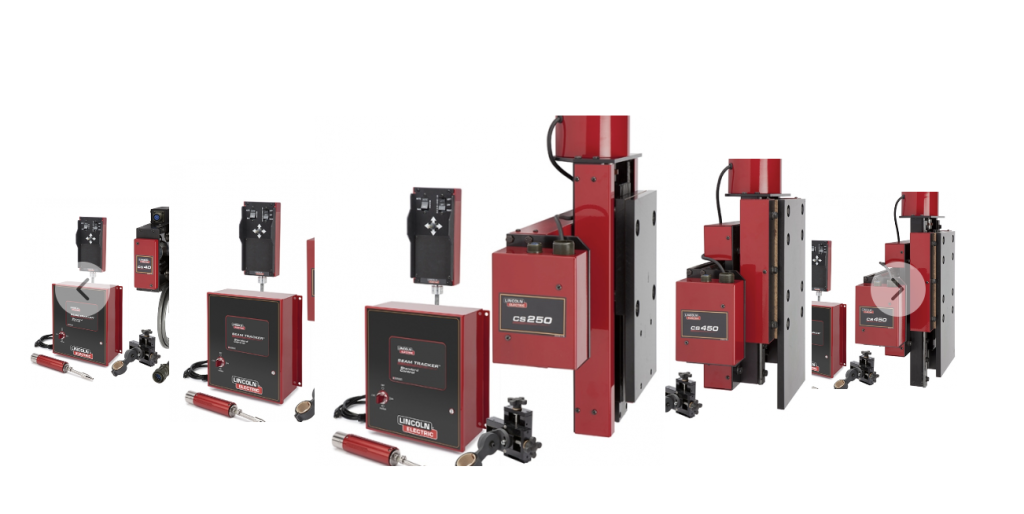
Robotic Welding Seam Tracker — what it is
A seam tracker is the sensing + control stack that lets a welding robot find the joint and stay on it in real time, correcting the torch path and angles for part/batch variation, fixture error, and heat distortion. It continuously nudges the robot TCP (ΔX, ΔY, ΔZ, ΔRx, ΔRy, ΔRz) so the arc stays in the groove and the bead size/penetration remain stable.
Main tracking methods
- Laser vision (most common for high accuracy)
- A laser line and camera (triangulation) scans the joint a few cm ahead of the arc.
- Algorithms extract the joint profile (butt, lap, fillet, V-groove), compute centerline, gap, root face, and surface normals.
- Robust to speed changes; uses band-pass filters, HDR shutters, arc-glare suppression, air-knife to keep the lens clean.
- Typical: FOV 25–120 mm, standoff 80–200 mm, resolution 0.02–0.10 mm, loop update 100–400 Hz, latency 5–20 ms, accuracy ±0.1–0.3 mm.
- Through-Arc Seam Tracking (TAST)
- Uses weld current/voltage feedback during a programmed weave. When the arc strikes a sidewall, electrical signature shifts → controller recenters the weave.
- Lower cost; works inside the puddle (no line-of-sight), but accuracy is lower and not ideal for big gaps or thin sheet.
- Accuracy ±0.5–1.0 mm typical; very process-dependent.
- Tactile/“wire touch” & probes (pre-weld find)
- Robot touches work with the wire or a probe at a few points to locate the start and rotate/offset the path.
- Used to locate before welding, then vision/TAST does the track.
System architecture
- Sensor head: laser/camera or arc-sensing interface; water-cooled or air-cooled, IP65+, anti-spatter window.
- Controller: runs joint extraction + visual servo loop; pushes corrections to the robot every cycle.
- Robot interface: real-time channel (e.g., ABB EGM, Fanuc TAST/iRVision, KUKA RSI, Yaskawa HLPC) to adjust TCP and weaving on-the-fly.
- Calibration:
- Tool Center Point (TCP) and tool orientation.
- Hand-eye (extrinsic): transform from sensor to robot tool frame.
- Laser/camera intrinsics for metric accuracy.
- Process I/O: sync with power source for CTWD, wire feed, travel speed, weave amplitude/frequency, crater fill, multi-pass logic.
What it actually does during a weld
- Seam finding: scan or touch to locate the start; compute base frame offsets (X/Y/Z + yaw/pitch/roll).
- Path planning: set target travel speed, weave pattern, stick-out, torch angles (work/lead).
- Real-time tracking: sensor reads the joint ahead of the puddle → controller outputs ΔX/ΔY/ΔZ and angle corrections at 100–400 Hz.
- Adaptive welding (optional): varies WFS/voltage/heat based on measured gap or fit-up; can add adaptive oscillation to bridge gaps.
- Multi-pass: re-scans the groove after each pass, offsets to the next layer, keeps torch centered between walls.
- Post-weld inspection (optional): laser profile of the bead for height/width/undercut metrics.
Where it helps
- Parts with variable fit-up (laser/plasma cut, pressed, or cast edges).
- Long seams where thermal distortion would otherwise walk the bead off-center.
- Complex joints (fillet on curved shells, V-grooves, T-joints, overlap).
- High-mix/low-volume where fixture precision is limited.
Practical limits & pitfalls
- Arc glare/fumes/spatter: need band-pass optics, air-knife, regular window swaps.
- Highly reflective Al or Zn-coated sheet: tune laser wavelength/exposure; use matte prep if needed.
- Tight corners/occlusion: off-axis heads can lose line-of-sight—use compact coaxial optics or switch to TAST.
- Calibration drift: knocks and heat move the sensor; run quick check-fixtures at shift start.
- Gap beyond procedure: tracker can follow the center of a bad joint but metallurgy may fail—enforce gap limits.
Typical performance (realistic)
- Travel speed (MIG/MAG): 0.3–1.0 m/min while tracking; faster for simple fillets.
- Positional correction range: ±5–15 mm (depends on head FOV).
- Angular correction: ±5–10°.
- Repeatability of start-point finding: ±0.2–0.5 mm (vision), ±1 mm (wire-touch).
Buyer’s checklist
- Joint types & thickness range (butt/lap/fillet, single-V, multi-pass grooves).
- Required accuracy vs. your procedure tolerances.
- Material/process (MIG/MAG, TIG, SAW, laser-hybrid) and expected gap variation.
- Sensor FOV/standoff vs. torch and fixturing space; heat shielding and cable routing.
- Robot brand support (real-time correction interface) and recipe management.
- Maintenance: window costs, lens cleaning access, spare heads.
- Data & QA: bead geometry logging, alarms when gap/offset exceed limits.
Bottom line: a robotic seam tracker is a closed-loop sensing system that keeps the torch exactly where welding physics wants it—on the joint centerline with the right angles and heat—so you get consistent penetration and bead geometry even when parts and fixtures aren’t perfect.