12/08/2025
What is FPT Flexible Pallet Tower for Milling Machines?

What it is
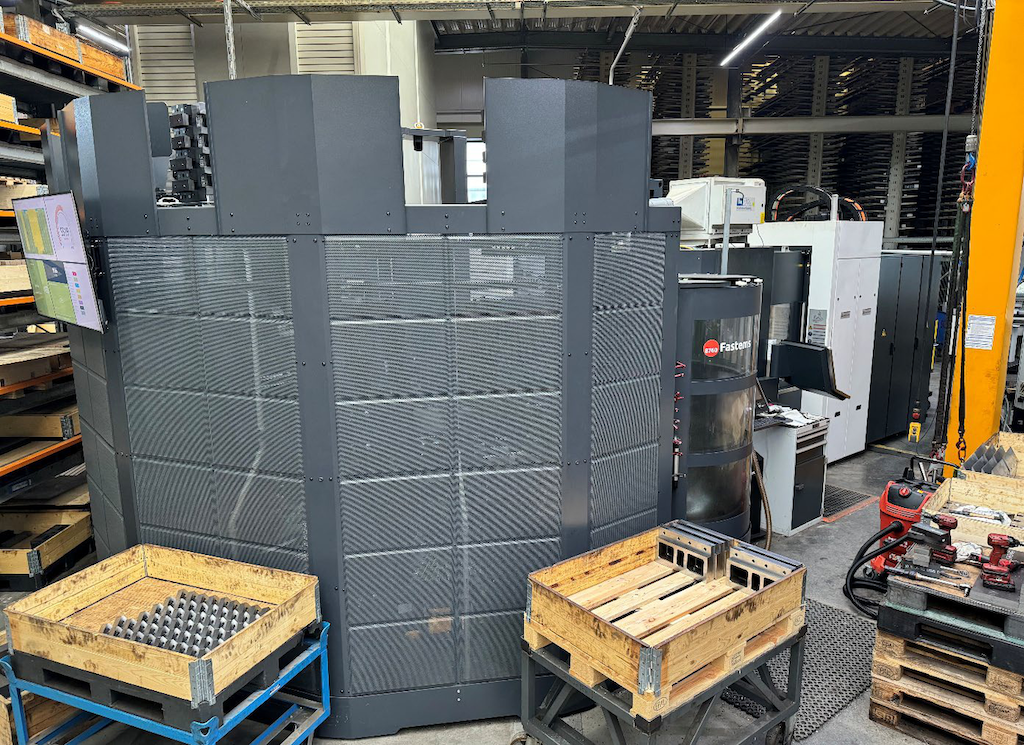
A compact, single-machine pallet automation system. Think of it as a vertical pallet warehouse with a servo lift that feeds pallets to your milling machine’s APC (Automatic Pallet Changer) and to an operator loading station. It’s designed to keep the spindle cutting while setups, loading, and CMM checks happen off the machine.
Hardware architecture
- Rack/tower: 2–4 storage levels holding 12–24 pallets (typical sizes 400–630 mm; payloads up to ~1,000 kg including fixture & part). Mixed pallet heights can be used in one tower.
- Lift/stacker unit: Multi-axis servo gantry or mast with forks engages standardized pallet grooves. Positioning repeatability is typically ±0.1 mm or better at storage; repeatability at the machine comes from the zero-point/pallet interface on the HMC.
- Machine interface port: Aligns to the machine tool’s APC station; mechanical datum and safety interlocks ensure correct docking before transfer.
- Operator loading station: Ergonomic, lockable 90°/180° index (or full rotation depending on option), media couplings (hydraulic/pneumatic) for fixture actuation and seat checks.
- Utilities: Drip trays, chip/ coolant management, status beacons, fenced or light-curtain guarded cell, E-stops all tied into the tower PLC and the machine’s STO chain.
Controls & software
- Cell PLC: Runs the lift axes, safety, interlocks, and handshake with the CNC.
- MMS (Manufacturing Management Software): The brain that plans and executes orders. Core functions:
- Order-based scheduling with horizon planning (e.g., 72–96 h).
- Resource checks before release: pallet available, NC program present, correct fixture and media configuration, tools present with remaining tool-life, raw material ready.
- Tool/presetting data exchange (e.g., via RFID/barcode and DNC), automatic import from CAM, job progress & utilization dashboards, alarms/remote notifications.
- Machine handshake: Digital I/O/fieldbus (e.g., DP/DP coupler, Profinet, etc.). Typical signals: “APC ready / pallet clamp OK / door closed / cycle start / M-function for pallet call / cell in control”.
Operating cycle (simplified)
- Operator kits a pallet offline at the loading station (tombstone or plate with zero-point).
- MMS validates resources and queues the job.
- When the machine signals APC-ready, the lift retrieves the next pallet from storage and docks to the APC.
- Machine swaps pallets; cutting starts immediately.
- The returned pallet goes back to storage or to the loading station for OP20/inspection while the spindle keeps cutting.
Process/fixture details
- Works best with horizontal machining centers and standardized zero-point pallets; tombstones let you run OP10/OP20 on the same pallet.
- Media interface options (hydraulic/pneumatic) allow automatic clamping checks and fixture actuation; seat/pressure sensors can be required by MMS before release.
- Tool management integrates tool-life and sister tools; MMS can issue pick-lists to presetting and block jobs until tools are green.
Performance & sizing
- Footprint ~18–22 m² for a 12–18-pallet tower (varies by model).
- Utilization: The big gain is spindle utilization—typical users move from 30–40% to 60–85%+ spindle time because setups and inspections are offloaded from the machine.
- Changeover: Pallet change is seconds; actual APC time is dominated by machine doors/table positioning.
Where it fits vs. other automation
- FPT vs. simple pallet pool: FPT adds vertical storage density, mixed heights, full MMS resource scheduling, and better traceability.
- FPT vs. full FMS/MLS: FPT is for one machine; faster to install and cheaper. An MLS (multi-level system) links multiple machines via rails/robots for higher throughput and redundancy.
Requirements & limits
- Your mill needs an APC or a compatible pallet port.
- Pallet standardization (size, zero-point) is essential.
- It doesn’t move parts between multiple machines—if you need routing across machines, you’re in FMS/robot territory.
Bottom line: an FPT is a compact pallet automation cell that, paired with MMS, keeps your milling spindle cutting by turning setups into parallel work, enforcing resource readiness, and orchestrating pallets with a fast, safe machine handshake.