14/01/2023
What is Flanging Machine for Smooth Surfaces?
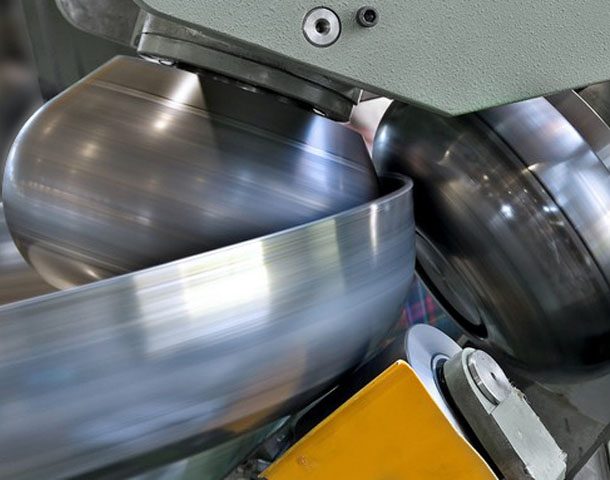
A flanging machine (rotary flanger) forms a clean rim on the edge of round or cylindrical sheet-metal parts—think lids, tanks, cookware, drum ends, HVAC rings. Instead of a press hit, it rolls the edge with hardened rollers against a mandrel, so the metal flows gradually. That rolling contact is why the edge and face finish stay smooth (no die lines, no chatter marks).
How it works (quick cycle)
- Clamp on mandrel – the disk, cone, or cylinder is centered on a copy mandrel.
- Pre-flange pass – a forming roller turns the edge up/down to ~30–60°.
- Final flange/hem – the roller follows a guided path to 90° (flange), 135–180° (curl/hem), or into a bead.
- Planish – a polished planishing roller “irons” the surface to the final thickness/finish.
- Trim/calibrate – optional rotary trim knife sets exact OD after forming.
Key components
- Headstock & tailstock with servo RPM control (typ. 200–1,500 rpm).
- Forming/planishing rollers (polished, 58–62 HRC or PCD-tipped) on CNC slides.
- Copy mandrel (steel or aluminum, mirror finish for visible parts).
- Backup/anti-wrinkle rolls to hold the wall and prevent buckles.
- Lube & cooling to avoid galling (especially on SS/Al).
What makes the surface “smooth”
- Rolling deformation (not stamping) + polished tools.
- Low feed per rev (≈0.1–0.6 mm/rev) and constant-radius tool paths.
- Planishing pass that evens thickness and reduces Ra (≈0.8–1.6 μm common).
- Correct edge radius (min ~2–4× sheet thickness) to prevent micro-cracks.
Typical capability (rule-of-thumb)
- Materials: mild steel, stainless, Al, Cu, Zn-coated.
- Thickness: ~0.3–4.0 mm (up to 6 mm with higher power and large diameters).
- Flange height: up to ~3–5× material thickness (before hemming).
- Diameters: from ~80 mm to >2,000 mm depending on model.
Common operations
- 90° flange for bolting/welding.
- Curl/Hem (180°) for safe edges or gasket seats.
- Beading to stiffen shells.
- Joggle for step joints.
- Edge calibration & rotary trimming.
Quality pitfalls & fixes
- Wrinkling (compression buckles): use backup rolls, higher clamp force, pre-flange in steps.
- Cracking at outer fiber: increase bend radius, anneal if needed, reduce feed/RPM, add lube.
- Galling/tool marks: polished/PCD rollers, correct coolant.
- Ovality: good mandrel fit and synchronized tailstock pressure.
Where it shines vs. press-brake/stamping
- Superior surface finish and visible-grade edges.
- Fast changeover (swap mandrel/roller) for short runs.
- Less tonnage; better for large diameters and conical parts.
Buyer’s checklist (sheet-metal shop)
- Thickness & diameter range you actually run.
- Number of CNC axes (at least X/Z; Y/tilt gives better profiles).
- Power & torque at low RPM (SS needs it).
- Quick-change mandrels/rollers, programmable anti-wrinkle rolls.
- Integrated trimming and planishing if you need cosmetic parts.
- Proven samples on your material (SS 304/430 and Al 5xxx behave differently).
In short: it’s a roller-forming machine that turns, curls, or hems the edge of round sheet-metal parts while keeping the face and rim cosmetically smooth—ideal when you need both strength and a showroom-grade finish.