What is Eccentric Press?
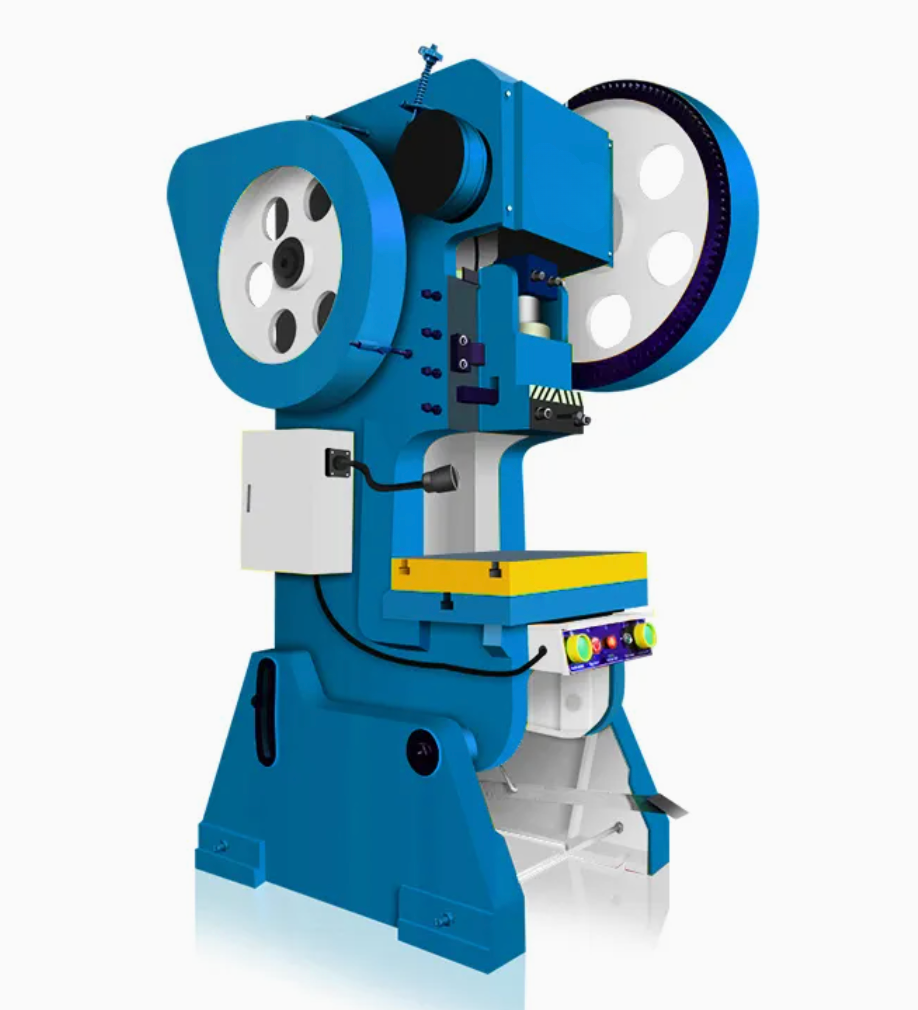
An eccentric press is a mechanical press used in the sheet metal and metalworking industries for forming, cutting, punching, or shaping metal workpieces. It operates by converting rotational motion into linear motion through an eccentric mechanism, delivering high force to a ram or slide that presses against the workpiece. Below is a detailed technical explanation tailored to sheet metal and metalworking applications:Working PrincipleThe eccentric press derives its name from the eccentric shaft or cam, which is a key component in its operation. Here’s how it works:
- Eccentric Shaft Mechanism:
- The press is powered by an electric motor that drives a flywheel, which stores rotational energy.
- The flywheel is connected to an eccentric shaft, a circular component offset from its rotational axis. As the shaft rotates, the offset (eccentricity) causes the connected ram or slide to move up and down in a linear motion.
- The eccentric shaft converts the continuous rotary motion of the motor into reciprocating (up-and-down) motion of the ram.
- Ram and Tooling:
- The ram, a heavy component, is guided by the press frame and moves vertically.
- Attached to the ram is a die or tooling set (upper die), which mates with a lower die fixed to the press bed.
- When the ram descends, the upper die presses the sheet metal against the lower die, performing operations like punching, blanking, bending, or forming.
- Force Generation:
- The force exerted by the ram depends on the press’s tonnage rating (e.g., 50 tons, 200 tons), which indicates the maximum force it can apply.
- The flywheel’s stored energy ensures consistent force delivery, especially for high-speed or repetitive operations.
Key Components
- Frame: The rigid structure (C-frame or H-frame) that supports the press and withstands the forces generated during operation.
- Flywheel: Stores rotational energy to smooth out power delivery and reduce motor strain.
- Eccentric Shaft/Crankshaft: Converts rotary motion to linear motion.
- Ram/Slide: The moving component that carries the upper die and applies force to the workpiece.
- Clutch and Brake: Control the engagement and disengagement of the flywheel to start/stop the ram’s motion.
- Die Set: Custom tooling designed for specific operations (e.g., punching holes, bending sheet metal).
- Bed/Bolster Plate: The stationary surface where the lower die is mounted.
Applications in Sheet Metal and MetalworkingEccentric presses are widely used in sheet metal fabrication and metalworking due to their versatility and efficiency. Common applications include:
- Punching and Blanking:
- Punching creates holes in sheet metal by forcing a punch through the material into a die.
- Blanking cuts out a flat shape (blank) from the sheet for further processing.
- Bending:
- The press uses a punch and die to bend sheet metal into specific angles or shapes (e.g., U-shapes, V-shapes).
- Forming:
- Complex shapes are created by deforming the sheet metal without removing material (e.g., embossing, deep drawing).
- Shearing:
- Cutting straight lines or trimming sheet metal to size.
- Coining and Stamping:
- Coining applies high pressure to create precise, detailed impressions.
- Stamping forms patterns or logos on the metal surface.
Technical Specifications
- Tonnage: Ranges from small presses (10-50 tons) for light sheet metal work to large presses (500+ tons) for heavy-duty forming.
- Stroke Length: The distance the ram travels per cycle, typically adjustable for different operations.
- Speed: Measured in strokes per minute (SPM). High-speed eccentric presses can exceed 1000 SPM for mass production.
- Shut Height: The distance between the ram and bed when the ram is at its lowest point, determining the maximum die height.
- Drive Type: Can be single-eccentric (for lighter presses) or double-eccentric (for higher force and stability).
Advantages
- High Efficiency: Suitable for high-speed, repetitive operations in mass production.
- Versatility: Can handle various sheet metal thicknesses and materials (e.g., steel, aluminum, copper).
- Precision: Accurate die alignment ensures consistent part quality.
- Cost-Effective: Relatively simple design reduces maintenance and operational costs compared to hydraulic presses.
Limitations
- Fixed Stroke: The eccentric mechanism provides a fixed stroke length, which may limit flexibility for some applications.
- Force Variation: Maximum force is only achieved near the bottom of the stroke, unlike hydraulic presses, which can apply constant force.
- Material Limitations: Best suited for thinner sheet metals; thicker or harder materials may require hydraulic or servo presses.
Types of Eccentric Presses
- C-Frame (Open-Back) Presses:
- Open on three sides for easy access to the work area.
- Ideal for smaller parts and manual operations.
- Prone to deflection under high loads.
- H-Frame (Straight-Side) Presses:
- More rigid and suitable for heavy-duty applications.
- Used for larger workpieces and high-tonnage operations.
- Single-Action vs. Double-Action:
- Single-action presses use one ram for a single operation per cycle.
- Double-action presses have multiple rams for complex forming in a single cycle.
Safety and Maintenance
- Safety Features: Modern eccentric presses include light curtains, two-hand controls, and emergency stops to protect operators.
- Lubrication: Regular lubrication of the eccentric shaft, bearings, and slide guides is critical to prevent wear.
- Die Maintenance: Dies must be inspected and maintained to ensure precision and prevent damage to the press.
Comparison with Hydraulic Presses
- Eccentric Press: Faster, more energy-efficient for high-volume production, but limited by fixed stroke and force profile.
- Hydraulic Press: Offers variable stroke and constant force, better for deep drawing or thick materials, but slower and more expensive.
In summary, eccentric presses are a cornerstone of sheet metal and metalworking due to their speed, precision, and reliability. They excel in high-volume production of components like automotive parts, appliances, and electronics casings, making them indispensable in manufacturing environments.