02/02/2025
What is Coil Handling Equipment?
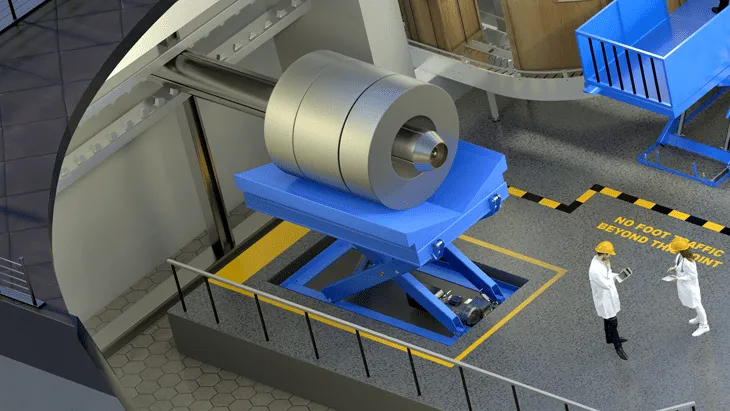
Technical Explanation of Coil Handling Equipment
Coil handling equipment refers to a range of machinery and devices used to safely lift, transport, unroll, and process metal or material coils in manufacturing, fabrication, and metalworking industries. This equipment ensures efficient material flow, reduces manual handling risks, and improves production speed.
Key Components & Functions of Coil Handling Equipment
- Coil Upenders (Tilters)
- Function: Rotate heavy coils from a horizontal to a vertical position (or vice versa) for safe handling and feeding into production lines.
- Mechanism: Uses hydraulic or mechanical drive systems to tilt the coil at controlled speeds.
- Coil Cars & Transfer Carts
- Function: Move coils from storage areas to uncoilers or decoilers.
- Features: Can include powered or unpowered movement, hydraulic lifting platforms, and guided track systems.
- Decoilers & Uncoilers
- Function: Hold and release coil material in a controlled manner for processing.
- Types:
- Motorized Decoilers: Equipped with variable-speed drives for smooth unwinding.
- Manual Decoilers: Used for lower-volume applications where automatic control is not required.
- Dual-Mandrel Decoilers: Used in high-speed production to minimize downtime by allowing one coil to be loaded while another is in use.
- Coil Straighteners & Flatteners
- Function: Remove coil set (curvature from winding) and prepare material for stamping, forming, or cutting.
- Features: Uses a series of adjustable rollers to apply force and flatten the material to required tolerances.
- Coil Feeders & Servo Roll Feeders
- Function: Precisely feed the coil material into presses, cutters, or roll-forming machines.
- Mechanism: Uses servo motors and feedback systems to ensure accuracy in feeding lengths and speed synchronization.
- Coil Rewinders & Recoilers
- Function: Rewind processed material into coil form after cutting or slitting operations.
- Features: Can include tension control, automatic edge alignment, and variable-speed drive systems.
- Coil Lifting & Manipulation Equipment
- C-Hook Lifters: Used for overhead crane lifting of heavy coils.
- Magnetic Lifters: For handling ferrous metal coils without direct physical contact.
- Vacuum Lifters: Used for lightweight or delicate coil materials.
Technical Considerations for Coil Handling Equipment
- Load Capacity: Rated for specific coil weights and diameters to prevent overloading.
- Tension Control: Critical in decoiling and recoiling applications to prevent material distortion.
- Automation & Controls: PLC-based systems improve accuracy and integration with production lines.
- Safety Features: Includes overload protection, emergency stop systems, and fail-safe locking mechanisms.
Applications of Coil Handling Equipment
- Automotive & Stamping Plants
- Steel & Metal Processing
- Electrical Steel & Transformer Core Manufacturing
- HVAC & Sheet Metal Fabrication
- Roll Forming & Tube Mills
Efficient coil handling improves productivity, reduces labor costs, and ensures material quality, making it a crucial part of modern manufacturing processes