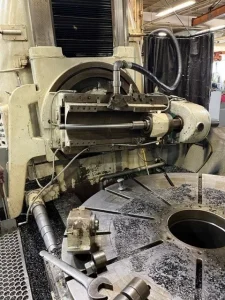
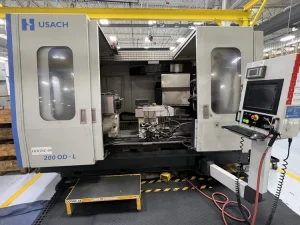
What is a CNC Turning Machine used for, designed for the micrometric machining of lamination stacks, commutators, claw poles, slip rings, rotors of starters, alternators, and distance rings?

A CNC (Computer Numerical Control) Turning Machine is a precision subtractive manufacturing tool that rotates a workpiece on a spindle while single-point cutting tools remove material to create cylindrical or conical features. In the context of micrometric machining—defined as achieving tolerances on the order of 1–10 micrometers (μm) for diameters, concentricity, and surface finish—this machine is optimized for high-precision, high-volume production of electrical components in automotive and industrial applications, such as starter motors and alternators. It employs advanced servo-driven axes, closed-loop feedback systems, and rigid machine frames to maintain sub-micron accuracy under high-speed operations.Core Technical PrinciplesMachine Architecture and Kinematics
- Spindle and Turret System: The workpiece (e.g., a lamination stack or rotor) is clamped in a high-precision collet or chuck on the main spindle, which rotates at variable speeds (typically 1,000–10,000 RPM) controlled by a brushless AC servo motor. A tool turret (multi-station, often 8–12 positions) holds carbide or diamond-tipped inserts for turning operations. Linear axes (X for radial movement, Z for axial) provide 2–3 axis interpolation, with optional Y-axis for off-center machining.
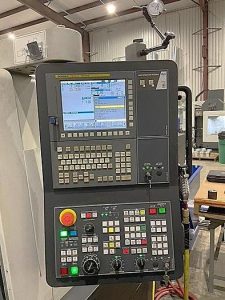
- CNC Controller: Powered by software like Fanuc, Siemens, or Heidenhain, it interpolates G-code/M-code instructions from CAD/CAM models. Real-time feedback from encoders (resolution <0.1 μm) and linear scales ensures closed-loop control, compensating for thermal expansion or vibration.
- Micrometric Precision Features: Incorporates hydrostatic or air-bearing spindles to minimize runout (<1 μm TIR, total indicated runout). Vibration damping via polymer-concrete bases and active damping systems reduces chatter, enabling surface finishes of Ra 0.1–0.4 μm.
Machining ProcessesThe machine performs turning operations tailored to rotational symmetry:
- Rough and Finish Turning: Removes material in multiple passes to achieve precise outer diameters (OD) and inner diameters (ID). For a commutator (copper segments on a steel core), it machines the OD to ±2 μm while preserving segment integrity.
- Facing and Grooving: Planes end faces perpendicular to the axis (squareness <5 μm) and cuts axial grooves for keyways or slots.
- Threading and Profiling: Generates fine threads (e.g., M2–M6 with pitch accuracy ±1 μm) or contoured profiles using C-axis indexing for live tooling.
- Cycle Time Optimization: High feed rates (up to 20 m/min) and rapid traverses (50 m/min) via ball-screw drives enable cycle times under 30 seconds per part, with tool life extended by coolant delivery at 20–50 bar pressure.
Material and Tooling Considerations
- Workpiece Materials: Designed for ferrous (e.g., low-carbon steel for claw poles) and non-ferrous (e.g., copper alloys for slip rings, aluminum for rotors) with hardness up to 40 HRC. Lamination stacks (thin silicon steel sheets, 0.35–0.50 mm thick) require delicate handling to avoid burrs or stack separation.
- Cutting Tools: Indexable inserts with coatings (TiAlN or DLC) for wear resistance, sharpened to edge radii <5 μm. For distance rings (thin-walled spacers), ultra-fine grained carbide prevents micro-chipping.
Specific Applications in Electrical ComponentsThis machine variant is engineered for the automotive electrification sector, where tolerances directly impact electromagnetic performance and mechanical fit:
| Component | Machining Focus | Key Tolerances | Technical Rationale |
|---|---|---|---|
| Lamination Stacks | OD/ID turning of stacked sheets for stator/rotor cores | Concentricity ±3 μm; Stack height ±5 μm | Ensures uniform air gap in magnetic flux paths; prevents cogging torque in alternators. |
| Commutators | OD profiling of segmented copper rings | Roundness <2 μm; Segment flatness ±1 μm | Maintains brush contact for efficient DC commutation in starter motors; minimizes arcing losses. |
| Claw Poles | Contoured turning of forged steel poles | Profile accuracy ±4 μm; Root diameter ±2 μm | Optimizes magnetic field strength in alternator rotors; claw interlocks require precise mating. |
| Slip Rings | OD and groove turning for carbon brush contact | Surface roughness Ra 0.2 μm; Groove width ±3 μm | Facilitates low-friction sliding in high-speed rotation (up to 20,000 RPM); reduces wear in excitation circuits. |
| Starters/Alternators Rotors | Multi-step turning of shaft-integrated rotors | Runout <1 μm; Balance plane ±2 μm | Achieves dynamic balance (G2.5 grade) to minimize vibration; shaft features ensure press-fit assembly. |
| Distance Rings | Thin-wall ID/OD boring | Wall thickness ±2 μm; Cylindricity <3 μm | Provides precise axial spacing in assemblies; prevents misalignment in stacked rotor components. |
Advantages for Micrometric Applications
- Scalability: Bar-fed or robotic loading supports 10,000+ parts/day production.
- Quality Assurance: Integrated metrology (e.g., in-process laser gauging) flags deviations in real-time, with SPC (Statistical Process Control) for CpK >1.67.
- Limitations and Mitigations: Heat generation is managed via flood mist coolant; for ultra-precision (<1 μm), hybrid machines add grinding spindles.
In summary, this CNC Turning Machine transforms raw forgings or stacks into functional precision parts by leveraging interpolated axis control and feedback systems, ensuring electromagnetic and mechanical reliability in high-stakes applications like vehicle powertrains.