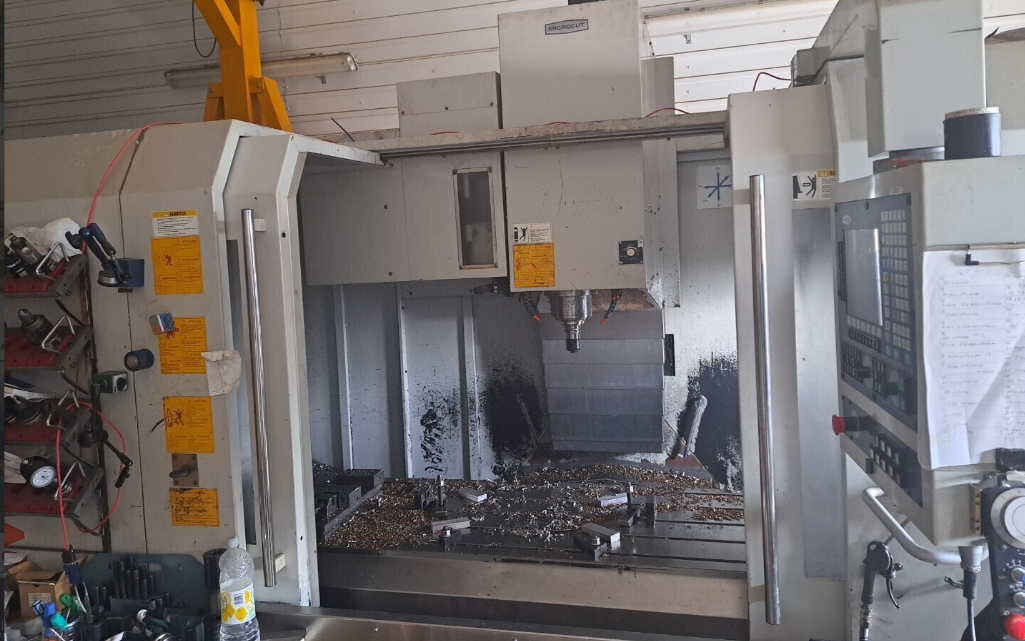
What Industry Experts Recommend Before Purchasing a Pre-Owned / Second-Hand / used Microcut Challenger 1300?
Here’s a detailed guide — based on what experts in CNC machinery recommend — for what to check, inspect, ask, and verify before purchasing a used Microcut Challenger VMC-1300 (or similar large vertical machining center). These tips cover the machine’s specifications, its likely wear points, cost-of-ownership, and what to demand from the seller.
What the Microcut Challenger VMC-1300 Is / Key Specs to Know
Before inspecting, it helps to have the machine’s spec sheet in mind so you can compare actual condition vs original. Here are typical specs for the Challenger VMC-1300:
| Parameter | Spec / Range |
|---|---|
| X / Y / Z travels | ~ 1300 × 710 × 710 mm |
| Table size | ~ 1500 × 660 mm |
| Max table load | ≈ 1200 kg |
| Spindle taper | ISO 40 (standard), sometimes ISO 50 with geared head for higher torque |
| Spindle speed | Up to ~ 10,000 rpm (for ISO 40); ISO 50 geared-head lower rpm (≈6000 rpm) |
| Main motor power (depending on version) | ~ 15 kW or more for heavier duty versions |
| Rapid traverse rates | ~ 24 m/min in X, Y, Z for many configurations |
| Guide‐ways | Box-type ways in many units, with telescopic covers usually present on X & Y axes |
| Tool changer | Typically 32-tool arm type ATC |
Knowing these lets you benchmark performance, check wear, and see if what you’re inspecting matches what you need.
What to Inspect / Questions to Ask
When evaluating a used Challenger 1300, experts recommend you go through these detailed checks. Some require technical measurement, others observational.
1. Machine Usage & History
- Hours / cycle count: Spindle hours, total operation hours, how many cycles the ATC has done. If possible, see the machine’s control history logs.
- Material types used: Hard materials, castings, abrasives accelerate wear. If the machine was heavily used with such materials, expect more component fatigue.
- Duty-type: Was it used intermittently for light duty, or continuously for production?
- Crash or misuse history: Any accidents impacting axes, spindle crashes, or overloads. Ask for damage reports.
2. Spindle Health
- Run at various RPMs (including high RPM for the ISO 40 version) and listen for abnormal sounds (grinding, whine).
- Check for run-out / taper damage: tool pull-back issues, shank condition.
- Heat behavior: Does the spindle heat excessively? Does it warm up evenly? Any imbalance?
- Bearings: Backlash / play, especially radial or axial play, which often show up under load or at high speed.
3. Axes, Guides, Ball Screws
- Inspect linear guides and box ways: look for wear, rust, scoring, lubrication condition, cover (telescopic or otherwise) condition.
- Ball screws / leadscrews (if used): check for backlash, smooth movement, pre-load condition.
- Rapid moves: are there jerks, misalignments, noises under fast traverses?
4. Accuracy Tests
- Check positional accuracy and repeatability: move to a position, note, move elsewhere, return, see if it’s exact.
- Test machining of a reference block or test piece: measure squareness, flatness, surface finish.
- Thermal drift: Let the machine run warm, do test cuts, see if dimensions shift over time.
5. Controller / NC / Software & Electronics
- What controller version is installed (Fanuc, Siemens, Fagor, etc.)? Is it current or obsolete? Are spare parts available locally?
- All the panels, buttons, switches — are they responsive? Any failures?
- Are the wiring harnesses, connections clean, intact, not corroded or damaged?
- Are there error logs? History of faults?
- Software licenses / parameters / offsets: are these intact and transferable?
6. Tool Changer & Accessories
- ATC: Does it load / unload properly? Any mis-grip, collisions, or mis-indexing?
- Magazine: condition of stations, cleanliness, any worn grippers?
- Tool holders: are they matching, clean, not damaged?
- Optional features (if present): coolant through spindle, chip conveyors, high pressure coolant, rotary or 4th axis prep — check functionality.
7. Auxiliary Systems: Cooling, Lubrication, Chip Management
- Coolant system: pump(s), filters, hoses, nozzles, quality of coolant (contamination etc.).
- Lubrication systems: automatic lubrication or manual, adequacy, condition of lines.
- Chip removal / conveyor: does it clear chips cleanly? Any blockages?
- Temperature control: spindle motor cooling, ambient cooling, oil cooling if present.
8. Mechanical Conditions & Physical Inspection
- Check for rust, corrosion, especially on ways, covers, and under splash areas.
- Alignment of covers, panels: loose bolts, alignment of doors, guards.
- Foundation / leveling: is the machine level and resting properly? Any past moves that may have shifted components?
- Doors, safety interlocks: do they operate properly? Are guards all intact?
9. Capacity and Fit for Your Needs
- Verify usable workspace vs your parts + fixtures. Even though travel is high, your fixtures/tools may reduce practical working envelope.
- Table loading capacity: your parts, fixtures, and clamping needs should be within the machine’s rated capacity.
- Spindle power/torque vs material: for heavy cuts or tough materials, the ISO 50 versions or geared heads may be more suitable.
- Tool sizes you’ll use: big diameter tools, long overhangs — check whether there is tool interference or head banging.
10. Total Cost of Ownership and Support
- Spare parts availability: locally, how long lead times are, cost for big parts like spindle, bearings, ATC parts.
- Service support: are there technicians local who know Challenger / Microcut machines? Are manuals / parts catalogs available?
- Electrical supply, utility requirements: is your plant able to supply required power, cooling, compressed air etc.?
- Transport & installation costs, including foundation, leveling, rigging.
- Software updates / upgrades: cost, availability.
Common Weaknesses / Risk Areas Specific to Microcut Challenger VMC-1300
While every machine is different, from available sources these are some risk areas or special things to watch out for for this model:
- Spindle speed drop / power vs wear: As the spindle ages, bearings or belts/gears (depending on version) may lose performance, causing lower effective rpm or increased vibration.
- Tool changer mis-indexing or wear: With 32-arm ATCs, grippers, magazine rails etc. suffer a lot of cyclic wear — misfires, dropped tools, or errors in pick/place are possible.
- Guideway protection: The X/Y telescopic covers are often critical. If they’ve been damaged, crushed, or poorly maintained, dirt or chips may have entered ways causing wear.
- Coolant and lubrication contamination: Over time, coolant becomes dirty (rust, chips, microbial growth), lubrication systems can fail, filters clog — leading to overheating, corrosion, or feed inaccuracies.
- Electrical / control obsolescence: Older Fanuc, Fagor, or other controllers may have parts discontinued or hard to service, which can lead to long downtimes.
What You Should Ask the Seller / Demanded Evidence
To mitigate risk, here’s a list of documentation / proofs / test runs to request:
- Full maintenance logs: what has been replaced (bearings, belts, guides), when, by whom.
- Spindle hour reading, ATC cycles, control usage time.
- Evidence of accuracy / calibration: test reports, CMM reports, alignment reports if done.
- Demo machining: ideally try machining a part similar in size or material to what you intend to produce.
- Photos of hidden parts: underside, insides, ways, spindle taper, etc.
- Proof of no crash: if there was a crash, what was damaged and what was repaired, by whom.
- Manuals, parts lists, electrical schematics.
- Warranty / guarantee if possible (seller-backed), or at least some short-term guarantee.
Red Flags to Watch Out For
Here are warning signs that suggest a machine may require much more repair / investment:
- Excessive play (axial or radial) in spindle that’s audible or felt under load.
- Uneven wear on way covers or damage to telescopic covers.
- Oil leaks, coolant leaks, signs of corrosion.
- Control panel failures, frequent errors or alarms.
- Tool changer failures or misalignment of magazine.
- Spindle taper deformation, signs of “burned” or uneven contacts.
- Missing or patchy documentation / parts / manuals.
Rough Pricing / Value Considerations
- Expect that even if the used machine looks good, you may have to replace wear parts (bearings, ways, guide covers, belts/gears if any). Budget for that.
- Transport, leveling, commissioning, recalibration are often nontrivial costs.
- If you need optional accessories (coolant through spindle, 4th/5th axis, chip conveyor, spindle oil cooler etc.), check whether existing machine has them or if you’ll need to install.