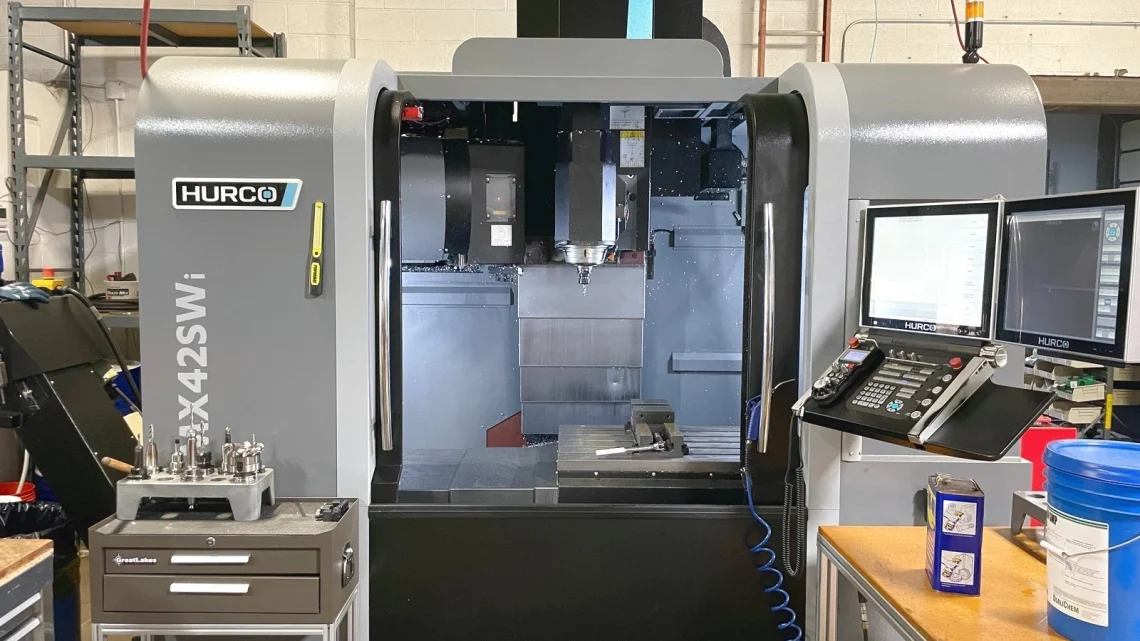
What Do Buyers Look for Before Investing in a Pre-Owned, Used, Secondhand, Surplus CNC Equipment Before Purchase HURCO VMX42SWi CNC 5-Axis Vertical Machining Center Swivel Head made in Germany?
If you are evaluating a used / second-hand (or surplus) Hurco VMX42SWi (a 5-axis vertical machining center) before purchase, there are several critical things buyers typically look for to decide whether it’s a safe, worthwhile investment. Below I outline the most important checks and considerations — especially for a 5-axis VMC like the VMX42SWi.
✅ What to check before investing in a used 5-axis CNC like Hurco VMX42SWi
• Machine history, documentation & service records
- Ask for detailed maintenance logs or service history: frequency of maintenance, any major repairs or overhauls, spindle rebuilds, part replacements, etc. Regular maintenance is a strong sign that the machine was well cared for.
- Confirm the manufacture date, total power-on hours, and (if available) actual cutting/working hours, not just idle hours. A seemingly low power-on hour count may hide heavy usage during active machining.
- If possible, get previous operating conditions: what kind of parts/materials were machined (light duty vs heavy duty), how intensively the machine was used. Heavy-duty work tends to accelerate wear.
• Structural condition (frame, housing, build integrity)
- Perform a visual inspection of the frame, housing and base. Look for cracks, deformation, dents — signs of mechanical stress or past crashes.
- Check for signs of rust, corrosion, or poor maintenance (this can indicate long-term neglect or storage problems).
- For a robust 5-axis machine, ensure there are no structural modifications or hack-fixes that alter alignment or rigidity (these can badly affect precision).
• Spindle, bearings, and tool-holding / tool-changer system
- The spindle is the “heart” of the machine: run it, listen for unusual noise or vibration, check for wobble, and look for excessive heat or bearing play.
- Inspect the tool holder / taper / taper surface carefully for scoring or wear; poor taper condition degrades tool accuracy and can lead to runout.
- If the machine has an automatic tool changer (ATC) / tool magazine: test it to confirm smooth and accurate tool changes, and inspect for wear or misalignment in the grippers/clamps.
• Guideways, ball screws / linear axes, axis movement & accuracy
- Check linear guideways and ball screws for wear, backlash, binding, smooth movement — these are critical for precision and repeatability.
- Move each axis (X, Y, Z, and any rotary/trunnion axes for 5-axis) through its full travel to check for smooth, consistent motion, without jerks, binding, or unusual resistance.
- For 5-axis machines: test rotational/tilt axes (swivel head or trunnion) — verify geometry/accuracy by doing alignment tests (e.g. bore a hole, rotate 180°, then verify position; check squareness across 90° rotations) to ensure the 5th-axis geometry is correct.
• Control system, software, electronics & compatibility
- Power up the CNC control panel: ensure all controls, displays, buttons, switches work properly; no error messages, no missing parts.
- Verify the CNC control software (controller version, updates, compatibility) — for a machine of this sophistication, compatibility with your CAD/CAM, post-processor, and tooling workflows matters.
- Inspect electrical wiring, connectors, hydraulics/coolant system (if relevant), lubrication systems, and any hoses/pneumatic components for leaks, corrosion, wear or neglect.
• Real-world testing: dry run + test cut + precision & repeatability check
- First perform a dry run (no cut) to observe the machine’s movement, axes synchronization, tool changers and general behavior under motion.
- Then perform a test cut using representative material and tools to verify dimensional accuracy, surface finish, repeatability, cycle times. This gives you practical insight into machine performance beyond just mechanical condition.
- For 5-axis geometry checks: after a cut, do positional checks (e.g. bore alignment at different angles, multi-axis tool paths) to ensure trunnion/swivel axis is correctly calibrated.
• Extras: tooling, accessories, spare parts availability & total cost of ownership
- Check what tooling/accessories come with the machine (tool holders, vises, fixtures, maybe even rotaries or pallets) — missing tooling may add significant extra cost.
- Evaluate availability of spare parts and service support for the model. If the machine is older or rare, parts might be expensive or hard to find, which increases long-term maintenance cost.
- Factor in transportation, rigging, installation costs, and setup time required to commission the machine at your facility — sometimes these add up to substantial amounts, diminishing the savings from buying used.
Additional Things to Watch Out For — “Red Flags”
- Frame or housing damage, weld repairs, or obvious structural deformations.
- Spindle wobble, excessive noise, heat — indicates worn bearings or spindle problems.
- Excessive backlash or scoring on guideways / ball screws — compromises precision/accuracy.
- Tool-changer malfunctioning or missing parts/tool holders.
- Old, outdated control system that may not support modern CAM/CNC software easily, or with limited spare-part support.
- No or incomplete maintenance history — risk of hidden problems or neglect.
- Lack of spare parts availability or high cost of maintenance for that model.
- Hidden costs: shipping, installation, tooling replacement may cumulatively make a “cheap” machine expensive.
Why This Matters — Specifically for a 5-Axis VMC (Like Hurco VMX42SWi)
Because a 5-axis VMC is complex (rotational/trunnion/swivel axes, more moving parts, more potential wear points), the geometry, calibration, spindle health, and reliability of axes & tool changer matters much more than with a simple 3-axis 2D/3D mill. Even small misalignment or wear can lead to unacceptable errors in complex 5-axis toolpaths.
A thorough inspection, test cuts, and verification of geometry are essential to ensure the machine will deliver the precision and repeatability required for multi-axis work — otherwise, the advantages of 5-axis machining (complex shapes, fewer setups, improved efficiency) may be lost.