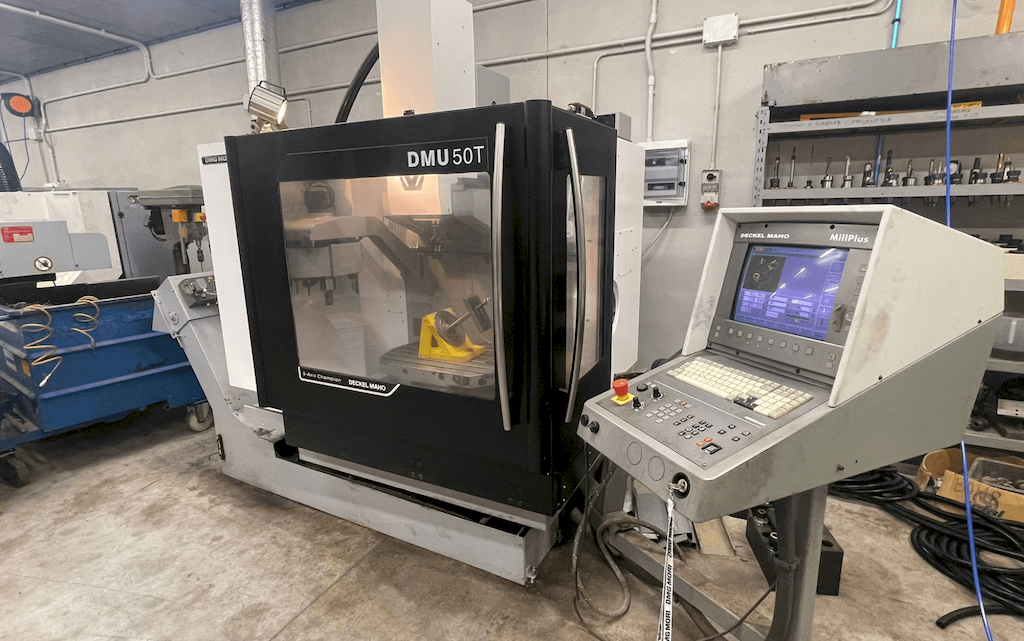
What Do Buyers Look for Before Investing in a Pre-Owned, Used, Secondhand, Surplus CNC Equipment Before Purchase Deckel Maho DMU 50T CNC Milling Machine made in Germany?
This guide explains, in clear and professional terms, what experienced buyers evaluate before purchasing a used Deckel Maho DMU 50T CNC milling machine. The focus is on technical condition, accuracy, reliability, long-term support, and total cost of ownership, not appearance.
1. Machine Type and General Overview
The DMU 50T is a German-built CNC milling machine from Deckel Maho, designed for high-precision machining of complex parts in toolmaking, mold manufacturing, aerospace components, and general precision engineering. It is known for:
- Rigid cast-iron construction
- High geometric accuracy
- Reliable European CNC control platforms
- Long service life when properly maintained
Because many DMU 50T machines are now sold on the second-hand market, condition varies significantly. Proper inspection is critical.
2. Key Technical Specifications (Typical Configuration)
Exact specifications may vary slightly by production year and options, but buyers generally expect the following baseline data:
Travels
- X-axis: approx. 500 mm
- Y-axis: approx. 400 mm
- Z-axis: approx. 400 mm
Table
- Table size: approx. 700 × 500 mm
- Maximum table load: approx. 200 kg
Spindle
- Spindle taper: SK40
- Spindle speed range: up to approx. 9,000 rpm
- Spindle power: approx. 13 kW
Tool System
- Automatic tool changer
- Tool capacity: typically 16 positions
CNC Control (Common Versions)
- Heidenhain TNC 426
- Heidenhain TNC 430
These specifications determine whether the machine is suitable for the buyer’s intended part size, material, and tolerance requirements.
3. Mechanical Condition and Wear Assessment
Buyers place strong emphasis on mechanical integrity because repairs are expensive.
Linear Motion Components
- Check backlash on X, Y, and Z axes
- Inspect ballscrews for wear or noise
- Verify smooth movement across full travel
Spindle Condition
- Listen for abnormal noise at low and high RPM
- Check spindle runout with an indicator
- Review spindle operating hours if available
Structure and Castings
- Inspect machine base, column, and table for cracks or repairs
- Look for corrosion or damage caused by poor coolant maintenance
Mechanical wear directly impacts accuracy, surface finish, and resale value.
4. Accuracy and Performance Verification
A professional buyer does not rely on visual inspection alone.
Common checks include:
- Test cuts on representative material
- Measurement of part accuracy and repeatability
- Verification of axis squareness
- Optional laser or ballbar test if available
Machines that pass real cutting tests are far more valuable than machines that only power on.
5. CNC Control and Electronics Evaluation
The CNC control is one of the most critical components.
Buyers verify:
- Control model and software version
- Condition of display and operator panel
- Servo drives and motors for alarms or instability
- Backup status of parameters and PLC data
Older Heidenhain controls are respected for reliability, but buyers must confirm local service support and spare part availability.
6. Maintenance History and Documentation
A complete documentation package significantly increases buyer confidence.
Preferred documentation includes:
- Maintenance and service records
- Electrical schematics
- Operator and service manuals
- Records of major repairs or retrofits
A machine with documented maintenance history is considered lower risk and easier to resell.
7. Accessories and Included Equipment
Buyers carefully list what is included in the sale, such as:
- Chip conveyor
- Coolant system and pumps
- Tool holders or clamping systems
- Probing systems (if equipped)
Missing accessories can add substantial post-purchase costs.
8. Spare Parts Availability and Service Support
Before purchase, buyers confirm:
- Availability of mechanical and electronic spare parts
- Presence of qualified service technicians in their region
- Compatibility with modern CAM software
Machines with poor spare part support may become idle even if the purchase price is attractive.
9. Transport, Installation, and Commissioning Costs
The purchase price is only part of the investment.
Buyers calculate:
- Machine dismantling and loading
- International or domestic transport
- Re-installation, leveling, and alignment
- Electrical and pneumatic connection
These costs can represent a significant percentage of the total investment.
10. Market Value and Resale Considerations
The Deckel Maho DMU series has a strong reputation in the used machinery market.
Buyers assess:
- Current market prices for comparable machines
- Demand in domestic and export markets
- Expected resale value after several years of use
Machines with good documentation, tested accuracy, and standard controls hold value better.
11. Suitability for the Buyer’s Application
Finally, professional buyers ensure the machine matches their real needs:
- Required tolerances and surface finish
- Materials to be machined
- Batch size and production volume
- Tooling and fixturing strategy
A technically excellent machine is still a poor investment if it does not match the intended application.
Conclusion
Before purchasing a used Deckel Maho DMU 50T CNC milling machine, experienced buyers focus on:
- Verified mechanical and spindle condition
- Proven accuracy through test cutting
- CNC control reliability and service support
- Complete documentation and maintenance history
- Real total cost, including transport and installation
A carefully inspected DMU 50T can remain a highly productive, accurate, and valuable asset for many years, making it a sound investment when evaluated professionally.