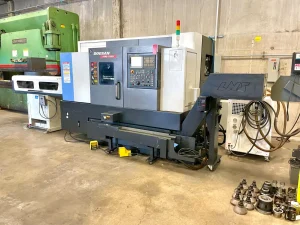
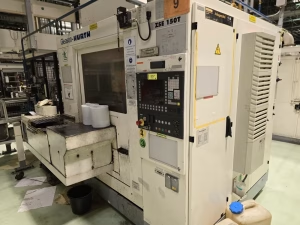
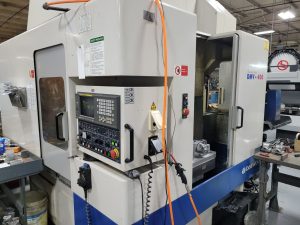
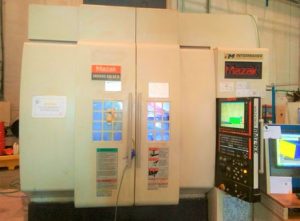
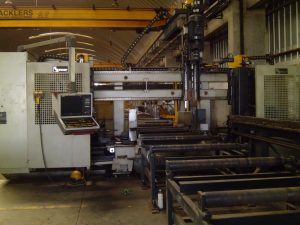
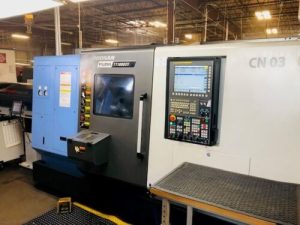
What is CNC Sawing Machine?

A CNC Sawing Machine (Computer Numerical Control Sawing Machine) is an automated manufacturing tool that uses computer-controlled mechanisms to perform precise sawing operations on materials, primarily metals, to cut them into desired shapes, sizes, or sections. It integrates traditional sawing techniques—such as bandsaw or circular saw cutting—with CNC technology for enhanced accuracy, repeatability, and efficiency. Unlike manual sawing, which relies on operator skill, CNC sawing machines execute cuts based on pre-programmed instructions derived from CAD (Computer-Aided Design) models, minimizing human error and enabling complex, high-volume production.In the sheet metal sector, CNC sawing machines are specialized for processing thin to medium-thickness metal sheets (typically 0.5 mm to 25 mm thick, depending on the material like steel, aluminum, or stainless steel). They are used for straight-line cuts, beveling edges, or sectioning large sheets into blanks or components before further fabrication steps like bending, punching, or welding. While laser or plasma cutters dominate intricate contouring in sheet metal, CNC sawing excels in high-speed, linear cuts on thicker sheets where cost-efficiency and minimal heat-affected zones are priorities. These machines are common in industries like automotive, aerospace, HVAC (heating, ventilation, and air conditioning), and construction, where sheet metal parts form enclosures, ducts, panels, and structural elements.Below is a technical explanation tailored to the sheet metal sector, covering design, operation, and applications.Technical Description1. Structure and ComponentsCNC sawing machines for sheet metal typically feature a robust frame to handle vibrations and material loads, with the following key components:
- CNC Controller: The “brain” of the machine, often based on industrial PCs or PLCs (Programmable Logic Controllers). It interprets G-code (a standard programming language for CNC) from CAD/CAM software, controlling axes, speeds, and feeds. Modern controllers support multi-axis interpolation (e.g., up to 5-6 axes for bevel cuts) and integrate sensors for real-time feedback.
- Sawing Mechanism:
- Bandsaw Type: Common for sheet metal; a continuous flexible blade (e.g., bi-metal or carbide-tipped, 10-50 mm wide) loops around wheels driven by AC servo motors. Blade speeds range from 50-500 m/min, adjustable via variable frequency drives (VFDs).
- Circular Saw Type: Uses a rotating disc blade (diameter 300-600 mm) for faster straight cuts on thinner sheets. Blades are segmented or toothed for metal, with spindle speeds up to 3,000 RPM.
- For sheet metal, the saw head is mounted on a gantry or carriage for linear motion.
- Worktable or Clamping System: A flat, perforated table (often with T-slots for fixturing) supports the sheet metal. Hydraulic or pneumatic clamps secure the material to prevent slippage. In automated setups, conveyor-fed tables handle large sheets (up to 3m x 6m).
- Drive System: Servo motors or stepper motors drive linear axes (X-Y for positioning, Z for blade depth). Ball screws or linear guides ensure precision movement, with resolutions down to 0.01 mm.
- Sensors and Safety Features: Encoders on motors provide closed-loop feedback for position accuracy. Proximity sensors detect material edges, while coolant systems (e.g., flood or mist lubrication) manage heat and chip removal. Safety interlocks comply with standards like ISO 13849 for machine safety.
- Auxiliary Systems: Chip conveyors remove metal swarf, and vision systems (cameras with AI) may align sheets automatically.
Materials for the machine frame include cast iron or welded steel for damping vibrations, ensuring stability during high-speed cuts.2. Working PrincipleCNC sawing operates on subtractive manufacturing principles, where material is removed via mechanical shearing. The process follows these steps:
- Design and Programming: A CAD model of the sheet metal part is created (e.g., using software like AutoCAD or SolidWorks). CAM software (e.g., Mastercam or Fusion 360) generates toolpaths, converting the design into G-code. Parameters include feed rate (mm/min), blade speed (m/min), and depth of cut.
- Material Loading: Sheet metal is placed on the worktable and clamped. Edge detection sensors or manual alignment ensures positioning accuracy.
- Execution:
- The CNC controller activates motors to position the saw head relative to the sheet.
- The blade engages the material, driven by the motor. For bandsaws, the blade travels continuously while the sheet or head moves linearly (X-Y axes).
- Cutting parameters are optimized: Feed rate = (Chip load × Number of teeth × RPM), where chip load is material-specific (e.g., 0.05-0.15 mm/tooth for aluminum sheets).
- Multi-axis control allows bevel cuts (e.g., 0-45° angles) by tilting the blade head.
- Feedback and Adjustment: Closed-loop systems use encoders to monitor position and adjust for deviations (e.g., due to blade wear). Vibration sensors can trigger pauses if anomalies occur.
- Completion: The cut part is unloaded, often via automated conveyors. Cycle times for a straight cut on a 2m steel sheet might be 1-5 minutes, depending on thickness.
The principle relies on kinematic chains—linked axes that ensure synchronous motion. For sheet metal, the focus is on planar cuts to avoid warping thin materials.3. Mathematical BasisSawing parameters are calculated to optimize tool life and surface finish:
- Cutting Speed (V_c): Vc=π×D×N1000V_c = \frac{\pi \times D \times N}{1000}
V_c = \frac{\pi \times D \times N}{1000}m/min, where D is blade diameter (mm) and N is RPM. For sheet steel, V_c ≈ 20-60 m/min. - Feed Rate (f): f=Vf×tf = V_f \times t
f = V_f \times t, where V_f is traverse speed (mm/min) and t is sheet thickness (mm). Typical V_f = 100-500 mm/min for 5 mm aluminum. - Material Removal Rate (MRR): MRR=Vc×f×bMRR = V_c \times f \times b
MRR = V_c \times f \times b, where b is cut width (mm, e.g., kerf ≈ 1-3 mm). This ensures efficient throughput in sheet metal production. - Tolerance and Precision: Achievable accuracy is ±0.1-0.5 mm, governed by axis resolution and backlash compensation in the CNC software.
Error compensation algorithms (e.g., via PID controllers) maintain straightness within 0.2 mm/m for long cuts.4. Technical Specifications (Tailored to Sheet Metal)
- Capacity: Sheet sizes up to 2000 mm × 6000 mm; thickness 0.5-25 mm (thinner for circular saws, thicker for bandsaws).
- Power: Spindle motor 5-15 kW; total system 20-50 kW.
- Axes: 3-6 axes (X-Y for linear motion, Z for depth, A/C for rotation/bevel).
- Speed and Accuracy: Positioning speed 10-50 m/min; repeatability ±0.02 mm.
- Materials Handled: Ferrous (mild steel, stainless) and non-ferrous (aluminum, brass) sheets; tolerances for burr-free edges via blade selection.
- Software Integration: Compatible with ERP systems for nesting (optimizing sheet layout to minimize waste, e.g., 5-10% scrap reduction).
5. Operation in Sheet Metal SectorIn sheet metal fabrication, CNC sawing is often the initial step for rough cutting:
- Workflow: Sheets are sheared into manageable blanks, then fed into downstream processes like CNC punching or laser cutting.
- Automation Levels: Semi-automatic (manual loading) to fully automated (robotic arms for loading/unloading, integrated with MES—Manufacturing Execution Systems).
- Cooling and Lubrication: Emulsions (5-10% oil in water) prevent overheating, crucial for thin sheets to avoid distortion.
Applications in Sheet Metal Sector
- HVAC and Ductwork: Cutting ventilation panels and ducts from galvanized steel sheets with straight or mitered edges.
- Automotive: Sectioning body panels or brackets from aluminum sheets for prototypes or low-volume runs.
- Electronics Enclosures: Precise cuts for server racks or control boxes from stainless steel, ensuring clean edges for assembly.
- Construction: Fabricating metal roofing or cladding sheets with bevels for joining.
- Aerospace: High-precision cuts on titanium or alloy sheets for lightweight components, where minimal heat distortion is essential.
Compared to alternatives:
- Vs. Laser Cutting: Sawing is cheaper for straight cuts on thicker sheets (>10 mm) but less suited for curves.
- Vs. Shearing Machines: CNC sawing offers programmable angles and automation for batch production.
Advantages
- Precision and Repeatability: Sub-micron accuracy reduces scrap (e.g., <5% waste in nested layouts).
- Efficiency: High throughput (up to 100 cuts/hour) and reduced labor; ideal for medium-batch sheet metal jobs.
- Versatility: Handles various alloys without tool changes; integrates with Industry 4.0 for IoT monitoring.
- Cost-Effective: Lower operating costs than plasma for linear cuts, with blade life up to 100-500 hours.
Limitations
- Limited to Linear Cuts: Not ideal for complex contours (use plasma/laser instead); kerf loss (1-3 mm) wastes material on thin sheets.
- Blade Wear: Frequent maintenance for abrasive metals like stainless steel; downtime 5-10% of runtime.
- Thickness Constraints: Less effective for very thin (<1 mm) sheets, where shearing is faster.
- Initial Setup: High upfront cost ($50,000-$500,000) and programming time for custom jobs.
Historical and Modern ContextEvolving from manual bandsaws in the early 20th century, CNC sawing emerged in the 1980s with microprocessor controls. Today, advancements like AI-optimized feeds and hybrid machines (sawing + milling) enhance sheet metal productivity. In 2025, integration with digital twins (virtual simulations) further reduces setup times by 20-30%.In summary, a CNC sawing machine is a pivotal tool in the sheet metal sector for efficient, precise linear cutting, bridging raw material processing and advanced fabrication. Its technical prowess lies in automated control and kinematic precision, making it indispensable for scalable production while complementing other CNC processes like folding or punching.