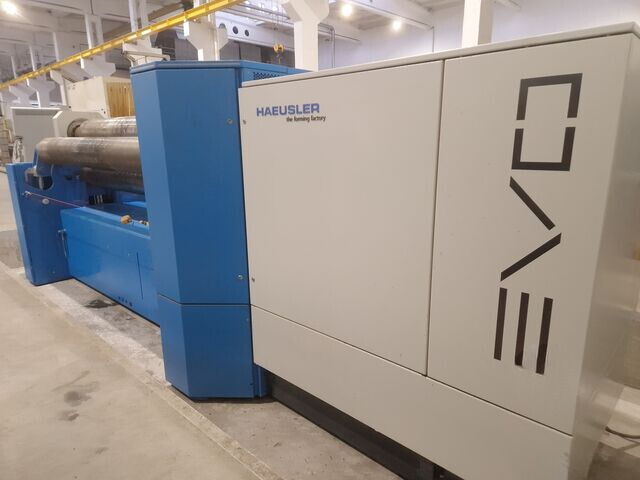
Technical Evaluation Guide: How to Identify a Quality Used, Secondhand, Pre-Owned, Surplus Haeusler EVO 31139 Sheet & Plate Bending Rolls 3 Rolls Machine made in Germany
1. Model & specification confirmation
Before inspection, verify that the machine is indeed the model you expect (EVO 31139) and matches key specifications.
Key specification reference
From HAEUSLER’s official documentation:
- The “139 Series” of EVO models include e.g. EVO 26139 / EVO 31139 / EVO 41139. Rolls width for EVO 31139 is about 3,100 mm (≈122″).
- Corresponding “rounding” capacity (for 139 series) is stated (for some widths) as ≈ 38 mm (for 3100 mm width) → this gives a ball-park of its heavy capacity.
- The machine uses HAEUSLER’s patented features: VSA® geometry adjustment technology, HHDS® Hybrid Drive, BENDtronic® control system.
What you should ask/verify
- Confirm the exact model designation on the machine’s nameplate: e.g., “EVO 31139”.
- Check the rolls width (3100 mm) and verify the “series” (139 series) so that the capacity matches what you expect (for your application).
- Ask for the original factory documentation / manual for that exact machine if available (so that you can verify specs).
- Verify the drive / control version (e.g., BENDtronic version, whether VSA and HHDS are included) — earlier machines may lack full features.
- Check the machine’s build year, serial number, and ask for service history.
2. Mechanical condition & wear-inspection
When inspecting second‐hand machines, the mechanical wear and condition are critical to value and future reliability.
What to inspect
- Roll surfaces: Check top and bottom rolls (and side rolls) for wear, scoring, pitting, or hard spots. Rolls must be straight and cylindrical; any run-out or significant wear will degrade bending precision.
- Roll bearings and drive components: Listen for unusual noises in bearings when machine is running (or can be run). Excessive play or vibration is a red flag.
- Frame & foundation: Inspect main frame for cracks, distortions, or repairs. Machine should sit solidly on its foundation; any shifting or unevenness may have caused misalignment.
- Hydraulic / electric drive system: Although the EVO uses a hybrid drive (electric motors + planetary gearbox) for the roller rotation and position, it may also have hydraulics for roll adjustments. Verify there are no oil leaks, hoses in good condition, oil cleanliness, and that motors run smoothly.
- Roll adjustment geometry / VSA mechanism: One of the key advantages of the EVO is its VSA® side‐roller geometry which lets you adjust for smaller diameters or heavy plates. Ensure the mechanism moves freely, and there is no excessive backlash.
- Control system & electronics: Check the control panel (BENDtronic®) is functional, screen displays are good, emergency stops, read‐outs correct. Also check if all axes move as commanded without lag or faults.
- Safety guards & accessories: Are all protective guards in place, work lights functioning, safety interlocks working? Missing guards may mean the machine is in poorer condition or not compliant with safety codes.
Wear / lifetime considerations
- Large machines like this may still have life, but expect significant costs if major components (rolls, gearbox, bearings) are worn.
- Ask for usage hours (if tracked) or estimate by inspecting condition of wear parts.
- If the machine has been used heavily (e.g., bending thick plates frequently) the wear will scale accordingly.
- Check when the last major service or rebuild was done (roll resurfacing, gearbox overhaul, bearing replacement).
3. Functional testing & bending capability
Assuming you can run the machine (or the seller allows a test), verify functional performance.
Tests to run
- Run the machine through a full cycle: roll clamp, side roll adjustment, top roll movement, plate bending simulation (even without a full plate). Listen/feel for smoothness.
- If possible, test bending a sample plate (or check recent production records) for quality of radius, edge condition, uniformity along width. EVO claims “bending becomes child’s play” via BENDtronic® intelligence.
- Check pre‐bending and full bending capacities: For the 139 Series EVO 31139, check if it meets its spec for rounding/pre-bending thickness given your plate widths. (Table from brochure: “pre‐bending capacity ~ 32 mm for 3100-width” approx)
- Check repeatability: Bend the same plate twice and compare results (radius, straight ends, spring‐back).
- Check control responsiveness: Are all axes (top roll, bottom roll, side rolls) moving as commanded, without undue lag or errors.
- Check guards, safety stops, emergency stops: test them.
What to measure / note
- Measure the actual roll width vs nominal.
- Measure actual roundness/diameter output vs expected capacity. If the machine claims say 38 mm rounding, but actual performance is significantly less, it may be an issue.
- Note any signs of plate edge damage, misalignment, or uneven bending across width (indicating roll wear or misalignment).
- Record any error codes or repeated faults in control system.
4. Documentation, history & spares
Used machines often come with risks around maintenance, parts, etc. Document history is important.
Ask for
- Maintenance/service records: Even if simple, but any record of roll resurfacing, bearing replacement, drive repairs.
- Original manual and wiring diagrams: Especially for the control system.
- History of the machine: previous owner(s), how intensively used, what materials were processed (e.g., heavy plates vs light).
- List of included accessories: For example, roll exchange kits (for small diameters), upper supports, lateral supports, infeed roller conveyors — EVO brochure lists optional equipment.
- Status of software for BENDtronic® control: Are updates available? Are there any issues or if software is obsolete.
- Spares availability: HAEUSLER global service states they can deliver many spare parts worldwide. Check if the machine in question is on standard series or custom configured.
5. Suitability / application fit
You must check that the used machine fits your business needs (e.g., your second‐hand machine portal buyer will check this too).
Things to confirm
- Width (3100 mm) matches your typical plate width requirement.
- Thickness/rounding capacity: Ensure that the machine can handle the maximum plate steel thickness and minimum diameter you require. If your operation involves thicker plates, you need to check series spec.
- Materials processed: Was it used for standard carbon steel, or heavier/harder materials (stainless, high alloy)? If so, machine might have more wear (e.g., hardened rolls might be needed). EVO brochure mentions “hardened rolls if carbon and stainless material shall be bent”.
- Foundation and installation requirements: Large plate bending machines may require substantial foundations. Check whether the machine was installed on a good foundation or moved frequently (which may cause alignment issues).
- Power supply / drive compatibility: Used machine may have been configured for a specific voltage/frequency (for example Germany 400 V 50 Hz). If you are importing to your country, check compatibility or cost of conversion.
6. Cost & investment considerations
When buying second-hand, factor in not just purchase price, but transport, reinstallation, refurbishment, potential hidden repair costs.
Key cost factors
- Transport & installation: A machine of this size (3100 mm width, heavy rolls) will require crane, rigging, shipping cost to your country (if abroad).
- Foundation works: If the machine requires new foundation or leveling, cost should be estimated. EVO brochure claims “ultra-compact design to reduce or even avoid foundation costs” in some cases.
- Re-commissioning and alignment: After transport, you may need professional alignment and trial runs.
- Spare parts and wear items: Rolls, bearings, drive motors, control panel may need replacement (depending on condition). Ask for quote of major wear items.
- Software/retrofit: If control system or software is out of date, you may need upgrade.
- Downtime risk: If machine has unknown history, factor risk of unscheduled downtime. EVO brochure mentions optional sensors for predictive maintenance.
- Life expectancy: Estimate remaining useful life. If major components are near end of life, the machine may have lower value.
7. Red flags — things to watch out for
Here are warning signs that may signal higher risk with a used machine.
- No or incomplete documentation / service history.
- Rolls are visibly scored, pitted, or heavily worn (indicating heavy usage or low maintenance).
- Excessive oil leaks, hydraulic system problems, electrical faults.
- Control panel or software errors, outdated or obscure custom modifications (which may complicate servicing).
- Machine built many years ago, and spare parts for that version may be scarce.
- Foundation misalignment or machine moved many times (leading to alignment / precision issues).
- Machine was used for very heavy duty beyond its spec (for example bending much thicker plates than the 139 series rating, which may cause overstress).
- Price is very low relative to condition — might indicate hidden faults.
- The machine is advertised as “3 roll” but your specification is a “4 roll” machine (for EVO 31139, verify exactly configuration) — mis‐labelling is possible in second-hand market.
8. Checklist summary (for your inspection)
You could use this as a quick check‐list when inspecting or listing the machine:
- Nameplate: model EVO 31139, serial number, year of manufacture.
- Rolls width: ~3100 mm.
- Rounding / pre-bend capacities according to spec.
- Rolls – visual condition (surface, straightness, wear).
- Bearings – smooth movement, no excessive play/vibration.
- Drive system – electric/planetary gear/hydraulics condition.
- VSA geometry mechanism – moves freely, minimal backlash.
- Control (BENDtronic) – operational, software version, display ok.
- Safety guards, emergency stops – functional.
- Foundation/frame – no cracks, no obvious misalignment.
- Service history & documentation – available.
- Accessories included – roll exchange kits, supports, conveyor tables.
- Tested performance – sample bending/result records.
- Installed location – power supply compatibility, transport ease.
- Cost estimation – transport, installation, refurbishment, spare parts.
- Ask seller: previous materials processed, usage intensity, reasons for sale.
- Red flag check – missing items, visible damage, discrepancies.
- Spare parts availability – confirm for this model in your region.
- Estimate remaining useful life – major wear items status.
- Contract/guarantee – clarify whether any warranty or return rights.
9. Applying this to your needs listing or buyer-advisory
Since you run a second-hand machinery portal, you can adapt the above into a standard “technical evaluation template” for machines of this type. For example:
- Provide a checklist for sellers of EVO 31139: ask them to fill in fields such as “Rolls width”, “Year of first use”, “Total hours/cycles”, “Last major service date”, “Roll condition (mm wear)”, “Control system version”.
- Provide an “inspection guide” downloadable PDF for buyers (with the above check‐list) so they know what to ask.
- For each listing of an EVO machine, require photographs of key components: rolls (top/bottom/side), nameplate, control panel, frame/foundation, drive motors, service record.
- Provide a buyer note: “Used machines need to be checked for precision & wear — budget for refurbishment”.
- Possibly create a category/tag in your portal: “HAEUSLER EVO 139 Series 4-Roll Plate Benders” and include key spec table (width, rounding capacity, etc) so buyers can filter properly.