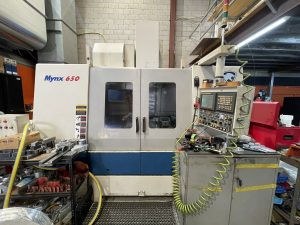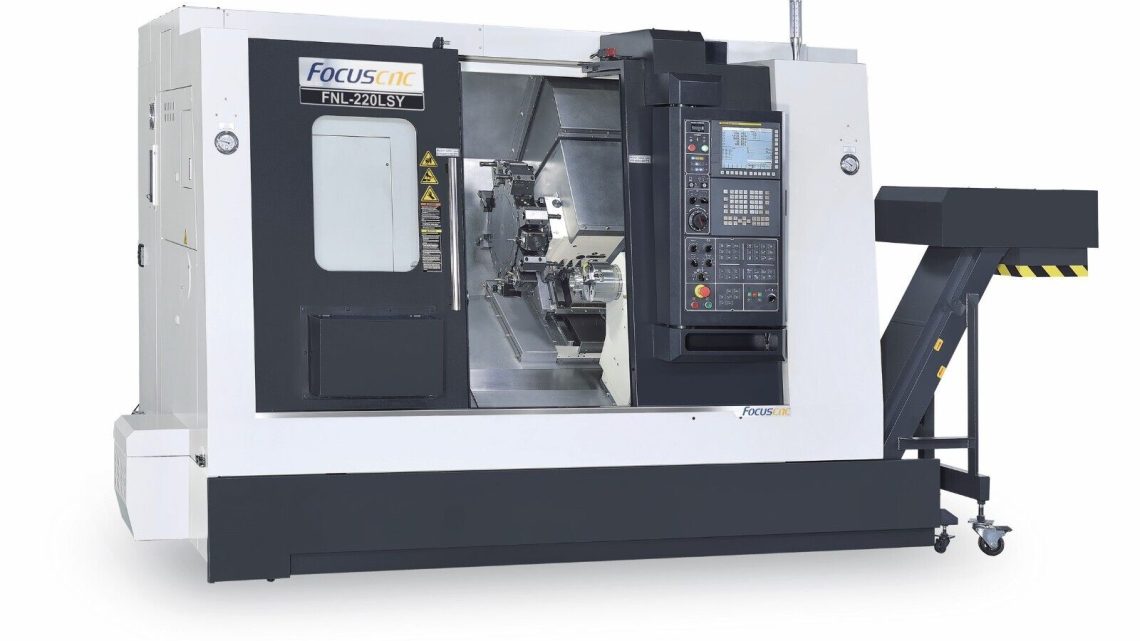
Technical Evaluation Guide: How to Identify a Quality Used, Secondhand, Pre-Owned, Surplus Focus CNC FNL-220LSY CNC Turning Center made in Taiwan
Key Areas to Inspect
When evaluating a used machine, focus on these broad categories:
- Machine Structure & Frame
- Check for visible cracks, repairs, welding, or distortion in the bed, column, and major castings.
- For the FNL-220LSY the manufacturer states a dual 30° slant-bed design (for increased rigidity) and roller linear guideways.
- Ensure the bed is level, and the guideways are still firmly fastened, not loose or excessively worn.
- Guideways / Linear Ways / Bearings
- Since this model uses “roller linear guideways” to reduce friction and stick-slip in heavy cutting.
- Look for signs of wear: shiny polished patches, spalling, pitting in the slideways, excessive backlash, or wobble.
- Test movement by jogging the axes (X, Y, Z) manually: any grinding, uneven motion, or surprise noises are red flags.
- Spindles (Main + Sub) & Turret / Tooling
- The FNL-220LSY has main spindle speed up to ~4,500 rpm and sub‐spindle up to ~6,000 rpm according to specs.
- Check spindle run-out (with a dial indicator) to ensure concentricity and no excessive wobble.
- Listen for bearing noise, check oil level/condition (if oil-lubed spindles).
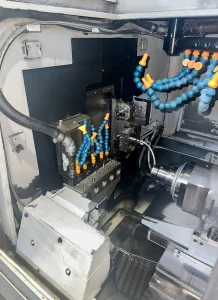
- Inspect turret: the model includes a live-tooling turret (12 or 16 stations, BMT-45 style) for milling/drilling as well as turning.
- Make sure all tool stations function (live tooling drives, indexing, turret lock/unlock operation) and that tooling interfaces are not damaged (holders, boring bar sleeves, etc).
- Axes Travel & Feed Systems
- Confirm the travel distances (X, Y, Z) against manufacturer specs: e.g., for FNL-220LSY X = 200 mm, Y = ±55 mm, Z ≈ 560 mm.
- Check ball screws, servo motors, backlash in each axis, and smoothness of motion. Excessive backlash or slack may mean a rebuild required.
- Verify that the feed rates, rapid traverse, and interpolation functions (if applicable) operate correctly.
- Electrical / Controls / CNC System
- Verify the control type (often FANUC or similar) is original or properly maintained. The brochure lists FANUC 0i-T for this model.
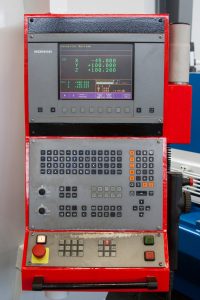
- Check for fault history, look at control panel, wiring condition (no overheated cables), maintenance logs.
- Test all functions: spindle up/down, coolant, lubrication/autolube systems, tool change, interlocks, safety guards.
- Confirm whether original software is intact (program memory, PLC backups) and whether anything has been modified or hacked.
- Hydraulics / Pneumatics / Lubrication Systems
- Many machines rely on hydraulic clamping, turret indexing, tailstock (if fitted). On this model the brochure mentions a hydraulic clamping cylinder with disk brake for sub-spindle/turning functions.
- Check for leaks (oil, hydraulic fluid), condition of hoses, cleanliness of reservoir, correct pressures.
- Ensure the automatic lubrication (centralized lubing) system is functioning; inspect oil levels, filters, look for sludge.
- Overall Condition / Usage History
- Ask for machine hours (spindle hours, axis usage), history of maintenance, whether it was used for heavy duty or light duty.
- Inspect wear parts: chuck jaws, spindle bore, tool‐holder interfaces, tailstock (if present), machine sheet (plate) for changes.
- Check for modifications: Has the machine been altered (e.g., additional devices added, control swapped, spindle changed)? That may affect resale value or reliability.
- Inspect for environment: Was the machine in a clean indoor shop or outdoors, dusty, damp, subject to coolant mist or rust? Condition reflects future upkeep.
- Accessories / Tooling / Attachments
- Check what is included: chucks, bar feeders, steady rest, live tooling holders, maybe automation (robot loading) etc.
- Confirm what is “standard” vs optional; missing accessories may mean additional cost later.
- Support / Spare Parts & Documentation
- Verify availability of spare parts for this model. Given that FOCUS CNC is a Taiwanese manufacturer (Taichung, Taiwan) , check local supply or import viability in your country.
- Ensure that machine has manual, parts list, electrical schematics, servo parameters, possibly spindle bearing records.
- Confirm that software/controls haven’t been discontinued or obsolete.
- Price & Transport / Installation Considerations
- For a second‐hand machine you must factor in shipping, customs (for Türkiye import), installation, leveling, foundation work (slant bed possibly needs specific alignment), operator training.
- Check machine weight and dimensions (the spec sheet gives floor space etc). Example: FNL-220LSY net weight ~ 5,700 kg in one spec sheet.
- Ask for proof of machine power connection, facility requirements (3-phase voltage, cooling & chip removal).
- Confirm warranty situation if any, or “as is” condition.
Model-Specific Considerations for FNL-220LSY
Given the specifics of the FNL-220LSY, here are particular items you’ll want to emphasise:
- Bed design: Slanted 30° bed reduces chip accumulation and improves operator access. If there has been any collision or damage to the bed, the structural integrity may be compromised. Use a straight‐edge to check flatness across bed surfaces.
- Y-axis capability: Because this model provides a Y-axis (±55 mm as noted) which many simpler turning centers don’t. Ensure the Y‐axis motion works reliably, doesn’t bind, and the ball screw and guideways for Y are still in spec.
- Live tooling turret: Because heavy cutting with live tools is a major selling point, confirm that the turret and live tooling system (6000 rpm tooling speed in specs) operate without vibration or overheating.
- Bar capacity: The spec says main spindle bar capacity Ø52mm (65mm optional) for FNL-220LSY. Confirm actual bore size and condition.
- Machine footprint: The documentation shows approx 4,109 × 1,954 × 2,122 mm (floor space) for this model. Make sure your shop has capacity for transport, rigging, installation.
Sample Inspection Checklist (Printable)
Here’s a simplified checklist you can carry when physically inspecting the machine:
| Item | OK / Needs Work | Notes |
|---|---|---|
| Bed flatness / structural damage | □ | Use straight-edge, look for cracks/welds |
| Guideway wear (X, Y, Z) | □ | Look for shine, chatter, backlash |
| Ball screw / backlash measurement | □ | Move axis, check end play |
| Spindle run-out (main & sub) | □ | Use dial indicator at chuck bore |
| Turret indexing, live tooling operation | □ | All stations functional? vibration? |
| Axis travels match spec | □ | Compare actual to spec book |
| Control panel / wiring condition | □ | Check burnt wires, errors in history |
| Hydraulic / coolant systems leak/free | □ | Check tank levels, hoses, filtration |
| Accessories included (chucks, tooling) | □ | List what is present / missing |
| Documentation present | □ | Manuals, parts list, electrical diagrams |
| Usage & maintenance history | □ | Hours, heavy duty usage, any rebuilds |
| Spare part availability | □ | Local supplier / import lead-time |
| Shop fit / rigging / foundation needs | □ | Weight, size, lifting plan |
| Price vs condition vs downtime risk | □ | Compare to market / downtime cost |
Red Flags (Beware of these)
- Major repairs or welds on bed, column, or base — may indicate prior damage or collision.
- Excessive spindle run-out or bearing noise — spindle rebuild is costly.
- Poor lubrication / dirty hydraulic system — may hint at neglected maintenance.
- Missing or outdated control system or software that is no longer supported — may lead to obsolescence.
- Heavy duty usage without major maintenance records — machine may be near end of useful life.
- Hidden modifications or non-OEM parts that complicate future service or resale.
- Lack of clear documentation or missing manuals/parts lists.
Conclusion
When looking at a used FOCUS CNC FNL-220LSY unit, if you ensure the machine meets structural integrity, guideways/spindles are within acceptable wear, the CNC and tooling systems are functioning, and you have clarity on usage and history — then you significantly reduce risk and increase the chance of a good investment.
Given your business (second-hand machinery online platform) this kind of checklist will help you vet machines thoroughly, provide transparency to buyers, and add value by offering “inspection-ready” units.