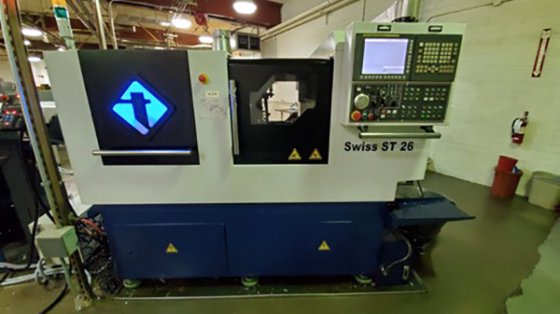
How to Avoid Common Pitfalls When Buying a Pre-Owned, Second-Hand, Surplus, Used Tornos Swiss ST-26 CNC Swiss Lathe made in Switzerland?
Buying a pre-owned, second-hand, surplus, used Tornos Swiss ST-26 CNC Swiss lathe made in Switzerland can be a highly strategic investment for precision, high-volume turning—provided you avoid the typical technical and commercial pitfalls. Below is a machine-specific, technically grounded guide focused directly on the Tornos ST-26 platform, not generic CNC advice.
1. Understand the Core Technical Design of the Tornos ST-26
Before evaluating condition, you must understand what you are buying.
Key technical characteristics (typical configuration):
- Maximum bar capacity: 26 mm
- Machine type: Swiss-type sliding headstock CNC lathe
- Guide bushing system: Yes (critical for precision)
- Main spindle: High-speed precision spindle (oil-air lubrication)
- Sub-spindle: Yes (for complete part machining)
- Axes configuration: Typically X, Y, Z + C-axis (main & sub)
- Tooling: Gang tooling + driven tools
- Applications: Medical, automotive, electronics, precision components
Why this matters:
The ST-26 is designed for tight tolerances and long, slender parts. Any wear in the guide bushing, spindle, or linear axes directly impacts accuracy.
2. Verify Spindle & Guide Bushing Condition (Most Critical Pitfall)
What to Inspect
- Main spindle runout (check with test bar)
- Sub-spindle synchronization accuracy
- Guide bushing wear and concentricity
- Spindle bearing noise at high RPM
Why It’s a Pitfall
On Swiss lathes, the guide bushing is the heart of precision. Even slight wear causes:
- Poor surface finish
- Tapered parts
- Inconsistent dimensional repeatability
Tip: Ask if the machine ran stainless steel or hardened materials—these accelerate wear.
3. Evaluate Axis Precision and Linear Guide Wear
Technical Checks
- Backlash on X, Y, Z axes
- Smoothness of axis travel at low feed rates
- Ball screw condition (noise, vibration)
- Linear guide lubrication system operation
Red flag: Axis movement that feels “notchy” or inconsistent.
4. Inspect CNC Control & Electrical System Compatibility
Depending on the production year, ST-26 machines may use:
- Fanuc-based controls
- Tornos-customized CNC interface
Common Pitfalls
- Obsolete CNC control versions
- No software backup available
- Unsupported servo drives or power modules
Always verify:
- Control powers up without alarms
- All axes reference correctly
- Emergency stop & safety circuits function properly
5. Driven Tools & Live Tooling Inspection
The ST-26 relies heavily on driven tooling.
Check:
- Live tool spindle bearings
- Torque consistency
- Tool change repeatability
- Coolant delivery to rotating tools
Hidden cost pitfall: Replacing worn live tool units can be very expensive.
6. Coolant, Hydraulic & Pneumatic Systems
Swiss lathes are system-intensive machines.
Inspect:
- High-pressure coolant pump performance
- Hydraulic unit stability (no pressure drops)
- Pneumatic valves for guide bushing and part handling
Warning sign: Oil contamination in coolant tanks or air lines.
7. Bar Feeder Integration & Interface
Many ST-26 machines are sold without the original bar feeder.
Confirm:
- Compatible bar feeder interface
- Electrical and control communication readiness
- Alignment condition
Pitfall: Buying a machine cheaply, then spending heavily to integrate a new bar feeder.
8. Tooling, Accessories & What’s Actually Included
Clarify exactly what comes with the machine:
- Tool holders and blocks
- Guide bushings (sizes & condition)
- Collets, pullers, part catchers
- Chip conveyor
Missing accessories can easily add 5-figure costs after purchase.
9. Perform a Test Cut Under Real Conditions
A serious seller should allow:
- Live cutting test
- Measurement of finished parts
- Repeatability verification
If no test cut is possible, factor risk into pricing—or walk away.
10. Machine Usage History & Application Match
Ask:
- What materials were mainly machined?
- Was it high-volume production or short runs?
- Was preventive maintenance followed?
Machines used for medical or precision parts are often better maintained than general job-shop machines.
11. Transportation, Installation & Re-Commissioning
The ST-26 is a precision Swiss machine, not a simple lathe.
Plan for:
- Professional rigging
- Controlled transport
- Leveling and alignment
- CNC parameter verification
Skipping this step often leads to performance issues blamed incorrectly on the machine.
12. Common Red Flags Specific to ST-26
❌ Excessive spindle noise at high RPM
❌ Worn guide bushing with no spares
❌ Control alarms explained as “normal”
❌ Missing live tooling units
❌ No documentation or backup files
Final Professional Advice
A used Tornos Swiss ST-26 is an outstanding production machine only if its precision systems are healthy. The real value lies in:
- Spindle condition
- Guide bushing accuracy
- Control integrity
- Complete tooling package
A cheap ST-26 with hidden wear is far more expensive than a properly inspected, higher-priced machine.