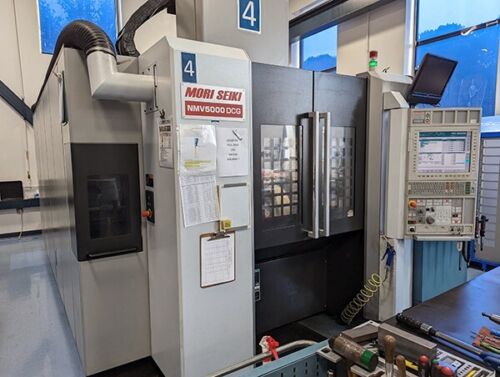
From Inspection to Installation: What to Verify Before Buying a Pre-Owned, Used, Secondhand, Surplus Mori Seiki NMV5000 DCG CNC 5 Axis Machining Center made in Japan?
Buying a pre-owned Mori Seiki NMV5000 DCG can be a highly strategic investment. This model is known for its DCG (Driven at the Center of Gravity) structure, thermal stability, and high-precision 5-axis machining capability. However, to secure long-term performance and avoid costly surprises, a disciplined inspection and verification process is essential. Below is a professional, step-by-step guide covering everything from on-site inspection to final installation.
1. Machine Identity & Documentation Verification
Before any technical evaluation, confirm the machine’s identity and background.
- Serial number & model confirmation against Mori Seiki factory records
- Year of manufacture and production revision (early vs later NMV5000 DCG versions)
- Original country of manufacture: Japan
- Service history records (scheduled maintenance, repairs, upgrades)
- Operating manuals, electrical diagrams, and parameter backups
- Ownership chain (single-user machines are usually preferable)
2. Control System & Software Check
The NMV5000 DCG typically features MAPPS (Fanuc-based) control architecture.
- Verify MAPPS version and Fanuc base control (e.g., 31i series)
- Check 5-axis simultaneous machining license activation
- Confirm tool center point control (TCP) and dynamic fixture offset functions
- Inspect parameter integrity and backup availability
- Test USB / Ethernet / DNC communication ports
3. Spindle Condition & Performance
The spindle is one of the most expensive and critical components.
- Measure spindle runout (cold and warm conditions)
- Listen for abnormal noise at low and high RPM ranges
- Verify spindle acceleration/deceleration smoothness
- Check spindle chiller unit and coolant flow
- Review any spindle rebuild or bearing replacement history
4. Linear Axes & DCG Drive System
DCG technology relies on balanced force transmission—any wear here directly affects accuracy.
- Inspect X, Y, Z ball screws and linear guideways for wear or scoring
- Check axis backlash and repeatability
- Perform laser calibration or ballbar test if available
- Verify axis servo load values under motion
- Confirm proper functioning of thermal compensation systems
5. Rotary Axes (A & B) Accuracy
5-axis machining performance depends heavily on rotary axis integrity.
- Check rotary table positioning accuracy and clamping force
- Inspect gearbox or direct drive units for vibration or noise
- Test simultaneous 5-axis contouring movements
- Verify zero-return repeatability on both rotary axes
- Inspect rotary axis seals for coolant ingress
6. Tool Magazine & Automatic Tool Changer (ATC)
Downtime caused by ATC issues can severely impact productivity.
- Check tool magazine capacity and pocket condition
- Test tool change cycles at various spindle orientations
- Inspect gripper arms, drawbar force, and tool retention
- Verify correct operation of tool breakage detection (if equipped)
7. Coolant, Chip & Thermal Management Systems
Efficient thermal control is key to maintaining precision.
- Inspect high-pressure coolant system (pressure, leaks, filtration)
- Check chip conveyor, augers, and disposal system
- Verify way lubrication system and alarm functionality
- Confirm machine enclosure sealing and splash protection
8. Electrical Cabinet & Safety Systems
A clean and stable electrical system ensures long-term reliability.
- Inspect electrical cabinet cleanliness and cooling fans
- Check servo drives, power supply modules, and relays
- Verify emergency stop circuits, door interlocks, and safety PLC
- Look for signs of overheating, moisture, or non-OEM wiring
9. Accuracy, Geometry & Test Cuts
Never rely on visual inspection alone.
- Conduct ballbar or laser interferometer tests
- Check squareness and axis alignment
- Perform a 5-axis test cut (cone or complex contour)
- Measure surface finish quality and dimensional stability
10. Installation, Logistics & Commissioning Planning
Even a perfect machine can fail if installation is mishandled.
- Confirm machine weight, footprint, and foundation requirements
- Verify power supply compatibility (voltage, frequency, phase)
- Plan rigging, transport, and insurance professionally
- Ensure availability of qualified Mori Seiki / DMG MORI service engineers
- Schedule geometry calibration and acceptance testing after installation
Final Professional Advice
A Mori Seiki NMV5000 DCG CNC 5-Axis Machining Center made in Japan is engineered for precision, stability, and high-value machining. When properly inspected, verified, and installed, a pre-owned unit can deliver performance comparable to a new machine—at a significantly reduced capital cost.
Always prioritize documented history, measurable accuracy, and professional commissioning. Cutting corners during inspection often leads to long-term operational and financial risk.