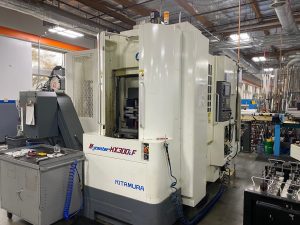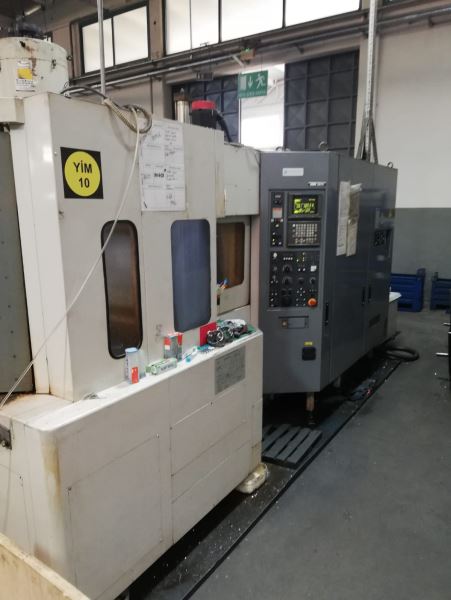
From Factory Floor to Your Workshop: Evaluating a Pre-Owned, Used, Secondhand, Surplus CNC Machine Before Purchase Mori Seiki MH40 CNC Horizontal Machining Center made in Japan
Here’s a detailed guide to help you evaluate a pre-owned machine like the Mori Seiki MH40 (Horizontal Machining Center) before making a purchase — covering both technical verification and condition assessment, from the factory floor to your workshop.
1. Know the machine: specifications & typical features
Getting the facts straight lets you benchmark what you’re seeing. For the MH40, some typical specs are:
- Model: MH40 (also referred to as MH-40) by Mori Seiki (Japan).
- Typical travels: X ≈ 560 mm (≈ 22″) … Y ≈ 500 mm (≈ 19.7″) … Z ≈ 510-600 mm (≈ 20-24″) depending on year/configuration.
- Pallet size: around 400×400 mm for some versions.
- Number of pallets: often 2.
- Spindle taper: often BT40.
- Tool magazine: 32-40 places typical.
- Weight & footprint: e.g. 22,000 lbs (~10 t) for one listing.
Knowing those numbers gives you a reference when you inspect the actual machine you’re evaluating.
2. Pre-purchase checklist: what to inspect
Here are the key questions and inspection areas you should cover. I’ll group them by mechanical/electrical and operational/run-out.
Mechanical / Electrical
- Frame & alignment: Look for visible damage, repairs or cracks in the cast base/table. Any signs of distortion matter.
- Spindle condition: Check spindle run-out (with test bar if possible), listen for bearing noise, check spindle taper for wear or distortion.
- Way covers / guards: Are the way covers intact (especially on a horizontal HMC, chips and coolant can cause accelerated wear)?
- Ball screws / axes drives: Check backlash and smoothness of each axis (X, Y, Z). Measure free play.
- Pallet changer (if fitted): Since many MH40 units have 2 pallets, ensure the pallet swapping mechanism works and is properly aligned.
- Tool magazine / tool changer: Make sure tool change operations are smooth, that there’s no collision damage in the magazine, that all tools are properly seated.
- Electrical/control cabinet: Check wiring, cleanliness, that there’s no signs of overheating, burnt modules, or flood/coolant ingress. Verify control type (e.g., Fanuc OM or Fanuc 11M) and whether spares are still available.
- Hydraulic / coolant / chip conveyor systems: Horizontal machines often accumulate heavy chips; check the conveyor system, coolant pumps, filters, presence of sludge, maintenance history.
- Accessories / tooling / fixturing: Check included tombstones, fixtures, pallet clamps, etc. Their presence or absence can affect the buying cost and setup burden.
Operational / Performance
- Test run: If possible, run the machine (or have the seller run) through a test cycle with a simple part: tool change, pallet change, axis moves, spindle run-up, coolant on/off, chip conveyor. Listen for unusual noise or vibration.
- Check accuracy: Run a test part or measurement. Check surface finish, dimensional accuracy, alignment of spindle to table, repeatability. Compare to what you expect for your workshop’s tolerance requirements.
- Check maintenance/usage history: Ask for hours (if recorded), how the machine was used (batch production vs heavy continuous use), what material processed, when major services (ballscrew, spindle bearings, way overhaul) were last done.
- Spare parts / consumables availability: For an older machine you must verify that key wear parts (spindle bearings, way covers, motors, control modules) are still obtainable.
- Documentation: Manuals, wiring diagrams, parts list, control parameter backups are valuable (especially for older machines).
- Alignment certification: If machine has been moved, ask for last alignment check (e.g., spindle to table orthogonality, axis squareness).
- Actual environment in seller’s workshop: Good indicator of how machine was treated. Clean workshop, well-maintained helps; heavy chip build-up, coolant leaks, lack of preventive maintenance are red flags.
3. Specific risks & older-machine concerns
When buying a machine that’s “used / second-hand / surplus” there are some additional risk areas to pay special attention to:
- Obsolete control: Many older MH40 units may have legacy controls (Fanuc OM, Fanuc 11M, etc). If the control is obsolete or there are upgrade costs (e.g., to newer Fanuc version) factor this in.
- Wear of horizontal table/pallet: For HMCs, the pallet and side-load conditions can generate wear that vertical machines may avoid. Check table top bearing surfaces, pallet face, indexing mechanism.
- Chip load and coolant corrosion: Especially if the machine processed high-volume heavy material (casting, moulds, etc) the wear can be more advanced. Coolant contamination over time can accelerate wear on linear ways and ball screws.
- Spindle bearing life remaining: The spindle is one of the most expensive components; determining remaining life is tricky. If the machine has a long service history without spindle rebuild, factor possible future cost.
- Transport / installation cost: A heavy HMC will have significant dismantle, shipping, rigging, leveling cost. Ensure you budget for that and check that the seller will help or at least provide full dismantling info.
- Hidden costs: Additional tooling, fixturing, training, set-up time, etc. An older machine might look cheap but come with higher downtime or maintenance cost.
- Downtime risk: If you rely on this machine for production, older machines might have higher risk of breakdown. Check the seller’s reliability, that replacement parts are available, and that you have a plan for service support.
4. Negotiation & purchasing tips
- Ask for recent proof of performance: Request recent manufacturing history — e.g., sample parts processed, before/after alignment, tool change speed, error logs.
- Get the machine inspected on-site (or bring in an expert): A third-party inspection gives you an objective condition report (mechanics, alignment, control health).
- Check what’s included: Is tooling, fixture, pallets included? Are custom fixturing and tombstones included or separate cost?
- Budget for installation: Include cost of rigging, foundation (if needed), leveling, power/coolant connection, operator training.
- Factor upgrade costs: If you need features (e.g., through-spindle coolant, 4th axis, new control) check how easy/upgradable the MH40 is.
- Warranty / return policy: With used machines it’s rare to get full warranty, but try to negotiate at least short-term machine-running guarantee (e.g., run test for a specified period after installation).
- Spare parts stock: Negotiate whether the seller supplies a basic spare parts kit (filters, belts, etc) or gives you lead time on parts.
- Transport and export logistics: If importing, you’ll need to factor in customs, shipping, insurance, and installation at your workshop.
- Resale value / flexibility: Consider how long you plan to run the machine. If you outgrow it in few years, will it have resale value? Understand the market demand for that model.
5. Final decision matrix
Here’s a simplified scoring matrix you can use to reach a decision. Rate each of these from 1 (low) to 5 (high) and multiply by the weight you assign:
| Inspection Area | Weight | Score | Comments |
|---|---|---|---|
| Mechanical condition (ways, spindle, table) | 30% | ||
| Control / electronics health | 20% | ||
| Operational test results | 20% | ||
| Maintenance & usage history | 10% | ||
| Included tooling/fixtures | 10% | ||
| Transport & installation cost | 10% | Negative score if cost high |
If your weighted score is low, you may either renegotiate price downward or walk away.
Summary
Purchasing a used machine such as the Mori Seiki MH40 can be a very good investment — but only if you do your homework. Ensure you:
- Know its specifications and how they match your production requirements;
- Perform a thorough inspection (mechanical, electrical, operational);
- Understand the risks unique to older horizontal machining centres;
- Include all hidden costs (installation, transport, downtime) in your budget;
- Negotiate appropriately and protect yourself (inspection, partial warranty, spare parts).